
What Does It Take to Recover? An Analysis of Needs and Experiences Described in 1,253 GoFundMe Campaigns Identified in Community-Led Directories in Altadena After the Eaton Fire
Executive Summary
This policy brief is the third in our Rebuilding Altadena: Housing Recovery After the Eaton Fire series, which examines equity in post-disaster housing recovery in Altadena, California.
The first report in the series, Who’s Coming Home?, tracked severe property damage, property sales, permitting, investor purchases, and early rebuilding among Altadena’s single-family homeowners. An update one year later found that rebuilding applications had accelerated, but only 30 percent of homeowners who filed applications had started construction. Rebuilding for Whom? documented the tenant population and rental market that existed before the Eaton Fire, changes in housing affordability, and the limited recovery of fire-affected rental housing.
This brief asks a different but related question: what is holding households back from recovery? To answer this question, we analyzed 1,253 verified public GoFundMe campaigns from Altadena, identified through Black, Latino, and Filipino community-led directories, to examine the immediate losses, circumstances, needs, and recovery barriers described after the January 2025 Eaton Fire. Most campaigns were created during the first months after the fire. We captured updates and campaign data as of June 2026.
These campaigns are not representative of all fire-affected households, but they provide a focused view of a large and severely affected subset of Altadena residents while capturing two dimensions central to our prior research. First, the sample captures many households of color in a community where racial disparities in fire damage threatened both housing stability and wealth. Who’s Coming Home? found that 59 percent of Black-owned single-family homes in Altadena sustained severe fire damage—the highest rate among the racial and ethnic groups examined. Given Altadena’s long-standing role as a center of Black homeownership, these losses threatened not only housing but also an important source of intergenerational wealth. Second, the sample includes a mix of homeowners and tenants experiencing severe housing loss. This tenure diversity allows us to examine two distinct recovery pathways: pathways of tenants who had fewer financial and housing protections before the fire (as Rebuilding for Whom? discusses) and pathways of homeowners.
GoFundMe campaigns are fundraising documents rather than interviews or complete household histories. They nevertheless provide a partial record of the needs that affected households—or their loved ones writing on their behalf—chose to describe publicly. Through systematically coding the narratives within each campaign, we identified experiences and concerns that appeared across a meaningful share of campaigns and were also repeatedly connected to other recovery needs. This approach allowed us to identify broader, systemic challenges rather than describe isolated experiences.
The policy recommendations in this report (summarized below) build from the needs documented in these campaigns and are also informed by other local and national disaster recovery research. The recommendations account for the existing policy and program landscape in Los Angeles County, California, and other disaster-affected jurisdictions.
Key Findings:
- Households sought a median of $30,000 in direct assistance through GoFundMe, with the median homeowner campaign seeking $35,000 and the median tenant campaign seeking $20,000. Nearly nine in ten of all campaigns fell short of their stated goals, underscoring the need to examine the recovery costs that families were unable to cover.
- GoFundMe campaigns frequently stated that households suffered total losses and evacuated without the documents and other essentials needed to access services to stabilize in the immediate aftermath of the fire. This theme highlights the potential need for stronger household preparedness education, evacuation support, and recovery planning.
- Mental health challenges following the Eaton Fire were closely tied to housing loss, displacement, instability, and unmet basic needs, suggesting that behavioral health support must be treated as a core component of disaster recovery rather than a separate service need.
- Both tenant and homeowner campaigns reported severe housing loss, but their paths towards stability differed: tenant campaigns more often emphasized securing and sustaining livable replacement housing and restoring basic needs, while homeowner campaigns more often described disruptions to multigenerational housing and caregiving networks. These differences underscore the need for tenure-responsive recovery programs that provide viable, accessible, and plentiful interim and long-term housing support.
- Housing loss, displacement, mental health challenges, and unmet basic needs frequently appeared together in GoFundMe campaigns, suggesting that fragmented, one-time recovery aid is poorly aligned with how households experience recovery.
Policy Recommendations:
For Los Angeles County
- Institutionalize rapid, flexible household disaster assistance within the County’s existing fire recovery fund and emergency grant infrastructure. This should include:
- A standing recovery funding reserve and activation framework that can stage cash assistance and delegate staff for management of the fund at the moment of disaster, filling gaps and delays in Federal Emergency Management Agency (FEMA) aid.
- Direct disaster case management referrals at the point of application.
- A rolling application and reassessment process.
- Establish equity-centered County standards for wildfire preparedness and evacuation readiness with clear performance metrics and accountability mechanisms. This should include:
- Recurring community-based preparedness outreach and targeted distribution of emergency supplies.
- Community-level performance benchmarks, public reporting, and accountability mechanisms.
- Minimum standards for redundant, accessible, and zone-based warning capabilities.
- Recurring funding for wildfire prevention and preparedness.
For the State of California
- Build a permanent, state-supported household recovery continuum for disaster-impacted tenants and homeowners by codifying, integrating, and permanently financing existing functions. This should include:
- State-funded disaster case management that does not rely primarily on federal disaster relief funding.
- Recurring grants to sustain local recovery coordination and case management capacity before, during, and after a disaster occurs.
- A statewide case management platform.
- Establish a standing disaster behavioral health recovery grant program. This should include:
- Rapid activation grants followed by multi-year continuation funding.
- Community-based, mobile mental health services and facilitated peer-support cohorts.
- Limited dependent care and transportation assistance that enables access to recovery services.
- Dedicated pathways for youth facing distinct recovery barriers.
Introduction
This brief examines what 1,253 verified public GoFundMe campaigns—identified through three community-led directories—reveal about immediate and early household recovery in Altadena after the Eaton Fire. It analyzes the needs, circumstances, and barriers explicitly described in the campaign narratives and the combinations in which those conditions appeared. In doing so, the brief helps to contextualize how affected households—and the relatives, friends, and community members writing on their behalf—described what they required to recover in their daily lives.
This household-level focus is especially important in Altadena because of the community that existed before the Eaton Fire. Altadena has long served as a multiracial and mixed-income haven for both homeowners and tenants and held a distinct place in the history of Black homeownership in Los Angeles County.1 Many Black families have built intergenerational wealth through homes in the community, while tenants and homeowners alike have established deep roots: nearly 88 percent of homeowners and 70 percent of tenants in Altadena had lived there since 2010 or before.2 Although Altadena’s median household income was relatively high before the fire—more than 1.5 times that of Los Angeles County—community-wide figures obscured substantial differences in income, housing costs, insurance coverage, tenure, and resources households could draw on after a major loss.3
These differences shaped the earlier briefs in our Rebuilding Altadena: Housing Recovery After the Eaton Fire research series, which established what was lost to the January 2025 fire and how the physical recovery of housing is unfolding. Who’s Coming Home? examined the recovery of single-family homeowners, documenting limited home sales, modest rebuilding activity, and widespread uncertainty in the months immediately following the fire.4 An updated analysis, one year after the fire, showed substantial growth in permit filings but a slowdown between permit approval and starting construction.5 Rebuilding for Whom? examined Altadena’s tenants and rental market, showing that the community had included long-term tenants, family-sized units, and rentals that were often more affordable than in the post-fire market because of rent stabilization and older housing stock. However, the recovery of that damaged rental housing remained slow one year after the fire, and the future affordability of rebuilt rental housing is in serious doubt.6 Together, these reports showed why homeowners and tenants entered the recovery process through different systems and with unequal levels of control over whether and how they could return.
Those property and housing measures discussed in prior reports, however, reveal much less about what households were navigating while they continued to be displaced. A permit does not show whether a homeowner can finance construction, remain housed while rebuilding, or manage the emotional burden of a prolonged recovery. A rental inventory does not show whether a displaced tenant can afford a new deposit, replace belongings, keep children connected to school, or remain near relatives, work, and trusted community institutions. The GoFundMe narratives we examined for this brief provide a partial view of household experiences by documenting what affected families and their networks believed was urgent enough to describe publicly and ask others to help address.
These campaigns constitute a convenience sample rather than a representative cross-section of Eaton Fire survivors. No comprehensive public directory of GoFundMe campaigns for Eaton Fire-affected households is publicly available. The directories used for this analysis were created by organizations serving displaced Black, Latino, and Filipino households (see methodology for details). While conclusions that can be drawn about the broader population from this sample are limited, our analysis captures a large group of severely affected households from communities facing a variety of housing pathways, wealth, tenure, and recovery barriers.
This brief asks how public and philanthropic systems should respond when households experience recovery as an interconnected set of financial, housing, material, and emotional challenges. It first places the GoFundMe campaigns within the context of Altadena’s broader housing recovery and the rising popularity of crowdfunding. It then describes how the sample was constructed and analyzed; presents five findings on financial requests, evacuation experiences, mental health, tenure-specific recovery needs, and interconnected barriers; and concludes with policy recommendations for Los Angeles County and the state of California.
Background
Disaster recovery extends beyond the rebuilding of housing
The destruction of housing is the most visible measure of a disaster, but the rebuilding of this housing is not the full measure of recovery. In the immediate aftermath of a wildfire, households may lose access to shelter, clothing, medication, identification, transportation, employment, schools, medical care, and community support all at the same time.7 As displacement continues, survivors must also navigate temporary housing, environmental hazards, public assistance, insurance, and, for property owners, the costs and administrative requirements of rebuilding.8
Recovery therefore unfolds through a sequence of interacting problems. A household that is left without identification or insurance records may face delays applying for assistance. The loss of a vehicle can disrupt work, school, medical appointments, and access to disaster recovery centers. Temporary housing far from Altadena can separate households from childcare, relatives, schools, and community institutions. Repeated moves can increase costs and intensify mental health and caregiving burdens. These challenges are closely connected.
Tenants and homeowners enter different recovery systems
Disaster recovery programs in the United States focus heavily on property owners.9 Insurance payments, rebuilding loans, permit relief, and many forms of government assistance are structured around ownership of property and documented property loss. These programs are essential for homeowners, but they also require households to navigate insurers, government agencies, architects, contractors, lenders, environmental requirements, and construction timelines. Progress in one of these systems does not guarantee progress in another.
Tenants face fewer property-related decisions but less control over whether they can return to their homes after a disaster. Their ability to come home depends on external factors: landlords, housing developers, tenant protections, insurance timelines, and construction costs, all of which shape the future of the rental market.10 Tenants also experience disasters and their aftermath with fewer financial protections and safety nets.11 Prior to the Eaton Fire, the median income of tenant households in Altadena was less than half that of homeowner households; tenants were more than four times as likely to live below the federal poverty line than homeowners and more than half of tenant households were cost-burdened.12 Many lived in older, small-scale, or informal rental arrangements that may be difficult to reproduce in a post-fire market.13
Recovery programs do not often meet household needs holistically
These socioeconomic differences in tenure shape the type of assistance that can move a household toward stability. However, disaster recovery assistance is generally administered through separate programs with different eligibility rules, documentation standards, allowable expenses, and timelines. The U.S. Government Accountability Office has described the federal recovery system as fragmented across more than 30 entities and has identified differing requirements, limited data sharing, and overlapping authorities as persistent barriers to recovery.14
This fragmentation is especially consequential for households whose needs change over time. A family may receive temporary lodging but still lack the funds to replace basic goods. A homeowner may receive a permit to rebuild but lack financing to begin construction. A tenant may secure a short-term hotel stay but remain unable to afford a long-term lease. In each case, assistance addresses one piece of recovery without resolving the multiple conditions that may be keeping the household unstable.
Campaign narratives provide a partial and time-bound view of household recovery
Charitable crowdfunding has become a way for households and their networks to directly mobilize financial support from individuals and communities, allowing people to quickly raise funds outside of traditional institutions.15 GoFundMe is a popular virtual crowdfunding platform used to raise money for various needs in times of personal emergencies. Since its launch in 2010, GoFundMe has been widely used by disaster-impacted families, their loved ones, and their friends in recovery, enabling them to quickly launch campaigns and mobilize support from their networks and the broader public. Its use expanded significantly during and after the COVID-19 pandemic as the need for urgent, flexible cash assistance grew and traditional systems struggled to respond quickly.16
However, crowdfunding is not a public safety net. Campaign visibility and outcomes depend on social networks, digital access, resources, and the ability of organizers to make a household’s needs legible to donors.17 Households must also establish a fundraising goal before they may fully understand the scale, duration, and cost of their recovery, making it difficult to request an amount that accurately reflects what they will ultimately need.
Research shows that GoFundMe campaigns in small towns tend to outperform those in larger cities. Studies suggest that small towns may have stronger social ties and a greater sense of collective responsibility, increasing the likelihood of donations when a community member is in need.18 These patterns are also shaped by local income and demographics. Counties in the highest income quintile generate a larger share of GoFundMe campaigns and receive more engagement, while lower-income counties produce fewer campaigns and attract less financial support.19 Because social networks themselves are shaped by longstanding patterns of racial and economic segregation, these dynamics can reinforce existing inequalities, giving already well-resourced communities a greater ability to identify, communicate, and mobilize support for their recovery needs in times of crisis.20
This report does not treat GoFundMe Campaign narratives as complete household histories or as representative accounts of all fire-affected households. Instead, it uses them as public records of needs and experiences organizers explicitly chose to describe. When examined systematically, the narratives show how multiple recovery conditions often appeared within the same campaign and demonstrate recurring areas where public systems may require greater coordination, flexibility, or targeted support. They do not, on their own, establish the prevalence of those conditions across Altadena or prove the efficacy or failure of a particular public program.
Methodology
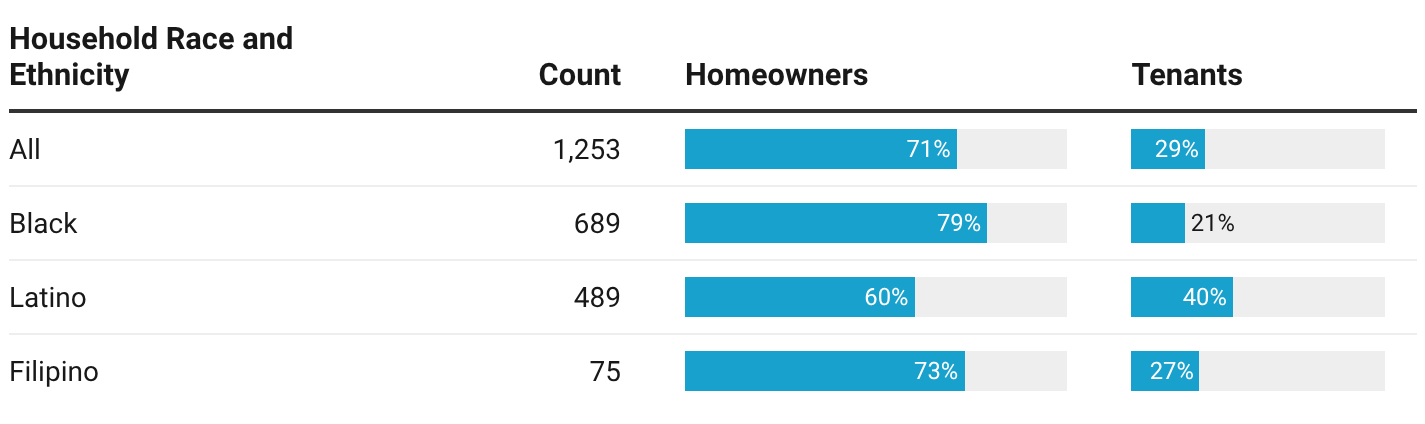
This analysis draws on a sample of 1,253 verified public GoFundMe campaigns created to support Altadena households affected by the January 2025 Eaton Fire. The sample includes 889 homeowner campaigns (71 percent) and 364 tenant campaigns (29 percent). It includes 689 Black, 489 Latino, and 75 Filipino households (Figure 1). Housing tenure varies within the racial and ethnic groups included in the analysis. Among Black households analyzed, 79 percent were homeowners and 21 percent were tenants. Among Filipino households, 73 percent were homeowners and 27 percent were tenants. Latino households had a more even tenure distribution: 60 percent were homeowners and 40 percent were tenants (Figure 1).
We identified the GoFundMe campaigns using three community-led directories that serve residents displaced by the Palisades and Eaton Fires: the Displaced Black Families GoFundMe Directory, created by Community Aid Dena, AFROPUNK and WalkGood LA;21 the Displaced Latine Families Wildfire Mutual Aid Directory by Latino Wildfire Aid;22 and the Displaced Filipino Families GoFundMe Directory by SoCal Filipinos.23 These directories offered the most comprehensive identifiable universe of campaigns, since no single public directory covers all GoFundMe campaigns associated with the Eaton Fire. The Displaced Black Families directory focused exclusively on Eaton Fire survivors, while the Latino and Filipino directories included campaigns for households affected by either the Eaton or Palisades Fires. For all three directories, we filtered to campaigns supporting verified pre-fire Altadena households affected specifically by the Eaton Fire.
Campaigns were created and updated at different points in the recovery period from January 2025 to June 2026. For each campaign, we collected beneficiary names, fundraising goals, amounts raised, and the narratives that accompanied each campaign; 131 campaigns provided at least one narrative update, which we documented and included in our narrative thematic analysis. Our analysis does not separately weigh initial campaign narrative text or later campaign updates; all texts were consolidated and reviewed in early June of 2026. Our analysis does not determine whether a condition mentioned in a narrative continued after its last mention or whether needs omitted from later updates were resolved.
Figure 1. Number of Altadena GoFundMe Campaigns Related to Eaton Fire Recovery by Race and Ethnicity and Housing Tenure of Household Beneficiaries
Source: Authors’ analysis of 1,253 GoFundMe households identified using Community Aid DENA, AFROPUNK, and WalkGood LA, “Displaced Black Families GoFundMe Directory,” Google Sheets, January 2025, available online; Latino Wildfire Aid, “Displaced Latine Families – Wildfire Mutual Aid Directory,” Google Sheets, January 2025, available online; SoCaL Filipinos, “Displaced Filipino Families GoFundMe Links,” Google Sheets, January 2025, available online. Note: Our analysis excluded 261 campaigns due to the inability to verify recipient identities and/or their pre-fire residency in Altadena.
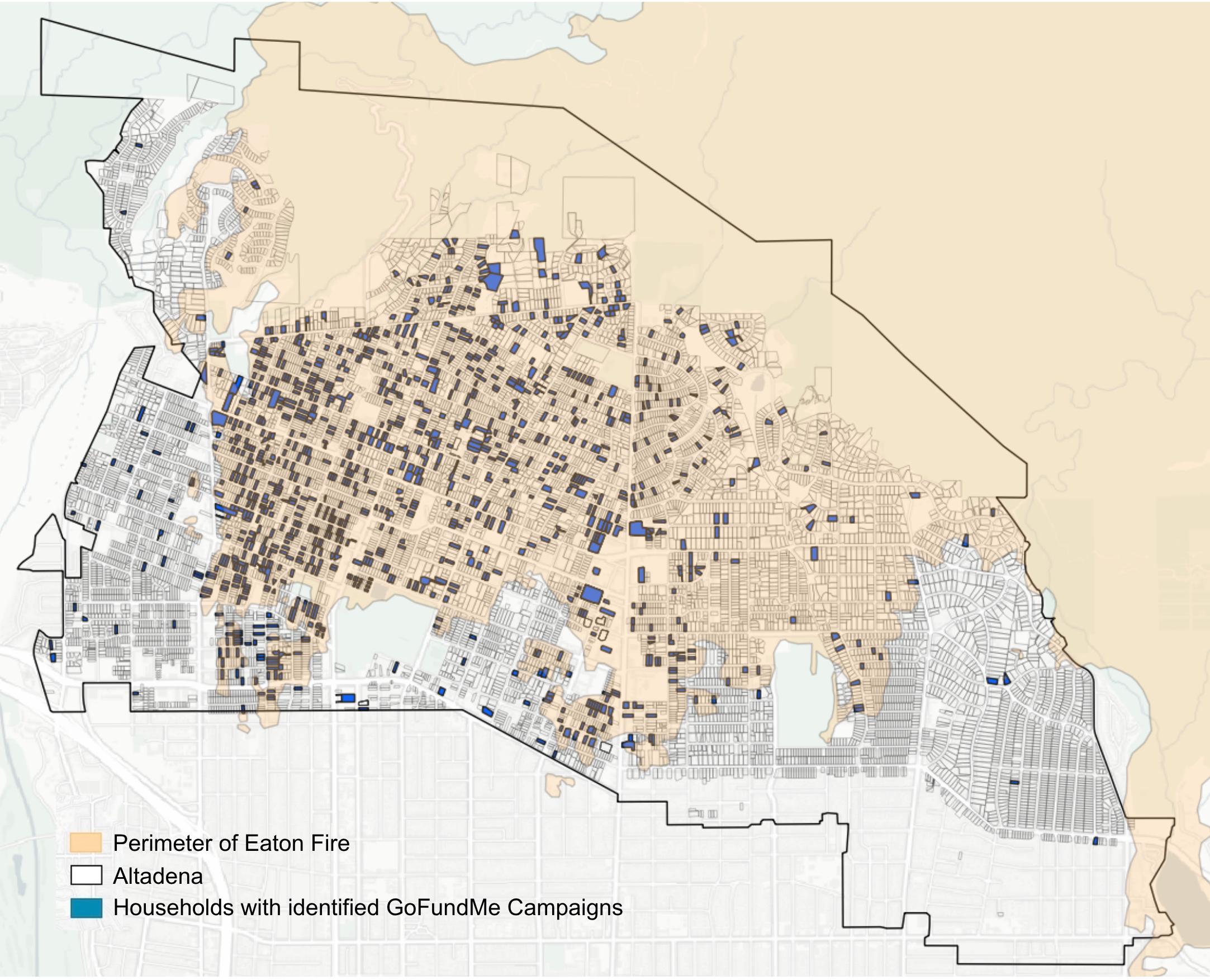
The GoFundMe households included in our analysis were concentrated in the areas of Altadena that experienced the most severe fire damage. Campaigns we analyzed were associated with properties located throughout the burn area but were especially concentrated in West Altadena, where many of the neighborhoods with the greatest structural losses were located (see Map 1). This pattern reflects the community’s pre-fire demographics.24 West Altadena has long been home to many Black residents and other households of color who were disproportionately affected by the fire.25 More than 85 percent of the verified GoFundMe households analyzed were associated with properties that were destroyed or that sustained damage to more than half of the structure (Appendix, Figure B-1). Catastrophic losses were particularly common among homeowners: 93 percent of homeowner households in the sample were completely destroyed, compared with 66 percent of tenant households (Appendix B, Figure B-2). Together, these findings show that most of the campaigns in our dataset came from households facing severe housing loss and major barriers to recovery.
Map 1. Location of 1,253 Altadena GoFundMe Campaigns Related to Eaton Fire Recovery
Source: Authors’ analysis of 1,253 GoFundMe households identified using Community Aid DENA, AFROPUNK, and WalkGood LA, “Displaced Black Families GoFundMe Directory,” Google Sheets, January 2025, available online; Latino Wildfire Aid, “Displaced Latine Families – Wildfire Mutual Aid Directory,” Google Sheets, January 2025, available online; SoCal Filipinos, “Displaced Filipino Families GoFundMe Links,” Google Sheets, January 2025, available online.
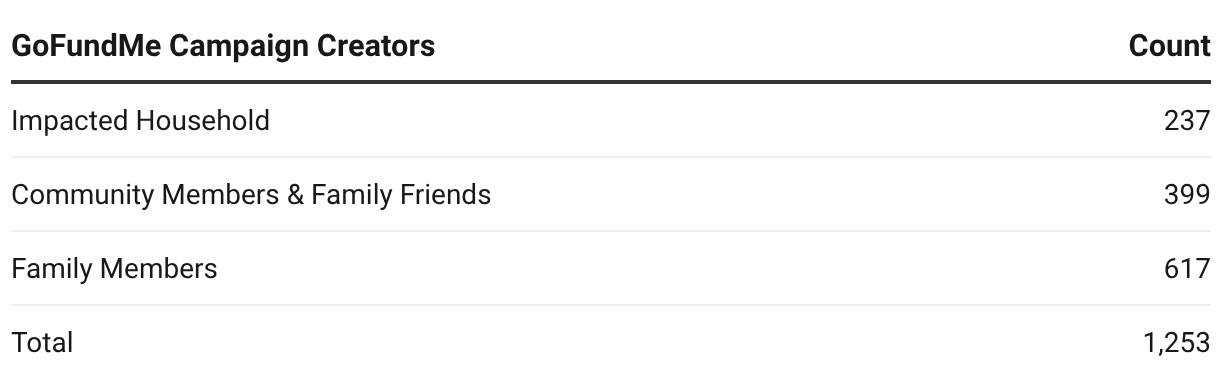
Lastly, most GoFundMe campaigns in the sample were created not by impacted households themselves, but by people within their close personal networks. Nearly half of campaigns (49 percent) were created by family members, while another 32 percent were created by community members or family friends (Figure 1). This pattern aligns with prior research showing that crowdfunding often depends on trusted relationships that can establish credibility, draw attention to a campaign, and mobilize support.26
Figure 2. Relationship of Altadena Eaton Fire Recovery GoFundMe Campaign Creators to Household Beneficiaries
Source: Authors’ analysis of 1,253 GoFundMe households identified using Community Aid DENA, AFROPUNK, and WalkGood LA, “Displaced Black Families GoFundMe Directory,” Google Sheets, January 2025, available online; Latino Wildfire Aid, “Displaced Latine Families – Wildfire Mutual Aid Directory,” Google Sheets, January 2025, available online; SoCal Filipinos, “Displaced Filipino Families GoFundMe Links,” Google Sheets, January 2025, available online.
Data Verification
To ensure consistency across the dataset, our research team independently verified both recipient identity and pre-fire residency in Altadena. For each campaign, we documented the campaign beneficiary, the self-attested relationship between the GoFundMe author and beneficiary, and the beneficiary’s self-attested tenure in Altadena (homeowner or tenant). We confirmed homeownership through property records using Property Shark27 and supplemented with publicly available Los Angeles County assessor information when necessary. To link campaigns with fire-damage characteristics, we geocoded verified addresses to parcel-level data. Campaigns for which beneficiary identity or pre-fire residency could not be verified were excluded from the analysis.
Qualitative Analysis
To systematically analyze themes across the campaigns, each paragraph in a campaign narrative was labeled as a text segment so that distinct messages being conveyed could be coded separately. Given the size of the dataset, we employed a human–guided artificial intelligence (AI) coding process to extend this coding framework across all campaign narratives. Our team individually reviewed over 100 segments and developed a sample of concise codes grounded in the campaign narratives. Nine large language models (LLMs) were evaluated against a subset of human-coded segments to assess their ability to reproduce human coding decisions using standardized prompts and benchmark examples. We selected the model that most closely aligned with human coding, Claude Sonnet 4.1, and used it to apply the established coding framework to the remaining campaign narratives (a detailed description of the coding framework and AI prompt design is provided in Appendix A). Our team subsequently reviewed the AI-generated outputs; a subset of 3,000 AI-generated coded segments was carefully reviewed and categorized into 39 parent codes based on the predominant theme or idea conveyed. The parent coding framework was then shared with the model, which was tasked with assigning parent codes to the remaining approximately 9,000 unique coded segments. Finally, we grouped parent code assignments into 11 themes (full documentation for the definitions and household counts for the 11 group themes and 39 parent codes can be found in Appendix C).28
To facilitate analysis, we converted each parent code and group theme into a household-level indicator conveying the presence or absence of an idea in a given narrative. Percentages and analyses therefore represent the share of campaigns whose narrative segments included that parent code, not the share of narrative segments overall.
Thematic Content Analysis
We used the cosine similarity method to measure how strongly two coded themes appeared among the same GoFundMe campaigns after accounting for how common each theme was across our total sample. Each parent code was converted into a household-level indicator: a value of 1 when the theme appeared anywhere in a given campaign narrative and 0 when it did not. For any pair of themes, cosine similarity divides the number of households containing both themes by the square root of the product of the number containing each theme. Values range from 0, meaning the themes never appeared together, to 1, meaning the themes appeared among exactly the same set of households. Because the measure adjusts for the prevalence of each theme, it is useful for identifying patterns that might be obscured by raw co-occurrence counts alone. Applied across all themes, the cosine similarity method helps identify recurring bundles of recovery needs. It does not establish causality, severity, or the order in which needs emerged, so we present cosine similarity alongside the number of shared households and interpret the relationships within the context of the campaign narratives.
Cosine similarity is an established approach within computational and mixed-methods content analysis. Researcher Andreas Armborst describes cosine similarity and code co-occurrence as methods for measuring “thematic proximity” and identifying broader relationships among coded themes.29 Similarly, Jiang et al. created binary indicators showing whether framing elements appeared in news articles and used cosine similarity to weight the connections among those elements in a network.30 Additionally, Hardie et al. used cosine similarity to measure how closely individual lines from 1,396 qualitative interviews aligned with topics about family, work, health, religion, and criminal justice.31
Limitations of Analyses
The campaign sample we analyzed is not representative of every Altadena household affected by the Eaton Fire. Rather, it was constructed from three community-led directories that specifically tracked Black, Latino, and Filipino households displaced by the Eaton Fire. Households outside those networks—including white, Asian (non-Filipino), and other Altadena residents—as well as displaced households that did not create a campaign or were never included in any directory are not represented. Findings therefore should be interpreted as patterns within the campaigns analyzed, not as population-wide estimates.
Additionally, campaigns are fundraising documents and not neutral inventories of need. Organizers may emphasize losses and hardships they believe will motivate donors and may downplay or omit needs that feel private or stigmatizing. Silence about a need in a campaign narrative does necessarily not mean the need was absent from the household’s experience—it could instead mean the need was not part of the story the organizer chose to tell publicly. Because most campaigns were written by relatives, friends, or community members rather than by the affected household itself, language, emphasis, and interpretation may reflect the writer’s perspective on the household’s situation as much as the household’s own account. For this reason, findings are attributed to campaign narratives and households, not to the private beliefs, experiences, or intentions of individual survivors.
We do not compare substantive recovery findings by race or ethnicity. The racial and ethnic groups in our sample are small subsamples with different tenure distributions, so any apparent group difference could reflect tenure, household composition, directory practices, or other factors rather than race and ethnicity.
Parent codes simplify complex narratives into analytic categories. A household coded under a given theme is not fully described by that theme—a single parent code can capture a wide range of underlying experiences. A household’s absence from a code does not necessarily mean the underlying condition was absent from that household’s experience; it could instead mean that the condition was not described in a way our coding framework captured. Relatedly, household-level indicators measure presence, not severity. Because each parent code is converted into a binary indicator of whether a theme appeared anywhere in a household’s narrative, the analysis cannot distinguish a household that mentioned a need briefly from one for which that need was central and severe.
Human-AI coding, while validated, is not equivalent to full manual review of every campaign narrative segment. We benchmarked the coding model against human-coded examples and selected for its alignment with human decisions. Additionally, our team reviewed AI-generated outputs and resolved ambiguous cases. Even so, AI-assisted coding of nearly 12,000 narrative segments may miss minor contextual nuance that a fully manual, segment-by-segment human review may have captured. This approach places our analysis closer to what researchers Nicmanis and Spurrier describe as a “Small-q” aligned use of AI-assisted qualitative analysis—one grounded in structured coding and evaluated through agreement with human coders, rather than a “Big-Q” approach in which AI serves only as an interpretive collaborator alongside a fully manual analysis.32 Nicmanis and Spurrier note that this kind of validated, human-reviewed coding process is a well-established way of using AI to extend a qualitative analysis to a larger dataset but caution that even benchmarked models can still default toward the most common or expected interpretation of a narrative, potentially smoothing over rarer or more distinctive experiences within our sample.
Key Findings
Note: All percentages in the key findings section refer only to the 1,253 verified GoFundMe campaigns in our sample. This analysis is a subset of households displaced by the Eaton Fire in Altadena. These campaigns do not represent every household affected by the fire; campaigns merely provide a window into the losses, requested support, and recovery barriers documented in public fundraising narratives written by impacted household members or their loved ones.
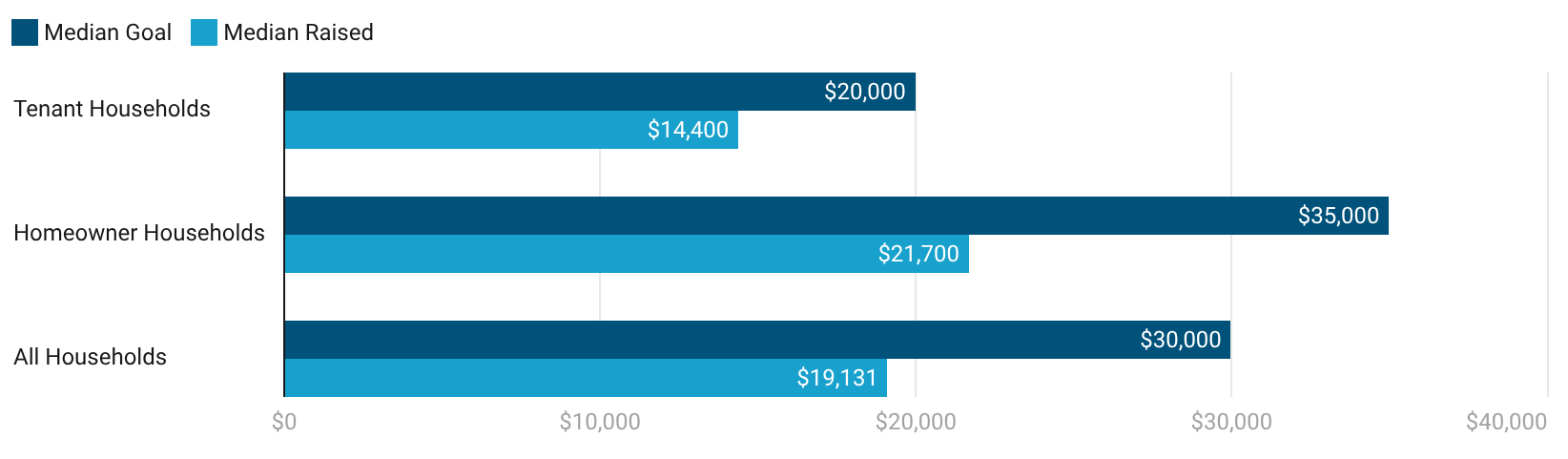
FINDING 1: Households sought a median of $30,000 in direct assistance through GoFundMe, with the median homeowner campaign seeking $35,000 and the median tenant campaign seeking $20,000. Nearly nine in ten of all campaigns fell short of their stated goals, underscoring the need to examine the recovery costs that families were unable to cover.
The GoFundMe campaigns we analyzed provide a window into the amount of direct and flexible financial support households and their networks believed they would need after the Eaton Fire. Among the 1,237 campaigns for which we could identify fundraising goals and amounts raised, the median campaign requested $30,000. The median campaign had raised $19,100 as of June 2026. In sum, all campaign households established nearly $49.5 million in stated campaign goals and raised approximately $34 million in support.
The amounts requested and raised differed considerably by housing tenure. Homeowner campaigns had a median goal of $35,000, while tenant campaigns had a median goal of $20,000. Homeowner campaigns also raised more in absolute dollars: the median homeowner campaign raised $21,600 while the median tenant campaign raised $14,400. These differences likely reflect the distinct costs facing each group as well as organizers’ expectations about how much a household might reasonably be able to secure through donations.
Despite these differences in dollar amounts, homeowners and tenants made similar relative progress toward their campaign goals. As of June 2026, the median homeowner campaign had reached 74 percent of its stated goal and the median tenant campaign had reached 72 percent of its goal. Yet only 11 percent of homeowner campaigns and 9 percent of tenant campaigns had reached or exceeded their goals. In other words, nearly nine in ten campaigns in both groups did not meet the financial targets set by campaign organizers.
These data should not be interpreted as complete measures of household recovery costs or final fundraising outcomes. Campaign goals are self-selected, may change over time, and may represent only the expenses organizers believed could reasonably be raised through crowdfunding. The reported progress reflects the amount observed as of June 2026 rather than the final outcome of every campaign, many of which remained active as of this report’s publication in August 2026. Campaign goals also do not consistently indicate how much insurance, public assistance, savings, or other support a household had already received. Taken together, however, the data show that crowdfunding provides some support but does not do so consistently or fully close the financial gaps households publicly identified.
Figure 3. Median GoFundMe Campaign Goals and Amounts Raised for Eaton Fire Recovery in Altadena, by Housing Tenure of Campaign Beneficiaries, June 2026
Source: The fundraising analysis uses 1,237 campaigns with both a valid goal and amount raised value. Progress percentages were available for 1,236 campaigns. The rest of the campaigns were excluded as their goals and contributions could not be confirmed at the time of analysis. Data points represent medians and the vertical lines represent the interquartile range. Source: Author’s analysis of GoFundMe Households identified using Community Aid DENA, AFROPUNK, and WalkGood LA, “Displaced Black Families GoFundMe Directory,” Google Sheets, January 2025, available online; Latino Wildfire Aid, “Displaced Latine Families – Wildfire Mutual Aid Directory,” Google Sheets, January 2025, available online; SoCal Filipinos, “Displaced Filipino Families GoFundMe Links,” Google Sheets, January 2025, available online.
FINDING 2: GoFundMe campaigns frequently stated that households suffered total losses and evacuated without the documents and other essentials needed to access services to stabilize in the immediate aftermath of the fire. This theme highlights the potential need for stronger household preparedness education, evacuation support, and recovery plan.
The conditions under which households evacuated became the first barrier many households carried into recovery. Seventy-four percent of campaigns (931 campaigns) described at least one experience of immediate danger, loss, or disruption during and directly after the fire.
Many households entered displacement without a home and/or the basic materials needed to navigate what followed. Fifty-six percent of campaigns (704 campaigns) described total housing loss and immediate household displacement, while 32 percent (408 campaigns) described evacuating with few or no belongings (see Figure 4). These experiences frequently overlapped: 17 percent (215 campaigns) described households leaving with minimal belongings and subsequently losing their home, producing a cosine similarity of 0.40 (see Appendix D). This pattern was consistent across household tenure.33 Rather than experiencing a temporary evacuation, these households were facing long-term displacement and trying to locate housing and seek assistance without clothing, medications, identification, insurance records, computers, or other essentials needed to reestablish daily life.
Campaign narratives suggest that many residents did not initially perceive their departure as permanent, helping explain why so many households left without essential belongings. Some described not realizing how quickly the fire would reach their neighborhood, expecting to return soon, or recognizing the urgency only after smoke, flames, or embers were nearby. Several described neighbors waking residents or urging them to evacuate. Across these accounts, households predominantly understood their departure as temporary until conditions had already escalated. These narratives document residents’ perceptions and lived experiences; they do not independently establish whether official warnings were timely or adequate.
These campaign narratives are consistent with broader evidence suggesting gaps in preparedness, warning, and emergency communication before and during the fire. A May 2025 survey of 1,228 Altadena residents found that nearly three-quarters of respondents recalled receiving no County fire- or disaster-preparedness outreach before the Eaton Fire, while only five percent recalled being invited to a preparedness meeting.34 Los Angeles County’s after-action review of the Eaton Fire documented a combination of extreme fire behavior, impaired situational awareness, power and communications outages, inconsistent procedures, and resource constraints that limited system effectiveness.35 Altadena residents reported receiving little or no warning, receiving alerts only after they had begun evacuating, or being told to prepare when the danger had already become immediate.36 Together, these sources help explain why campaigns often described households experiencing evacuation as a matter of minutes and why some residents did not understand the severity of the threat until it was imminent.
Household Campaign Spotlight:
Evacuating Without Essentials
Figure 4. Number and Share of GoFundMe Campaigns Related to Eaton Fire Recovery in Altadena that Reported Emergency Conditions and Immediate Harms, June 2026

Note: Some campaigns included more than one condition, so percentages do not sum to 100. Categories reflect conditions explicitly described in GoFundMe campaign narratives and should not be interpreted as population-wide estimates. Source: Author’s analysis of 1,253 GoFundMe Households identified using Community Aid DENA, AFROPUNK, and WalkGood LA, “Displaced Black Families GoFundMe Directory,” Google Sheets, January 2025, available online; Latino Wildfire Aid, “Displaced Latine Families – Wildfire Mutual Aid Directory,” Google Sheets, January 2025, available online; SoCal Filipinos, “Displaced Filipino Families GoFundMe Links,” Google Sheets, January 2025, available online.
FINDING 3: Mental health challenges following the Eaton Fire were closely tied to housing loss, displacement, instability, and unmet basic needs, suggesting that behavioral health support must be treated as a core component of disaster recovery rather than a separate service need.
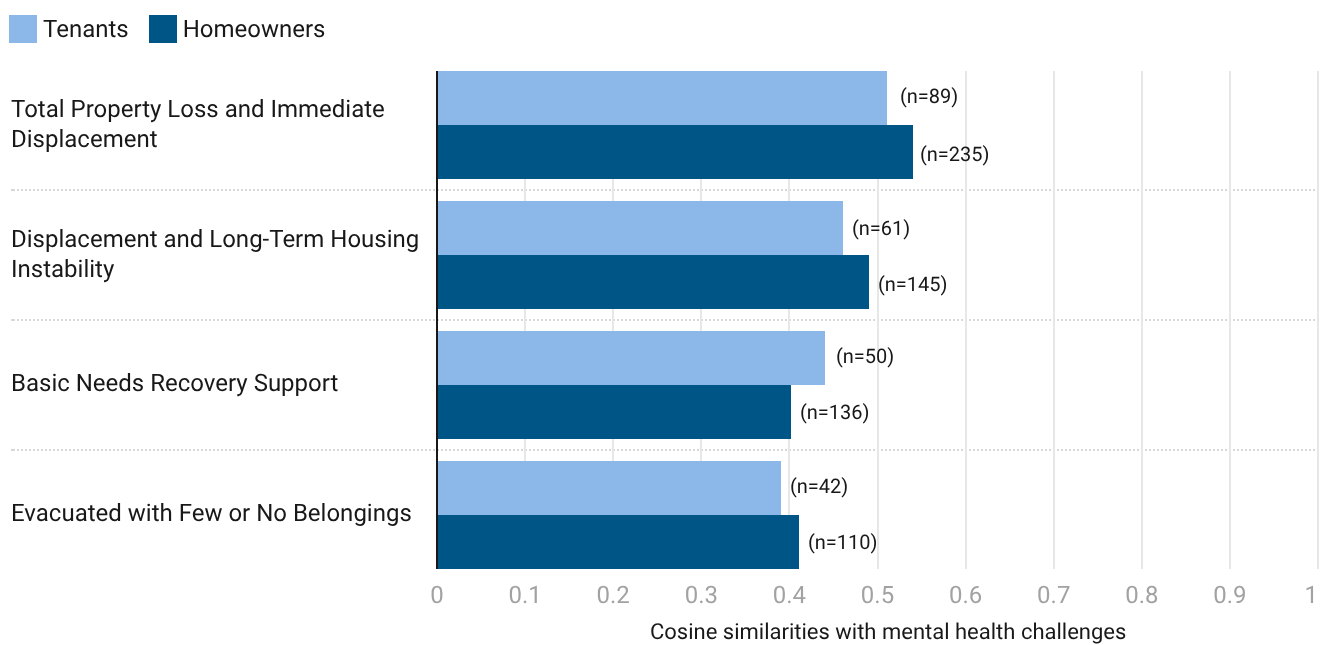
Campaign narratives suggest that emotional distress was not simply a consequence of the fire itself, but of the housing instability, displacement, and practical challenges households continued to face during recovery. Forty-two percent of GoFundMe campaigns (524 campaigns) described grief, trauma, shock, anxiety, fear, and overwhelm as well as the distinct emotional distress of children. Figure 5 depicts the narrative themes that most often overlapped with mental health concerns, demonstrating that distress was most closely connected to the loss of housing, unstable living arrangements, and the practical burdens of trying to recover (see Figure 5).
Total housing loss had the strongest relationship with mental health impacts for both homeowners and tenants. Among homeowner campaigns, disaster mental health challenges appeared together with total property loss and immediate displacement experiences in 235 campaigns and had a cosine similarity of 0.54 (Figure 5). Among tenant campaigns, the two experiences appeared together in 89 campaigns and had a cosine similarity of 0.51. The sudden destruction and loss of housing therefore represented more than the loss of physical shelter. Campaigns connected mental health challenges to grief over belongings and memories, the disruption of routines, the loss of financial security, and uncertainty about whether return to Altadena would be possible.
Prolonged housing instability carried emotional consequences even after households reached immediate safety. Mental health challenges and long-term housing instability appeared together in 145 homeowner campaigns, with a cosine similarity of 0.49, and in 61 tenant campaigns, with a cosine similarity of 0.46 (Figure 5). These relationships indicate that trauma did not end when households left the evacuation zone. It continued through repeated moves, difficult housing decisions, and uncertainty about what housing or financial resources would ultimately become available.
Evacuation experiences continued to shape emotional recovery, particularly among households that left without essential belongings and later learned their homes had been destroyed. Mental health and evacuating with few or no belongings appeared together in 110 homeowner campaigns, with a cosine similarity of 0.41, and in 42 tenant campaigns, with a cosine similarity of 0.39 (Figure 5). Leaving with little time to gather medication, identification, clothing, photographs, or other meaningful possessions likely compounded the shock of displacement, particularly for households that expected to return home only to learn later that everything had been lost.
Mental health challenges were also closely connected to households’ efforts to meet basic needs while displaced. Basic needs recovery support and mental health experiences appeared together in 136 homeowner campaigns, with a cosine similarity of 0.40, and in 50 tenant campaigns, with a slightly stronger cosine similarity of 0.44. This relationship suggests that the daily challenge of rebuilding basic routines and managing displacement became an additional source of distress beyond the initial loss of housing.
The prominence of mental health challenges during recovery is consistent with broader disaster research showing that emotional harm can result from both the immediate danger of the disaster and the instability that follows. In fact, studies suggest that roughly one-third of disaster-affected people experience outcomes such as post-traumatic stress disorder (PTSD), anxiety, or depression.37 These impacts may result directly from evacuation, injury, bereavement, or witnessing destruction, but they may also emerge indirectly through job loss, forced relocation, disrupted health care, separation from social networks, and the prolonged loss of community and routine that follow the disaster.38
These mental health risks are particularly concerning for households with children and older adults, whose recovery may depend more heavily on stable routines, caregivers, social support, and connection to familiar institutions. Children’s emotional recovery after a wildfire is closely shaped by how parents and caregivers cope, the stability parents and caregivers are able to provide, and whether children can remain connected to school, peers, and familiar activities.39 Similarly, research finds that adults aged 65 and older are more than twice as likely as younger adults to develop PTSD or adjustment disorders after a disaster.40 This heightened risk among older adults is often driven by a loss of livelihood and savings, reduced access to support networks, and greater exposure to traumatic bereavement.41
Household Campaign Spotlight:
Mental Health Challenges
“It’s hard to believe it’s already been six months since we lost everything. Now that I’m no longer in full survival mode, the grief hits differently, sometimes like a punch straight from Mike Tyson. I’ve started receiving mental health support and while I can see progress, I also recognize this is a long journey.” – Homeowner Campaign
“It has now been two months since the Eaton Fire took everything from us—our home, our belongings, and the sense of security we built over 10+ years in Altadena. While the world has moved on, for us, the loss is still fresh. Every day, we are reminded of what we no longer have and the long road ahead to rebuild our lives.” – Tenant Campaign
“My parents shared with me that they are completely traumatized by the devastation of our family, friends, and neighbors. Both of my parents are now in their 60s with medical issues, and it is extremely hard to watch them go without eating or sleeping well during these times.” – Homeowner Campaign
Figure 5. Number of GoFundMe Campaigns Related to Eaton Fire Recovery in Altadena Reporting Mental Health Issues Alongside Other Recovery Concerns, by Housing Tenure of Campaign Beneficiaries, June 2026
Note: “Mental health experiences” combines two parent codes from our qualitative analysis: Disaster Mental Health and Psychological Recovery Needs, and Child Mental Health and Trauma Recovery Needs. A campaign is counted only once if either or both themes appear in co-occurrence with another parcel code. Longer bars indicate that two themes appeared among more similar groups of campaigns after accounting for how common each theme was. Labels show the number of homeowner or tenant campaigns in which both themes appeared. Source: Author’s analysis of 1,253 GoFundMe Households identified using Community Aid DENA, AFROPUNK, and WalkGood LA, “Displaced Black Families GoFundMe Directory,” Google Sheets, January 2025, available online; Latino Wildfire Aid, “Displaced Latine Families – Wildfire Mutual Aid Directory,” Google Sheets, January 2025, available online; SoCal Filipinos, “Displaced Filipino Families GoFundMe Links,” Google Sheets, January 2025, available online.
FINDING 4: Both tenant and homeowner campaigns reported severe housing loss, but their paths towards stability differed: tenant campaigns more often emphasized securing and sustaining livable replacement housing and restoring basic needs, while homeowner campaigns more often described disruptions to multigenerational housing and caregiving networks. These differences underscore the need for tenure-responsive recovery programs that provide viable, accessible, and plentiful interim and long-term housing support.
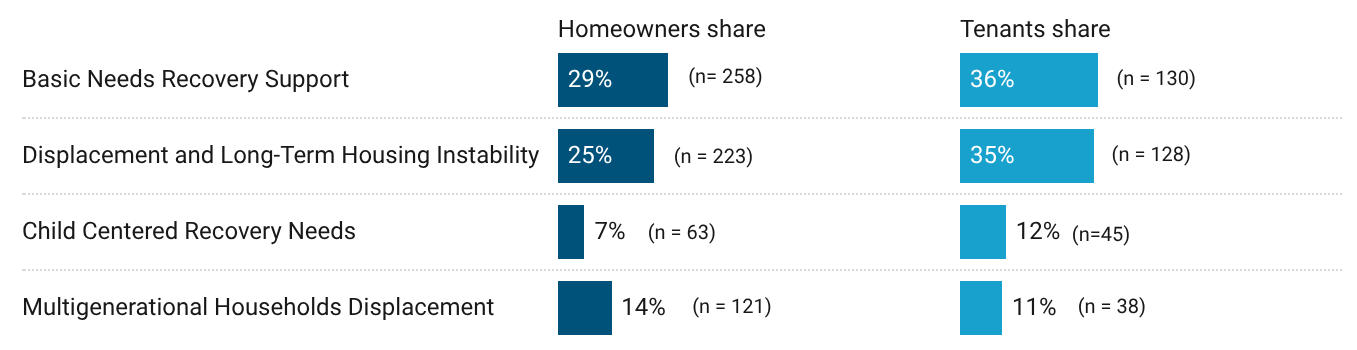
Housing stability required more than placing a household under a roof; it also depended on whether households could replace the goods, transportation, caregiving arrangements, and routines needed to make temporary or replacement housing workable. Fifty-seven percent of GoFundMe campaigns (724 campaigns) described at least one concern related to housing stability or ability to meet basic needs. Households sought both shelter and the practical resources required to live safely and resume daily life (see Figure 6).
Tenant campaigns more often described both unstable housing and the need to replace the essentials that make housing livable. Displacement and housing instability were described in 36 percent of tenant campaigns, compared with 25 percent of homeowner campaigns, while 36 percent of tenant campaigns and 29 percent of homeowner campaigns described issues in accessing basic needs. In these narratives, basic needs included food, clothing, beds, furniture, cooking supplies, household goods, and other everyday items lost in the fire. These basic needs were not separate from housing needs. They determined whether a family could comfortably adjust to new housing and begin restoring ordinary routines.
Tenant campaigns also more frequently involved the needs of children in their household. Child-centered recovery needs appeared in 12 percent of tenant campaigns, compared with 7 percent of homeowner campaigns (Figure 6). These campaigns described costs and disruptions involving children’s clothing, school supplies, childcare, and toys to help restore routines for children.
The challenges described in tenant campaigns reflect broader structural barriers identified in prior research on tenants during disaster recovery. For instance, a multiyear study following households after Hurricane Katrina found that tenants took nearly a year longer than homeowners to reach stable housing, with households raising children and those without strong support networks taking even longer.42 That same pattern has been visible in Altadena’s recovery, where the Altadena Tenants Union found that 72 percent of surveyed tenants (from May to June 2025) still needed housing, 78 percent could not afford the average asking rent for a one-bedroom unit, and 78 percent lacked insurance before the fire.43
Homeowner campaigns described fewer immediate housing instability and basic needs concerns than tenant campaigns, but they more often showed how the fire disrupted extended family housing systems. Multigenerational household displacement appeared in 14 percent of homeowner campaigns, compared with 11 percent of tenant campaigns (see Figure 6). This category captures campaigns in which several generations, related households, or multiple family properties were displaced at once. For these households, the destruction of a home also meant the loss of a gathering place, informal caregiving arrangements, and housing for older relatives.
Ultimately, homeowners and tenants did not need identical forms of housing support. On one hand, tenants’ campaigns more often described needing assistance that made replacement rental housing affordable, livable, and sustainable, including deposits, furnishings, transportation, and child-centered support. Homeowner campaigns, on the other hand, were more likely to describe the need for funding to address the displacement of their broader family network.
Household Campaign Spotlight:
Ongoing Housing Instability
“We’re also still dealing with our insurance company issues, which means that we get limited access to help from FEMA… We’ve spent February with some of us in an AirBnb, one child in a neighbor’s house, and another with one of their best friend’s parents. It hasn’t been ideal to be in separate homes while trying to heal and plan for what is next, but we’ve been so very fortunate to have so much support from so many people.” – Homeowner campaign
“We’ve been staying in hotels and unable to return and are in search of new living situation where we can both still navigate to our workplaces… sadly our son’s room was most affected and it does not appear we’ll be able to salvage much of our son’s things including his bed, clothing, toys and books… Sadly our network and family were also impacted with their residences burning down, including my aunt who ran an in-home daycare that our son attended, and now we’re in search of (a likely significantly more expensive) daycare as well as housing.” – Tenant campaign
Figure 6: Share of GoFundMe Campaigns that Mentioned Housing Stability and Basic Needs Concerns by Housing Tenure of Campaign Beneficiaries, June 2026
Note: Percentages are calculated separately within homeowner and tenant campaigns. Campaigns may include multiple concerns. Basic-needs recovery support includes food, clothing, furniture, beds, cooking supplies, household goods, and other essentials needed to make temporary or replacement housing livable. Source: Author’s analysis of 1,253 GoFundme Households identified using Community Aid DENA, AFROPUNK, and WalkGood LA,“Displaced Black Families GoFundMe Directory,” Google Sheets, January 2025, available online; Latino Wildfire Aid, “Displaced Latine Families – Wildfire Mutual Aid Directory,” Google Sheets, January 2025, available online; SoCal Filipinos, “Displaced Filipino Families GoFundMe Links,” Google Sheets, January 2025, available online.
FINDING 5: Housing loss, displacement, mental health challenges, and unmet basic needs frequently appeared together in GoFundMe campaigns, suggesting that fragmented, one-time recovery aid is poorly aligned with how households experience recovery.
GoFundMe campaign narratives described recovery as a bundle of connected problems rather than a sequence of isolated needs. The median campaign included three of the 31 recovery experiences we identified in our household-level analysis. Tenant campaigns included an average of 3.58 experiences and homeowner campaigns an average of 3.32. Because fundraising narratives are brief and may omit private or less visible hardships, these counts likely understate the full complexity of household recovery. Even within these relatively brief narratives, households regularly described housing, material, emotional, family, and administrative challenges occurring together (see Figure 7).
Figure 7 makes the interconnected structure of household recovery visible. Each circle represents a coded recovery experience, and larger circles indicate experiences that appeared in more campaigns. Experiences positioned closer together appeared among more similar groups of households, while thicker lines indicate that a larger number of campaigns included both experiences. The network does not establish that one condition caused another or that every household followed the same sequence. It does, however, identify these recurring combinations that recovery systems should anticipate.
The strongest relationships across the campaign narratives analyzed centered on the destruction of housing and the conditions that followed. Total property loss and immediate displacement and mental health issues due to the disaster formed the strongest supported relationship, appearing together in 313 campaigns with a cosine similarity of 0.522. Housing instability and long-term displacement and mental health challenges appeared together in 201 campaigns, with a cosine of 0.475, while property loss and basic needs support appeared together in 245 campaigns, with a cosine of 0.469. Total property loss and immediate displacement appeared together with housing instability and long-term displacement in 218 campaigns, with a cosine of 0.439. These combinations show that severe property loss generally activated multiple needs rather than producing one problem that could be resolved through a single intervention.
Moreover, we see that campaign narratives were anchored by many of the same conditions for tenants and homeowners, but the surrounding combinations differed. Tenant campaigns more often connected housing instability with basic needs, child centered recovery, and income or employment loss, while homeowner campaigns more often connected total property loss with multigenerational displacement, insurance, financing, and rebuilding uncertainty. These differences reinforce that an integrated recovery system still requires tenure-specific pathways.
Household Campaign Spotlight:
Overlapping Experiences and Needs
TENANT CAMPAIGN
| This tenant campaign centered on two working parents and their three young daughters. After losing their home and nearly all of their belongings, the family of five first crowded into a relative’s two-bedroom apartment and ultimately moved four times over the following year before settling near Altadena so their daughters could remain connected to their school. Along the way, they navigated renters’ insurance, a denied FEMA application, school closures, medical expenses, and the cost of replacing everyday essentials. Both parents continued working through the disruption; the mother took on additional doula work while completing disaster paperwork and caring for the children, and the father continued plumbing work for clients’ homes that remained standing. | |
| “[Their] FEMA application was denied. Some of [the husband’s] work supplies were destroyed in the fire. They have to replace all their belongings, and [they] are determined to find permanent housing for the family. They are still unsure if the girls’ school is standing from the fire, or if it will be safe to return at all due to the hazardous materials, air quality, and damage to the community. The girls are resilient but heartbroken that they lost everything…” | |
| This household identified the following recovery experiences: | |
|
|
HOMEOWNER CAMPAIGN
| This homeowner campaign centered on a multigenerational household headed by an elderly woman who owned the family home. She lived there with her adult son and relied on family for ongoing care due to her dementia. When the Eaton Fire destroyed the home, both she and her son lost all of their belongings, while her daughter took on the added responsibility of coordinating their recovery as power of attorney. The children have had to simultaneously navigate FEMA and insurance claims, arrange temporary housing, replace furniture and household essentials, and maintain specialized memory care for their elderly mother. As the recovery progressed, the family also learned that the home was significantly underinsured, with rebuilding costs estimated at more than $1 million; far beyond what their policy would cover. Therefore, many of these costs—extended accommodations, caregiving-related travel, and rebuilding—fell outside their available assistance. | |
| “At this point, we are relying solely on our GoFundMe support and our insurance policy to care for my grandmother and uncle. Unfortunately, we have learned that we are significantly underinsured, and the cost to rebuild was quoted at over $1 million, far beyond what our policy will cover.” | |
| This household identified the following recovery experiences: | |
|
|
Figure 7. Network Map of Recovery Experiences Described in GoFundMe Campaigns for Eaton Fire Survivors, June 2026
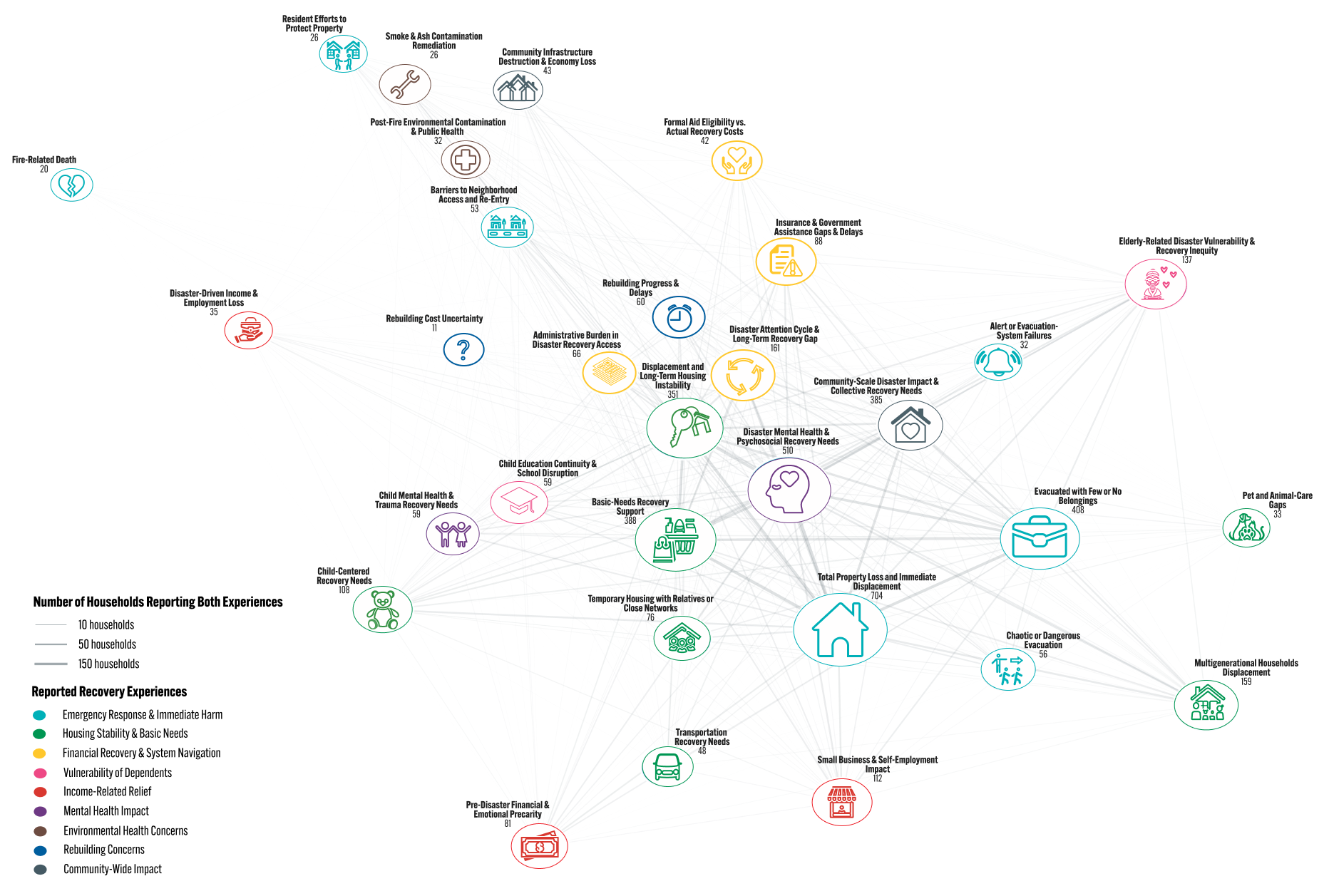
Note: Closer nodes on figure have stronger prevalence-adjusted co-occurrence; thicker edges represent more households sharing both parent codes; n = number of campaigns whose narrative included them and the size of the icons corresponds to the number of campaigns that included that theme in their narrative. Source: Author’s analysis of 1,253 GoFundMe Households identified using Community Aid DENA, AFROPUNK, and WalkGood LA, “Displaced Black Families GoFundMe Directory,” Google Sheets, January 2025, available online; Latino Wildfire Aid, “Displaced Latine Families – Wildfire Mutual Aid Directory,” Google Sheets, January 2025, available online; SoCAl Filipinos, “Displaced Filipino Families GoFundMe Links,” Google Sheets, January 2025, available online.
Policy Recommendations
Altadena’s recovery will take years, but displacement and household instability are ongoing. Recovery policy, therefore, must operate on two timelines at once: immediate stabilization and long-term return. Based on recurring needs and barriers documented in these campaigns as well as the existing policy landscape, policymakers should consider the following actions.
LOS ANGELES COUNTY
1. Institutionalize rapid, flexible household disaster assistance within the County’s existing fire recovery fund and emergency grant infrastructure. This rapid, flexible assistance should build on the existing County grant administration infrastructure and combine a dependable County funding commitment with the ability to accept state, federal, and philanthropic resources. The Chief Executive Office’s Office of Emergency Management (OEM) should both support in identifying funding sources and coordinating cross-departmental responsibilities; the County’s Department of Business and Consumer Affairs (DCBA) should administer the financial assistance component in coordination with a prequalified third-party administrator; the County’s Department of Public Social Services (DPSS) should serve as the core referral partner to connect households to existing public benefits; other county departments—including the Department of Public Health (PDH), Department of Mental Health (DMH), Department of Economic Opportunity (DEO), Department of Homeless Services and Housing (HSH), Los Angeles County Department Authority (LACDA), Treasurer and Tax Collector (TTC)—could serve as referral partners; and pre-qualified community-based organizations could provide application assistance. These may be better referenced as referral partners. The program’s activation framework should establish thresholds based on displacement scale, housing loss, and the capacity of the affected jurisdiction.
Under this model, the County should include:
- A standing recovery funding reserve and activation framework that can stage cash assistance and delegate staff for management of the fund at the moment of disaster, filling gaps and delays in Federal Emergency Management Agency (FEMA) aid. The County should maintain a designated reserve, standing appropriation, or other dependable source of initial funding so that the recovery program can begin before federal reimbursement or charitable contributions arrive. This funding should be paired with a pre-established framework that can outline when financial assistance is activated and delegate dedicated staffing, contracts, technology, and departmental roles for fund management and distribution. After streamlined verification of disaster impact, households reporting urgent needs should receive expedited review for a smaller first stage payment. This assistance could be delivered through a prepaid card, electronic transfer, check, or qualified community partners. Larger stabilization funding could follow more comprehensive review. The California Napa Valley Community Disaster Relief Fund provides a useful model; established with a $10 million philanthropic gift after the 2014 South Napa Earthquake, the standing fund–administered by a community foundation–has since distributed more than $30 million in response to multiple disasters through direct household assistance and grants to local organizations providing case management, temporary housing, counseling, legal services, and other recovery support to stopgap delays in FEMA aid in the immediate aftermath of a disaster.
- Direct disaster case management referrals at the point of application. Applicants should be able to opt into a direct, real-time transfer of care to recovery navigation, with ongoing case management offered to households with complex or ongoing unmet needs. Participating providers should contact households within a defined service standard and should provide expedited outreach for urgent health, safety, and displacement needs. Case managers should triage immediate needs, help households gather documents, connect survivors with housing and public benefits, and remain available during a defined recovery period as circumstances change. Boulder County provides an implementation model for integrated administration; its nonprofit administrator, Impact Development Fund, established a single application for multiple recovery programs following the 2021 Marshall Fire and maintained a dedicated disaster recovery team that included staff specifically assigned to intake and immediate case management.
- A rolling application and reassessment process. Applications should remain open during an initial activation period that may be extended based on documented unmet need, available funding, and recovery conditions. Participating households should be able to update their circumstances and request reassessment for funding. The Hawaiʻi Department of Human Services’ Temporary Assistance for Needy Families (TANF) Program provides a useful model. The program was backed by up to $100 million in federal TANF funding allocated by the state and administered through a contract with the community-based organization Maui Economic Opportunity. The TANF program allowed eligible families to apply for assistance based on their current housing, transportation, utility, clothing, and school supply needs and return later to seek additional assistance. Boulder County’s more recent Recovery Support Program provides a complementary long-term model; four years after the Marshall Fire, the Community Foundation Boulder County and Impact Development Fund consolidated separate unmet needs, housing support, and property restoration programs into one application for Boulder County Wildfire Fund-Recovery Support that remains available through summer 2027 or until funding is exhausted.
| What research supports this recommendation? | Campaign narratives in this report indicate that evacuation conditions shaped households’ ability to begin recovery. Clothing and medication are needed immediately; a rehousing deposit might be needed a month later; and transportation, storage, childcare, or lost income could remain ongoing costs as temporary living arrangements change. No single County program paired flexible financial assistance with continuing case management across that full timeline. This helps explain why campaigns continued to describe unmet needs months after the fire, rather than showing a clear path from displacement through stabilization.
This assistance gap is also reflected in recovery efforts beyond this report. The Altadena Tenants Union, NCJWLA, Altadena Community Land Trust, and other partners have launched Direct Cash for Altadena Fire Recovery, a two-year initiative that pairs unrestricted monthly payments with optional supportive services for a small cohort of fire-impacted renter households. Its staged payment structure provides an emerging model that could provide lessons for managing sustained, flexible assistance as recovery needs change over time. |
| What existing policy does this recommendation build on, and what gaps remain? | Los Angeles County already has many of the administrative components needed to establish a broader household recovery fund. Through a January 2025 Board of Supervisors motion, the County established a unified Los Angeles County Fire Recovery Fund. DCBA subsequently partnered with The Center by Lendistry to launch the Household Relief Grant. The program created a centralized application portal, verification and prioritization procedures, and systems that ultimately distributed more than $31.7 million in flexible grants to 3,425 severely impacted households. The County has since continued to build administrative capacity to absorb new funding and respond to future emergencies through programs such as its Emergency Rent Relief Program, while the FEMA-funded Disaster Case Management Program provides participating survivors with case managers and comprehensive recovery plans. The County also opened an Altadena Survivor Support Location at the Altadena Community Center to preserve access to in-person assistance after the FEMA Disaster Recovery Centers closed.
However, several gaps remain in creating a cohesive and permanent system. Much of the existing County capacity was activated and assembled in response to the 2025 fires and currently depends on the availability and timing of federal, philanthropic, or other one-time resources. As a result, there is limited flexible financial assistance available; longer-term case management operates in separate programs and under different timelines; and services do not yet function as a continuous household recovery system that can be activated after any disaster and connect support from immediate displacement through longer-term stabilization. |
2. Establish equity-centered County standards for wildfire preparedness and evacuation readiness with clear performance metrics and accountability mechanisms. The Los Angeles County Board of Supervisors (Board) should institutionalize measurable wildfire preparedness and evacuation readiness standards through durable Board policy, identified budget authority, and multi-year community partner agreements. OEM should coordinate the standards and public reporting, with the Fire Department, Sheriff’s Department, and Agricultural Commissioner/Weights and Measures leading the relevant operational components. Other County departments, local jurisdictions, utilities, 211, and funded community organizations should participate through clearly assigned roles. The standards should apply directly to County-administered functions and unincorporated communities, with incorporated cities participating through Operational Area agreements, grants, mutual-aid arrangements, and joint exercises.
Priority areas should include communities within High and Very High Fire Hazard Severity Zones as well as other communities identified through local analysis of evacuation routes, infrastructure constraints, transportation access, social vulnerability, and potential wildfire consequences.
Under this model, the County should include:
- Recurring community-based preparedness outreach and targeted distribution of emergency supplies. The County should fund qualified community-based organizations to conduct repeated neighborhood outreach, help households develop evacuation and communication plans, enroll residents in Alert LA County, and provide culturally and linguistically appropriate preparedness education. Outreach should prioritize older adults, people with disabilities, limited-English-proficient households, medically dependent residents, residents without vehicles, tenants, and households with caregiving or animal evacuation needs. The County should build on its existing preparedness materials by distributing starter supplies and planning resources in priority communities, including masks, flashlights, radios, document sleeves, chargers, emergency contact forms. It should also provide guidance for preparing medications, identification, insurance information, children’s supplies, and pet materials for evacuation purposes. Tailored equipment or vouchers should be available to priority households whose medical, disability, transportation, or economic circumstances create additional preparedness barriers. California’s Listos California Grant Program provides a useful delivery model, funding community-based organizations, tribes, and Community Emergency Response Team (CERT) programs to provide culturally competent preparedness education to residents facing language, income, disability, age, and other barriers. Los Angeles County should pursue Listos resources while maintaining recurring County support so that community outreach does not depend on the availability of a competitive state grant.
- Community-level performance benchmarks, public reporting, and accountability mechanisms. The County should establish measurable preparedness targets for priority communities, including resident awareness of evacuation zones and warning terminology; the estimated share of households reached through preparedness outreach; enrollment in opt-in alert systems; participation in neighborhood planning and exercises; and access to plans addressing disability, medication, transportation, caregiving, and animal evacuation. Performance measures should assess community coverage rather than only counting meetings, materials, or events. OEM should build on the existing after-action implementation tracker by publishing community-level performance against these benchmarks, outstanding corrective actions, responsible agencies, and expected completion dates. Where data are reliable and can be reported without identifying residents, the County should examine performance by geography, language, age, disability and access-and-functional-needs status, housing tenure, transportation access, and race and ethnicity. Communities or populations that remain below established benchmarks should receive targeted investment and a documented accountability plan. Sonoma County’s community evacuation exercises provide a useful implementation model. Exercises test SoCo Alert and Hi-Lo sirens provide opportunities to practice evacuating with animals and conclude with community debriefing and participant surveys to benchmark progress.
- Minimum standards for redundant, accessible, and zone-based warning capabilities. The County should define the minimum warning capabilities and backup protocols that must be maintained in each priority community, building on Alert LA County, Wireless Emergency Alerts, Genasys, the Emergency Alert System, radio, websites, social media, mobile Hi-Lo sirens, public-address systems, and door-to-door notification by defining the minimum combination of warning methods that should be available in each priority community. The standard should account for power loss, telecommunications failure, nighttime emergencies, limited cellular service, and residents who do not own smartphones or have not enrolled in an opt-in system. The California Statewide Alert and Warning Guidelines already provide a framework for redundant systems, accessible messaging, language access, testing, and consideration of residents who may require additional time and transportation to evacuate. The County should translate those principles into measurable local operating standards. San Diego County offers another useful community-based model; San Diego County trains a network of nonprofits, faith organizations, and community leaders to receive official emergency information and relay it to multilingual communities.
- Recurring funding for wildfire prevention and preparedness. The County should identify dependable core funding for outreach activities, performance reports, community partner agreements, and accountability mechanisms outlined in these recommendations. Restricted or competitive grants should expand this work, but they should not determine whether basic preparedness functions continue in the long term. The Marin Wildfire Prevention Authority provides a useful governance and financing model in which seventeen local agencies created a joint powers authority. Voters then approved Measure C, a ten-year parcel tax generating approximately $19.3 million annually for evacuation planning, public education, defensible space evaluations, vegetation management, grants, and other wildfire prevention work. Marin County links this recurring revenue to annual work plans, geographic funding rules, audits, citizen oversight, and public reporting. A dedicated funding structure is also consistent with the Los Angeles County Blue Ribbon Commission on Climate Action and Fire-Safe Recovery, which recommended a countywide ballot initiative to establish or expand a regional fire control district. Listos California and CAL FIRE Wildfire Prevention Grants may supplement funding for project-specific work.
| What research supports this recommendation? | The campaigns analyzed in this sample demonstrate that evacuation conditions shaped households’ ability to begin recovery. Nearly three-quarters of campaigns described immediate harm from the emergency response and about one-third described evacuating with only minutes to gather what they could carry. Some residents left without medication, identification, insurance records, clothing, or other necessities because they believed they would return quickly or had little time to leave. These findings show that preparedness cannot be treated primarily as an individual household responsibility. The County must maintain systems that help residents prepare before a fire, receive timely and reliable warnings during an emergency, and evacuate safely when conditions rapidly change.
Broader evidence from Altadena points to substantial gaps in the reach of public preparedness infrastructure before the Eaton Fire. The Altadena Resident Impact Survey and Evaluation found that among respondents, only five percent recalled being invited to a disaster-preparedness meeting, three percent recalled being invited to review online emergency plans, and nearly 75 percent reported receiving no County preparedness outreach during the year before the fire. Among responding property owners, 11 percent recalled receiving a County hazard notice or inspection. And a pending California Department of Justice investigation into whether race, age, or disability discrimination affected emergency preparation or response in West Altadena further underscores the need for geographic and demographic accountability, although the investigation has not reached public findings. |
| What existing policy does this recommendation build on, and what gaps remain? | Los Angeles County already has substantial institutional programming for disaster preparedness, warning, and evacuation infrastructure. OEM maintains Ready LA County, including household planning materials, emergency supply guidance, Alert LA County enrollment, and the Five-Step Neighborhood Action Kit. The Fire Department administers the Ready! Set! Go! Public education program and, with the Agricultural Commissioner/Weights and Measures Department, an annual Defensible Space Inspection Program. The County also uses Alert LA County, Wireless Emergency Alerts, the Emergency Alert System, Genasys evacuation zones, radio and online communications, mobile public address systems, and door-to-door notification where operationally feasible. The Board of Supervisors has also accepted the independent After-Action Review of alert systems and evacuation policies and directed departments to implement a multi-year plan. Current commitments include strengthening OEM staffing and authority, operating a continuously staffed Watch Center, developing preapproved and multilingual messages, expanding zone-based evacuation education, standardizing interagency training, equipping Sheriff patrol vehicles with Hi-Lo sirens, and conducting annual community evacuation drills in high-risk fire zones.
However, gaps remain in ensuring sustained funding, measurable standards, and accountability for whether preparedness programs consistently reach and prepare residents across all high-risk communities. Existing programs do not yet consistently translate these activities into measurable, community-level standards for preparedness and evacuation readiness across high-risk areas. Many preparedness activities also rely on individual programs, departmental budgets, or time-limited grants rather than a common set of performance expectations supported by durable funding. |
STATE
3. Build a permanent, state-supported household recovery continuum for disaster-impacted tenants and homeowners by codifying, integrating, and permanently financing existing functions. The California Governor’s Office of Emergency Services (Cal OES) should establish activation criteria and coordinate interagency implementation. The California Department of Social Services (CDSS) should administer the case management component, including provider standards, contracting, training, and quality assurance. Participating counties should coordinate local access points and county departments with state financial and technical support, while regional and local VOADs (Voluntary Organizations Active in Disaster), long-term recovery groups, and trusted community organizations should serve as the local delivery network.
Under this model, the State Legislature should enact legislation that includes:
- State-funded disaster case management that does not rely primarily on federal disaster relief funding. California should expand the existing CDSS Disaster Case Management Program (DCMP) by establishing a state-funded pathway that can be activated following qualifying state emergencies, including disasters that do not receive federal Individual Assistance. Activation should be based on clear thresholds, such as the number of displaced households, the severity of housing loss, evidence of unmet needs, and the capacity of the affected jurisdiction, rather than occurring automatically after every emergency proclamation. Participating households with unresolved disaster-related needs should be assigned a primary case manager from a qualified county agency or pre-vetted nonprofit provider. State funding should coordinate with and avoid duplication of FEMA-funded case management when federal disaster case management becomes available.
- Recurring grants to sustain local recovery coordination and case management capacity before, during, and after a disaster occurs. California should provide recurring grants for eligible disaster collaborations or their qualified nonprofit fiscal sponsors to maintain year-round staffing, provider networks, language capacity, data agreements, training, outreach plans, and readiness to support disaster case management. California’s Listos California Grant Program provides an important precedent for funding trusted community organizations to conduct culturally and linguistically appropriate disaster outreach, but it is primarily preparedness oriented. However, its stated scope also references response and recovery coordination and household case management. Oregon provides a close legislative model for implementation; Oregon’s 2023 HB 3059, codified at ORS 401.121 and 401.123 directs the Oregon Department of Emergency Management to identify and support Community Organizations Active in Disaster. Oregon implemented this authority through its State Community Resilience Coalition Grant Program, which supported local coalition capacity for preparedness, outreach, training, case management coordination, and unmet needs work. This initial program relied on a one-time 2023-2025 allocation; California should establish a more durable financing structure.
- A statewide case management platform. California should establish a state-governed or state-contracted system that allows authorized agencies and qualified nonprofit providers to coordinate assistance without requiring households to repeatedly submit the same information. Eligible households that opt in to case-management should be offered a primary case manager, and their information should be maintained in a shared case-management record containing only what is needed for recovery coordination, including verified disaster impacts, documentation already completed, assistance received, pending applications, referrals, unmet needs, and the household’s recovery plan.
California would also not be starting from zero on case management standards and technology. Cal OES’s Local Assistance Center (LAC) intake survey provides an existing starting point for standardized data collection, but it is not a substitute for a shared, long-term case management system. Recipients of the state recovery grants described above should be required and adequately resourced to comply with common data, privacy, consent, and reporting standards. Regional and local VOAD partners in Northern California have used VisionLink to support multi-agency intake and disaster case management; in Southern California, recovery partners are beginning to adopt the platform. California should assess and resource the expansion of, or interoperability with, existing VOAD-led systems rather than create duplicative infrastructure. Texas Government Code 418.054, enacted through HB 1307 in 2019, provides a legislative model. Subject to available funding, it directs the Texas Division of Emergency Management to contract for an electronic disaster case management system that may be used by affected residents, local governments, state agencies, federal agencies, and other approved entities.
| What research supports this recommendation? | The patterns documented in this sample of GoFundMe campaigns suggest that property loss, displacement, unmet basic needs, and mental health strain occur together, even as paths toward household stability diverged by tenure. Fragmented, single purpose referrals are not designed to address that much need at once. Households should not have to move from organization to organization, repeatedly explain their circumstances, and determine for themselves which programs address each part of their recovery. A coordinated system should instead connect tenants to relocation, deposit, affordability, and return support, while connecting homeowners to insurance navigation, financing, permitting, and rebuilding assistance.
Altadena Rising Now has made a similar case, calling for increased case management funding, clearer communication about available assistance, and a unified database that tracks who is receiving support, from whom, and for which needs. Such a system could reduce duplication while improving consistency, follow-up, and accountability. The LA2025-funded initiative Older Adult Fire Relief: Connections & Support initiative has also emphasized that older adults represent a meaningful share of Altadena’s population and face distinct barriers during disaster recovery, including gaps in reaching LGBTQIA+, Black, and Spanish-speaking seniors. Together, these efforts demonstrate why a coordinated recovery system must include specialized pathways rather than assume that a single generalist model will work for every household. |
| What existing policy does this recommendation build on, and what gaps remain? | California already has many of the important institutional and foundational components needed to create a coordinated household recovery system. Cal OES coordinates Individual Assistance across state, federal, local, and nonprofit partners; supports local governments in planning and operating temporary Local Assistance Centers (LAC); coordinates California’s Recovery Support Function Structure; and maintains relationships with voluntary and community-based organizations through its Voluntary Agency Liaison. CDSS also administers two programs available following presidentially declared major disasters that authorize Individual Assistance. The State Supplemental Grant Program (SSGP) provides up to $10,000 in state-funded supplemental assistance to eligible households that have received the maximum FEMA Individuals and Households Program award. CDSS also administers the FEMA-funded Disaster Case Management Program (DCMP), which connects eligible households with case managers who assess unmet needs and develop individualized recovery plans. Together, these programs provide an important foundation for household recovery.
However, several gaps remain. Disaster case management depends substantially on federal disaster declarations and funding; local coordination capacity varies across disaster and jurisdictions. Additionally, households often must navigate multiple providers and intake systems without a consistent mechanism for sharing information or maintaining case management continuity throughout the course of recovery. |
4. Establish a standing disaster behavioral health recovery grant program administered by DHCS. The program should provide rapid activation funding and defined multiyear continuation awards to counties affected by qualifying state or federal disasters. Eligibility should not depend exclusively on a presidential declaration. DHCS should coordinate activation criteria with Cal OES based on displacement, housing loss, deaths and injuries, disruption of schools and care systems, documented behavioral health needs, and local provider capacity. The California Department of Social Services and Department of Aging should advise on eligible dependent care and caregiver support uses. State funding should supplement and coordinate with FEMA crisis counseling, Medi-Cal, the Behavioral Health Services Act, private insurance, school funding, and philanthropic support rather than duplicate reimbursable services. Because the GoFundMe campaigns analyzed here connect emotional distress to prolonged displacement and financial instability, behavioral health support should be embedded within—rather than operate separately from—household stabilization and recovery systems.
Under this model, the State Legislature should include:
- Rapid activation grants followed by multiyear continuation funding. Affected counties should be able to receive an initial noncompetitive award shortly after a qualifying disaster, followed by continuation funding for a defined multiyear period based on displacement, service demand, provider capacity, and documented unmet need. Funding should be flexible enough to shift from crisis outreach and navigation during the initial response to clinical care, family support, peer services, and school- or community-based programming as recovery continues. Disaster case management, housing intake, school support programs, and other recovery touchpoints should include a voluntary offer of behavioral health assistance and, when requested, a warm handoff to a navigator, peer specialist, or provider. Los Angeles County’s Fire Resiliency Centers provide a useful local model for this integrated approach because they combine counseling and crisis support with case management, support groups, and direct connections to other recovery resources.
Colorado’s HB 21-1281 provides a useful governance and provider-readiness precedent by formally integrating community behavioral health organizations into state disaster planning and authorizing annual or as-needed support. It is not a direct model for multiyear survivor services, and Colorado’s subsequent budget consideration of eliminating the program’s funding further demonstrates why statutory authority must be paired with a durable appropriation. California’s program should therefore be established with appropriations sufficient for state administration, rapid activation grants, and multiyear continuation awards.
- Community-based, mobile mental health services and facilitated peer-support cohorts. Consistent with Altadena Rising Now’s call to meet survivors where they already are, counties should fund services in schools, faith institutions, libraries, community organizations, temporary housing sites, and homes. Programs should include culturally and linguistically responsive licensed clinical care, family and youth services, peer support, mobile services, outreach, navigation, and nonclinical recovery support. Trained peer specialists and qualified community organizations should also be able to facilitate ongoing survivor support cohorts that offer a lower-barrier entry point and include clear pathways to clinical care when participants need additional support.
- Limited dependent care and transportation assistance that enables access to recovery services. Counties should be able to provide time-limited vouchers, reimbursements, or contracted services when childcare, elder care, disability support, caregiver respite, or transportation is necessary for a survivor to attend counseling, medical care, support groups, or recovery case management appointments. Assistance should fill documented gaps in existing programs rather than function as a general dependent care benefit. California already has respite and caregiver programs through Area Agencies on Aging, Caregiver Resource Centers and some Medi-Cal Community Supports, but eligibility and availability vary. The disaster grant would address access gaps rather than build a new statewide care system.
- Dedicated pathways for youth facing distinct recovery barriers. Funding should support school-based mental health liaisons, family and youth services, and providers trained to work with children and families experiencing disaster trauma, repeated displacement, or disruption to schools and caregiving arrangements. California’s $2.2 million LA Rises school initiative provides a useful example of a sustained school-based partnership, supporting mental health and wellness programming at 33 affected schools for two full school years. The proposed grant program should make similar multiyear school and community partnerships available after future disasters without requiring each affected region to assemble a new philanthropic agreement.
| What research supports this recommendation? | Mental health issues appeared throughout the broader recovery network, surfacing alongside nearly every other kind of loss households described in the GoFundMe campaigns we analyzed. Campaigns connected distress to repeated displacement, insurance disputes, rebuilding delays, school changes, financial strain, caregiving responsibilities, and the loss of home and community. These findings show why mental health recovery cannot be separated from housing and financial recovery or treated as a service that ends once the immediate emergency has passed. Short-term crisis support may help households respond to the initial shock, but it is not designed to address distress that emerges or worsens as recovery barriers continue.
Research and advocacy groups point in the same direction. The National Alliance on Mental Illness (NAMI) supports integrating mental health services into disaster preparedness, emergency response, and long-term recovery. NAMI identifies prevention, outreach, screening, education, referral, short-term intervention, and coordination across public agencies and community organizations as necessary components of an effective disaster mental health response. Altadena Rising Now has similarly emphasized meeting survivors where they already are by placing culturally responsive support within schools, faith institutions, community organizations, temporary living arrangements, and homes. Together, these perspectives demonstrate that access depends not only on whether services exist, but also on whether survivors can use them while navigating the other demands of recovery. |
| What existing policy does this recommendation build on, and what gaps remain? | California already has many institutional components that could be better integrated into a permanent post-disaster behavioral health continuum. Following the 2025 Los Angeles fires, the California Department of Social Services oversaw the FEMA-funded Crisis Counseling Immediate Services Program, a nonclinical crisis counseling program generally limited to 60 days and contingent on a presidential disaster declaration. DHCS administered the Regular Services component of crisis counseling through February 19, 2026, as well as a Substance Abuse and Mental Health Services Administration (SAMHSA) grant that supported two Los Angeles County Fire Resiliency Centers through June 15, 2026. The centers provided individual and family counseling, support groups, crisis stabilization, case management, wellness activities, and connections to other resources. California has also used CalHOPE to provide ongoing, lower-barrier peer and emotional support, although it does not replace county clinical services or a dedicated disaster-recovery funding stream. A $2.2 million LA Rises and California Fire Foundation partnership is supporting UCLA Health’s Sound Body Sound Mind program at 33 affected schools over two full school years. Moreover, Medi-Cal and the Behavioral Health Services Act support eligible clinical care, early intervention, outreach, peer support, and trauma-related services, but do not have broader statutory priorities and are not dedicated sources of disaster surge or long-term recovery funding.
However, these programs create a patchwork of time-limited federal grants, disaster-specific partnerships, and broader behavioral health programs. Disaster-specific health resources are often time-limited, dependent on federal declarations or grant cycles, or funded through broader programs—such as Medi-Cal and the Behavioral Health Services Act—that are not designed or funded as a permanent disaster behavioral health continuum. As result, as displacement and financial, housing, caregiving, and rebuilding pressures continue, behavioral health needs may persist or emerge after crisis programs have ended. |
Conclusion
The 1,253 public GoFundMe campaigns described in this report do not represent every Altadena household affected by the Eaton Fire. Rather, they provide a time-bound account of what a subset of Black, Latino, and Filipino households—or their relatives, friends, and community members writing on their behalf—described publicly when they sought assistance. Primarily reflecting immediate and early recovery, with some later updates, the campaigns described sudden evacuation, severe property loss, unstable housing, mental health strain, and financial gaps, often within the same household narrative. Households repeatedly described property loss, displacement, and psychological strain occurring together, which helps explain why fragmented, single-purpose assistance programs so often leave households still asking for help even after receiving some support.
Homeowner and tenant campaigns shared a common core of loss, displacement, and emotional strain, even as the systems available to them diverged. Homeowners described navigating insurance, financing, permitting, and rebuilding, while tenants described navigating a rental market and landlord decisions beyond their control. The narratives do not provide a complete measure of formal assistance or system performance; instead, they show where campaign organizers perceived available support to be insufficient, delayed, difficult to navigate, or unable to address several connected needs at once.
Crowdfunding was never designed to be a public safety net. These campaigns instead provide a partial record of what households and the people supporting them believed was urgent enough to ask the public to help address. County and state policymakers, philanthropic partners, and recovery organizations can use the patterns documented in this sample to identify gaps in coverage and build systems that respond to recovery as households experience it: interconnected, changing over time, and shaped by different pathways for tenants and homeowners.
Appendix
APPENDIX A
Human-AI Coding Framework
The AI coding process was designed to replicate human inductive qualitative coding rather than generate summaries or thematic interpretations. The model was instructed to:
- code individual narrative segments rather than entire campaigns;
- generate the minimum number of codes supported by the text;
- avoid inference beyond what was explicitly stated;
- produce concise code names, grounded descriptions, and verbatim supporting quotations;
- return structured outputs for subsequent human review.
Multiple prompt configurations and large language models (LLMs) were benchmarked against manually coded examples. The selected model (Claude Sonnet 4.1) demonstrated the highest agreement with human coding decisions and was subsequently used to code the remaining campaign narratives under continued researcher oversight.
LLM Prompt Configurations
“You are assisting with inductive qualitative coding.”,
“”,
“You are a qualitative researcher working on understanding housing recovery trajectories in Altadena, California, after the January 2025 Eaton Fire.”,
“”,
“The data source is verified GoFundMe narratives describing household experiences of loss and recovery.”,
“These narratives may be written by fire-impacted households, including tenants and homeowners, or by friends, relatives, or community members writing on their behalf.”,
“”,
“The segments provided are excerpts from those narratives.”,
“”,
“Coding rules:”,
“1. Code at the segment level.”,
“2. Do not create themes.”,
“3. Do not summarize the segment as a whole or produce overarching thematic interpretations.”,
“4. Do not infer beyond what is directly supported by the text.”,
“5. Generate the minimum number of codes necessary to capture the substantively distinct meanings present in the segment.”,
“6. Avoid redundant, overlapping, or highly granular codes unless they capture a clearly distinct meaning.”,
“7. If multiple meanings are plausibly present, include multiple codes only when each meaning is directly grounded in the segment text.”,
“8. Provide at least one code per segment.”,
“”,
“Each code must include:”,
“1. code_name: maximum 4 words”,
“2. code_description: grounded in the segment text”,
“3. supporting_quote: copied verbatim from the segment, using a full sentence or multiple full sentences as needed”,
“”,
“Return valid JSON only.”,
“Do not return markdown.”,
“Do not return bullets.”,
“Do not return explanatory text.”,
“Do not include any text before or after the JSON.”,
“”,
“The JSON must have this exact structure:”,
‘{‘,
‘ “results”: [‘,
‘ {‘,
‘ “doc_id”: “string”,’,
‘ “segment_id”: “string”,’,
‘ “coder_id”: “AI”,’,
‘ “code_name”: “string”,’,
‘ “code_description”: “string”,’,
‘ “supporting_quote”: “string”‘,
APPENDIX B
Figure B-1. Extent of Eaton Fire Damage to GoFundMe Household Properties in Altadena
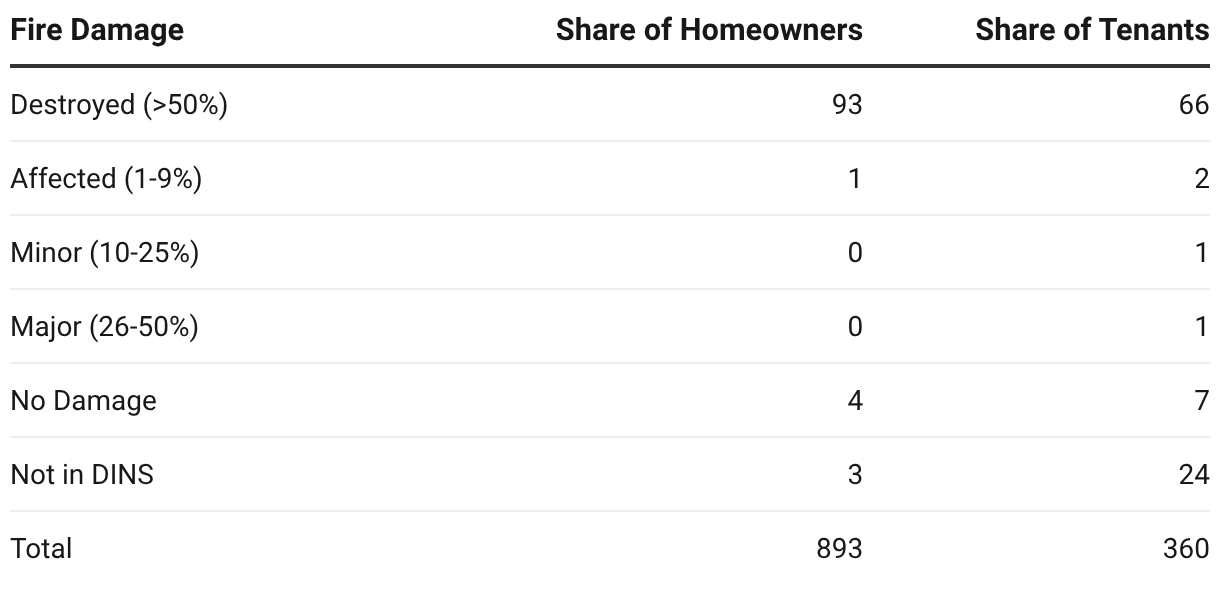
Source: Community Aid DENA, AFROPUNK, and WalkGood LA,“Displaced Black Families GoFundMe Directory,” Google Sheets, January 2025, available online; Latino Wildfire Aid, “Displaced Latine Families – Wildfire Mutual Aid Directory,” Google Sheets, January 2025, available online; SoCAl Filipinos, “Displaced Filipino Families GoFundMe Links,” Google Sheets, January 2025, available online; and California Department of Forestry and Fire Protection, CAL FIRE Damage Inspection Program (DINS) database, accessed September 16, 2025, available online.
Figure B-2. Extent of Eaton Fire Damage to GoFundMe Household Properties in Altadena, By Household Tenure
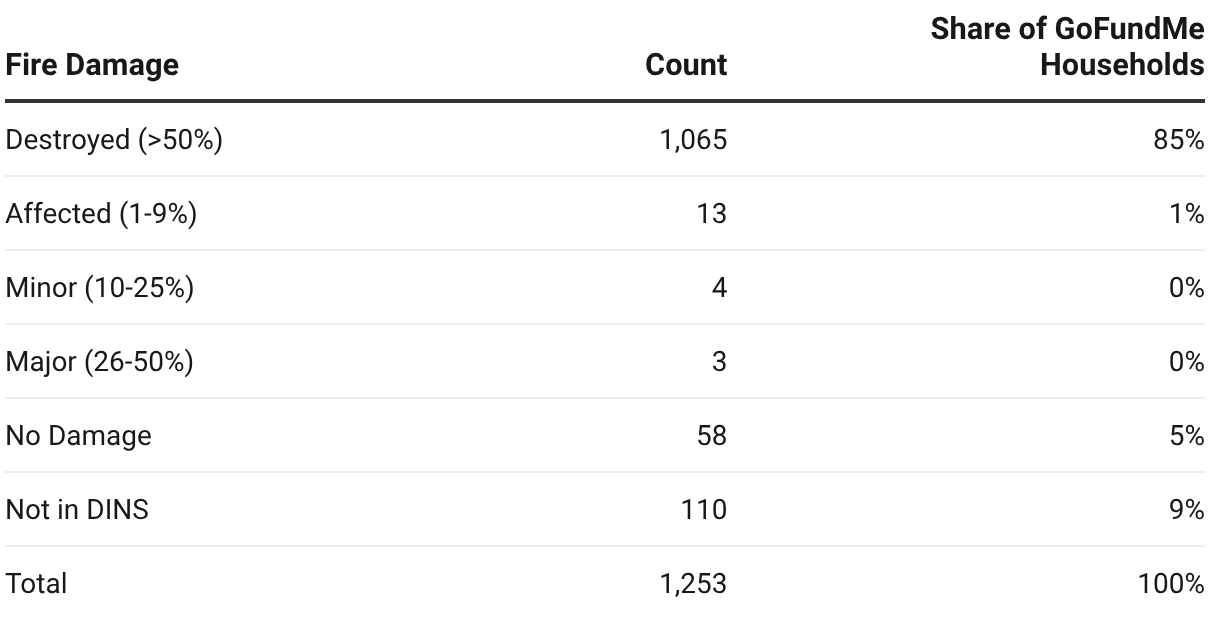
Source: Community Aid DENA, AFROPUNK, and WalkGood LA,“Displaced Black Families GoFundMe Directory,” Google Sheets, January 2025, available online; Latino Wildfire Aid, “Displaced Latine Families – Wildfire Mutual Aid Directory,” Google Sheets, January 2025, available online; SoCAl Filipinos, “Displaced Filipino Families GoFundMe Links,” Google Sheets, January 2025, available online; and California Department of Forestry and Fire Protection, CAL FIRE Damage Inspection Program (DINS) database, accessed September 16, 2025, available online.
APPENDIX C
Table C-1. Definitions and Counts for Group Themes and Parent Codes from 1,253 GoFundMe Campaign Narratives
| Group Theme | Definition of Group Theme | Parent Code | Definition of Parent Code | Prevalence in Campaigns (n) |
| Emergency Response & Immediate Harm | Captures the immediate dangers, losses, and disruptions households experienced during and directly after the Eaton Fire. | Alert or Evacuation System Failures | Narratives point to late, missing, confusing, or inadequate evacuation alerts and warnings that limited residents’ ability to leave safely or prepare. | 32 |
| Chaotic or Dangerous Evacuation | Narrative describes abrupt, dangerous, confusing, or emotionally intense evacuation experiences. | 56 | ||
| Evacuated with Few or No Belongings | Narrative describes that households evacuated quickly with little or no time to gather belongings or essential items. | 408 | ||
| Resident Efforts to Protect Property | Narrative describes that residents, neighbors, or civilians attempted to defend homes, protect property, or mitigate fire damage themselves. | 26 | ||
| Barriers to Neighborhood Access and Re-Entry | Narrative describes that limits, rules, or uncertainty around re-entering evacuation zones or disaster areas, affecting their ability to assess damage, retrieve belongings, or begin recovery. | 53 | ||
| Total Housing Loss and Immediate Displacement | Narrative describes that households experienced total loss of home or property and immediate displacement. | 704 | ||
| Fire-Related Death | Narrative describes that the fire caused or is associated with a death, fatal injury, or bereavement. | 11 | ||
| Housing Stability & Basic Needs | Captures the material and housing conditions households faced after displacement. | Basic Needs Recovery Support | Narrative describes that households seek support for immediate essentials after displacement, including food, clothing, toiletries, medications, supplies, and basic household replacement needs. | 388 |
| Displacement and Long-Term Housing Instability | Narrative describes that households face unstable, temporary, distant, unaffordable, or uncertain housing after the Eaton Fire and lack of a clear path to permanent housing. | 351 | ||
| Child-Centered Recovery Needs | Narrative describes recovery needs for children’s stability, safety, routines, belongings, care, and ability to regain a sense of normalcy after disaster-related loss or displacement. | 108 | ||
| Multigenerational Households Displacement | Narrative describes that displaced households rely on relatives or extended family for temporary shelter. | 159 | ||
| Temporary Housing with Relatives or Close Networks | Narrative describes that multiple relatives, generations, or linked family households are simultaneously displaced or affected by the fire. | 76 | ||
| Transportation Recovery Need | Narrative describes that the fire caused loss of, damage to, or need for a vehicle, creating transportation barriers in daily life. | 48 | ||
| Pet and Animal Care Gaps | Narrative describe that disaster displacement created unmet needs for pet or animal shelter and care, as well as housing-compatible accommodations. | 33 | ||
| Financial Recovery & System Navigation | Captures the financial and administrative barriers households encountered while seeking assistance and moving through recovery systems. | Insurance and Government Assistance Gaps and Delays | Narrative describes systemic delays and shortfalls in insurance payouts and government disaster assistance. | 88 |
| Gaps Between Formal Aid Eligibility and Actual Recovery Costs | Narrative describes that insurance, FEMA, SBA, or government relief is delayed, uncertain, difficult to access, or expected to fall short. | 42 | ||
| Disaster Attention Cycle and Long-Term Recovery Gap | Narratives worry that public attention, donations, or support will fade while recovery needs continue for months or years after the immediate crisis. | 161 | ||
| Administrative Burden in Disaster Recovery Access | Narrative suggests that survivors face burdensome paperwork, agency coordination, red tape, approvals, insurance processes, documentation demands, and procedural delays. | 66 | ||
| Income-Related Relief | Captures the effect of the Eaton Fire and displacement on households’ ability to earn income and maintain financial stability. | Disaster Impact on Small Business and Self-Employment | Narratives show that the fire disrupted small businesses, self-employment, tools, studios, client work, inventory, workspaces, or household income tied to entrepreneurship and independent work. | 112 |
| Disaster-Driven Income and Employment Loss | Narratives describe that households have loss income, work hours, jobs, clients, wages, or work capacity. | 35 | ||
| Pre-Disaster Financial & Emotional Precarity | Narrative suggests that households entered the Eaton Fire with existing financial vulnerability, unemployment, single-income dependence, or limited savings, which compounded disaster recovery challenges. | 81 | ||
| Mental Health Impact | Captures the emotional and psychosocial effects of the Eaton Fire, property loss, and displacement. | Disaster Mental Health and Psychosocial Recovery Needs | Narratives describe emotional distress, grief, shock, trauma, overwhelm, or psychosocial strain caused or intensified by the disaster and displacement. | 510 |
| Child Mental Health and Trauma Recovery Needs | Narratives describe that children experience trauma, fear, grief, stress, instability, or emotional disruption after the fire. | 59 | ||
| Vulnerability of Dependents | Captures recovery barriers affecting household members who rely on others for care, mobility, stability, or advocacy. | Child Educational Continuity and School Disruption | Narratives describe children’s schooling, routines, school communities, supplies, commutes, or educational stability are disrupted. | 59 |
| Elderly-Related Disaster Vulnerability and Recovery Inequity | Narratives describe that older adults are experiencing heightened recovery vulnerability because of age, fixed income, disability, health needs, mobility limitations, isolation, caregiving dependence, or difficulty navigating displacement and rebuilding. | 137 | ||
| Environmental Health Concerns | Captures post-fire health and habitability risks associated with smoke, ash, debris, and environmental contamination. | Smoke & Ash Contamination Remediation Gaps | Narratives describes that the home has been partially damaged and still requires significant smoke, ash, cleaning, remediation, replacement, or habitability support that makes it unlivable and unsafe. | 47 |
| Post-Fire Environmental Contamination and Public Health | Narrative describes failures in public health messaging to adequately communicate post-disaster contamination risks, leaving affected residents without sufficient information or guidance to protect their health. | 32 | ||
| Rebuilding Concerns | Captures households’ progress toward rebuilding and the barriers that shape whether rebuilding is feasible. | Rebuilding Progress & Delays | Narrative describes concrete progress or early action toward rebuilding, including debris removal, demolition, permitting, lot preparation, contractor engagement, site return, or breaking ground. | 57 |
| Rebuilding Cost Uncertainty | Narrative describes uncertainty about the total cost, timing, or affordability of rebuilding because of rising labor/material costs, unknown bids, or unclear insurance adequacy. | 11 | ||
| Community-Wide Impact | Captures losses that extend beyond an individual household to the broader neighborhood and local community. | Community Infrastructure Destruction & Local Economy Loss | Narrative describes that the fire destroyed or disrupted local businesses, schools, services, cultural/community assets, or economic infrastructure that residents rely on beyond their own homes. | 43 |
| Community-Scale Disaster Impact & Collective Recovery Needs | Narrative situates an individual household’s loss within neighborhood-wide devastation, collective grief, shared rebuilding needs, and concern for the broader Altadena/Pasadena community. | 285 | ||
| Crowdfunding and Donation Requests | Captures fundraising requests and solidarity in recovery. | Charitable Giving Request | Narratives request donations and gratitude for the support. | 954 |
| Community Resilience & Collective Recovery Identity | Narratives frame recovery as a collective process grounded in mutual aid and belief in the community’s ability to recover together. | 339 | ||
| Demographic Descriptors | Captures demographic descriptors of the community, household members, or GoFundMe author. | Community Identity & Place-Based Loss | Narratives emphasize emotional, cultural, historical, or identity-based attachment to place and the grief of losing a home, neighborhood, or community fabric. | 704 |
| Community Roots, Service, & Civic Contribution | Narratives establish affected households as long-standing residents, workers, educators, artists, volunteers, caregivers, or community leaders with deep ties and contributions to Altadena/Pasadena. | 492 | ||
| Identity of GoFundMe Writer | Narrative identifies the relationship or role of the person creating or managing the GoFundMe on behalf of the affected household, such as a family member, friend, coworker, neighbor, or community advocate. | 694 |
APPENDIX D
Table D-1. Cosine Similarity Across Recovery Themes Among All 1,253 GoFundMe Campaigns
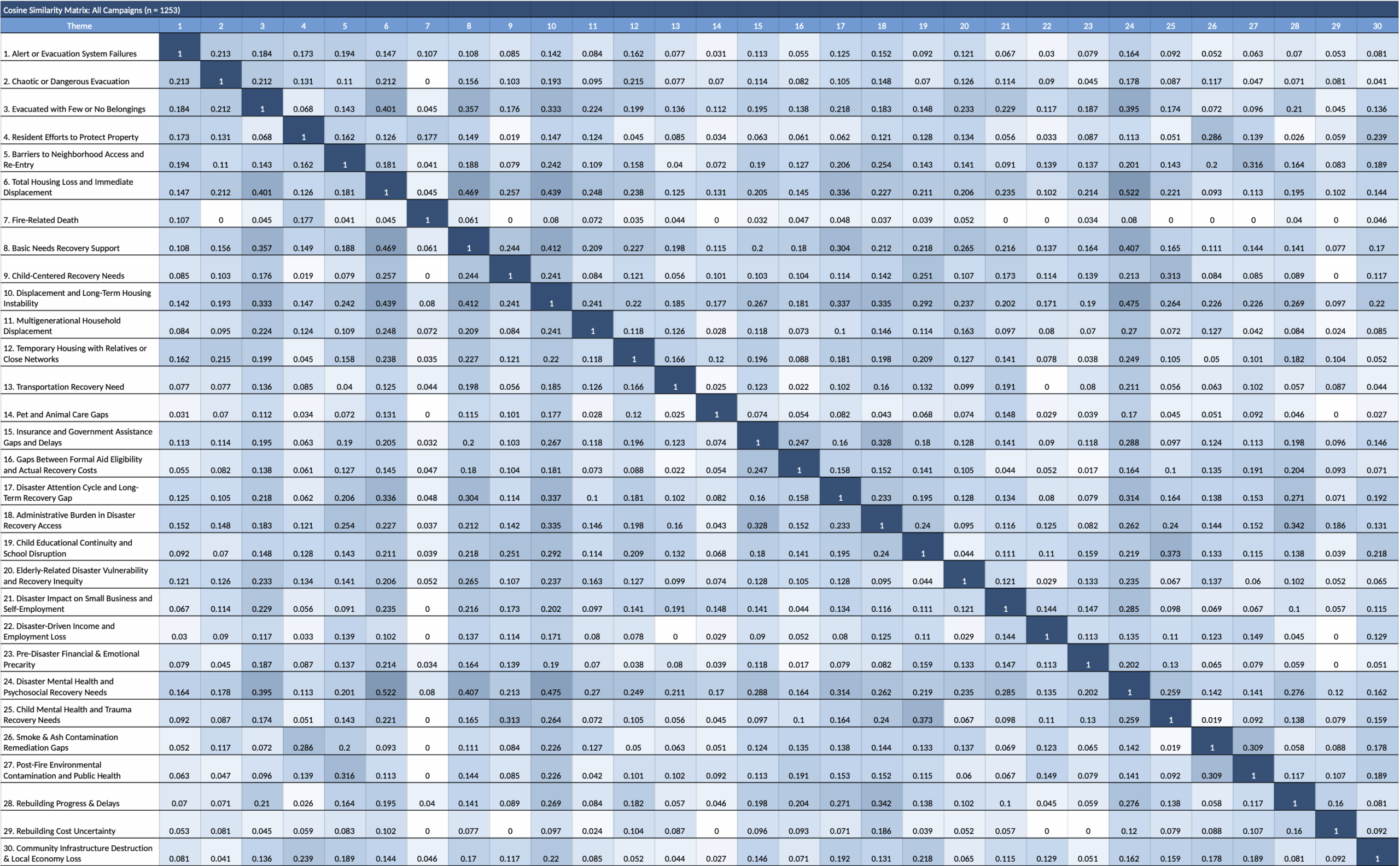
Note: Values report pairwise cosine similarity between recovery themes across all campaigns. Values closer to 1 indicate that two themes appeared among more similar sets of campaigns after accounting for how common each theme was. A value of 0 indicates no shared households. Diagonal values equal 1 because each theme is perfectly similar to itself. Cosine similarity does not indicate causation or the percentage of households experiencing both themes. The analysis excludes the following themes due to lack of policy relevance: Community Resilience & Collective Recovery Identity; Charitable Giving as Gap-Filler for Disaster Recovery Support; Community Identity & Place-Based Loss; Community Roots, Service, & Civic Contribution; Identity of GoFundMe Writer; Faith Sustaining Recovery; and Faith-Based & Informal Recovery Networks. Source: Authors’ analysis of household-level parent-code indicators from 1,253 verified GoFundMe campaign records identified through Community Aid DENA, AFROPUNK, and WalkGood LA’s “Displaced Black Families GoFundMe Directory;” Latino Wildfire Aid’s “Displaced Latine Families–Wildfire Mutual Aid Directory;” and SoCal Filipinos’ “Displaced Filipino Families GoFundMe Links,” January 2025.
Table D-2: Cosine Similarity Across Recovery Themes Among 360 Tenant Campaigns
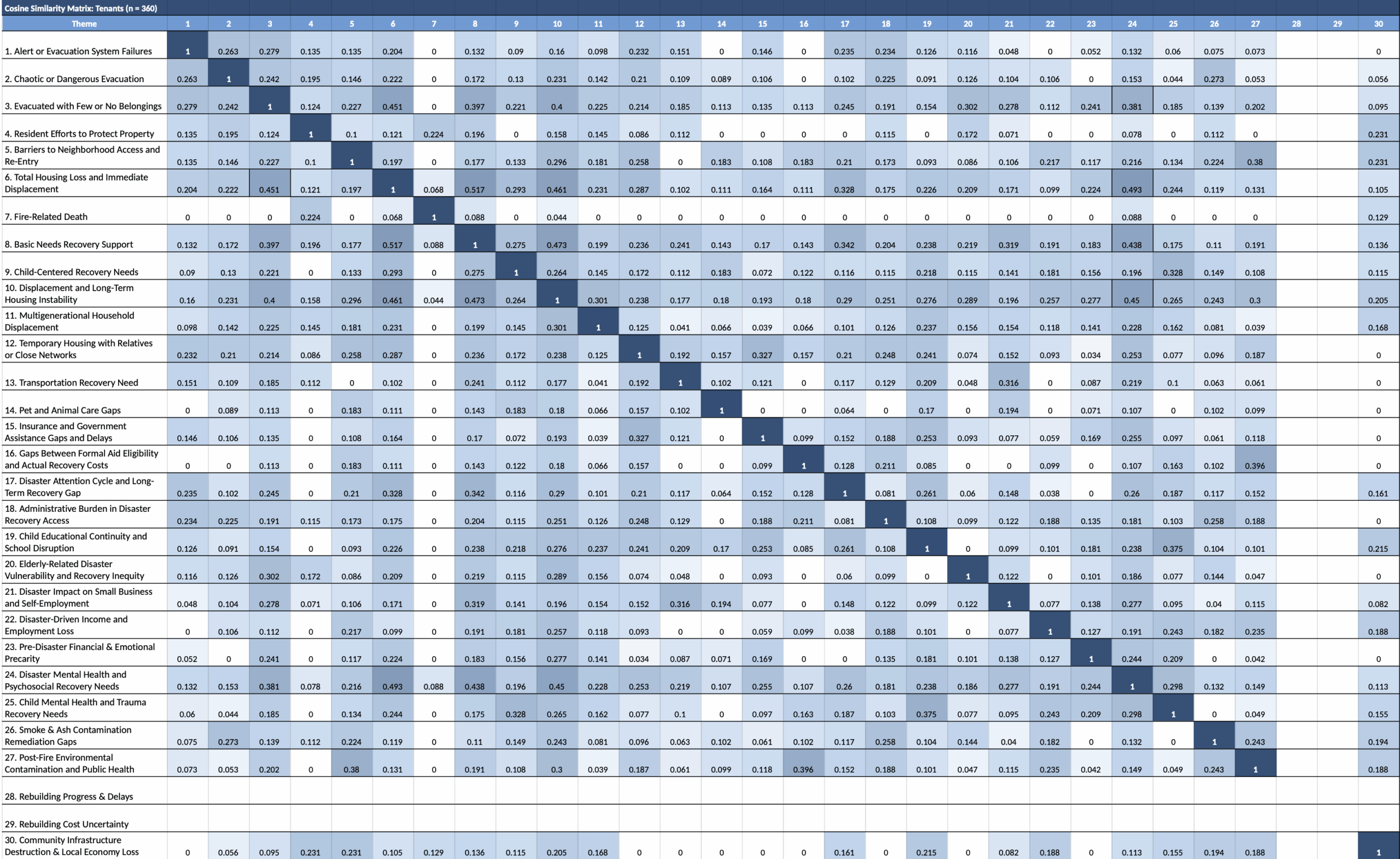
Note: Values report pairwise cosine similarity between recovery themes among tenant campaigns. Values closer to 1 indicate that two themes appeared among more similar sets of tenant campaigns after accounting for how common each theme was. A value of 0 indicates no shared households. Diagonal values equal 1 because each theme is perfectly similar to itself. Cosine similarity does not indicate causation or the percentage of households experiencing both themes. The analysis excludes the following themes due to lack of policy relevance: Community Resilience & Collective Recovery Identity; Charitable Giving as Gap-Filler for Disaster Recovery Support; Community Identity & Place-Based Loss; Community Roots, Service, & Civic Contribution; Identity of GoFundMe Writer; Faith Sustaining Recovery; and Faith-Based & Informal Recovery Networks. Tenants had no narrative codes for Rebuilding Progress & Delays or Rebuilding Cost Uncertainty, which is why those rows remain blank in the matrix. Source: Authors’ analysis of household-level parent-code indicators from 360 verified tenant GoFundMe campaign records identified through Community Aid DENA, AFROPUNK, and WalkGood LA’s “Displaced Black Families GoFundMe Directory;” Latino Wildfire Aid’s “Displaced Latine Families–Wildfire Mutual Aid Directory;” and SoCal Filipinos’ “Displaced Filipino Families GoFundMe Links,” January 2025.
Table D-3: Cosine Similarity Across Recovery Themes Among 893 Homeowner Campaigns
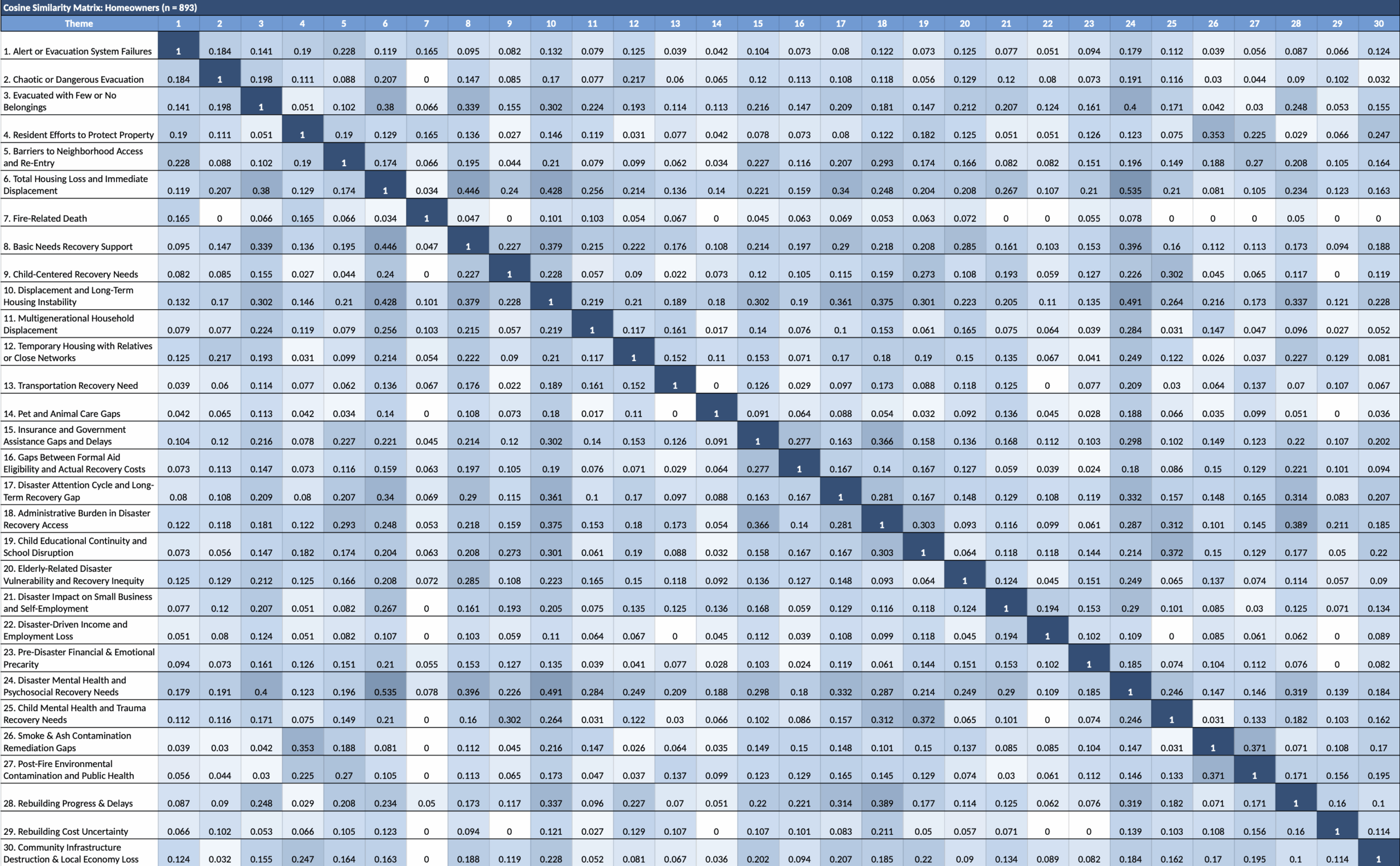
Note: Values report pairwise cosine similarity between recovery themes among homeowner campaigns. Values closer to 1 indicate that two themes appeared among more similar sets of homeowner campaigns after accounting for how common each theme was. A value of 0 indicates no shared households. Diagonal values equal 1 because each theme is perfectly similar to itself. Cosine similarity does not indicate causation or the percentage of households experiencing both themes. The analysis excludes the following themes due to lack of policy relevance: Community Resilience & Collective Recovery Identity; Charitable Giving as Gap-Filler for Disaster Recovery Support; Community Identity & Place-Based Loss; Community Roots, Service, & Civic Contribution; Identity of GoFundMe Writer; Faith Sustaining Recovery; and Faith-Based & Informal Recovery Networks. Source: Authors’ analysis of household-level parent-code indicators from 893 verified homeowner GoFundMe campaign records identified through Community Aid DENA, AFROPUNK, and WalkGood LA’s “Displaced Black Families GoFundMe Directory;” Latino Wildfire Aid’s “Displaced Latine Families–Wildfire Mutual Aid Directory;” and SoCal Filipinos’ “Displaced Filipino Families GoFundMe Links,” January 2025.
End Notes
1 Paul Ong, Chhandara Pech, Lorrie Frasure, Samyu Comandur, Eric Lee, and Silvia R. González, “LA Wildfires: Impacts on Altadena’s Black Community” (Ralph J. Bunche Center for African American Studies, University of California Los Angeles, Los Angeles, January 2025), available online.
2 Gabriella Carmona, Dr. Vinit Mukhija, Rodrigo Dominguez-Villegas, Mariah Bonilla, Sofia Barajas, Xalma M. Palomino, and Ana Guadalupe Lua Martel, Rebuilding for Whom? An Analysis of Tenant Demographics, the Rental Market, Affordability, and the Rebuilding Efforts in Altadena (Los Angeles: UCLA Latino Policy & Politics Institute, 2026), available online.
3 Paul M. Ong, Gabriella Carmona, Silvia Gonzalez, and Jonathan Ong, Underserved and Overlooked: Understanding Pre-Fire Economic Inequality Among Residents in Altadena, California (Los Angeles: UCLA Latino Policy & Politics Institute, 2025), available online.
4 Gabriella Carmona, Paul M. Ong, Xalma M. Palomino, Vinit Mukhija, and Rodrigo Dominguez-Villegas, Who’s Coming Home? An Analysis of the Property Sales, Permits, and Rebuilding Efforts of Single-Family Homeowners in Altadena, CA After the Eaton Fire (Los Angeles: UCLA Latino Policy & Politics Institute, 2025), available online.
5 Sofia Barajas, Gabriella Carmona, Paul M. Ong, and Dr. Vinit Mukhija, One Year Later, Who’s Coming Home? (Los Angeles: UCLA Latino Policy & Politics Institute, 2026), available online.
6 Gabriella Carmona, Dr. Vinit Mukhija, Rodrigo Dominguez-Villegas, Mariah Bonilla, Sofia Barajas, Xalma M. Palomino, and Ana Guadalupe Lua Martel, Rebuilding for Whom? An Analysis of Tenant Demographics, the Rental Market, Affordability, and the Rebuilding Efforts in Altadena.
7 Los Angeles County Department of Public Health, Los Angeles County Wildfire Needs Assessment Report (Los Angeles: Los Angeles County Department of Public Health, 2025), available online.
8 Amy Liu, Federal Post Disaster Recovery, A Review of Federal Programs (Washington, D.C.: What Works Collaborative, Urban Institute and Brookings Institution, 2010), available online.
9 Sayma Khajehei and Sara Hamideh, “Post-Disaster Recovery Challenges of Public Housing Residents: Lumberton, North Carolina After Hurricane Matthew,”Urban Affairs Review 60, no. 1 (2023): 232-271, available online; Marcy C. Comerio, “Housing Issues After Disasters,” Journal of Contingencies and Crisis Management 5, no. 3 (1997): 166-178, available online; United States Senate Committee on Homeland Security and Governmental Affairs, “Far From Home: Deficiencies in Federal Disaster Housing Assistance after Hurricanes Katrina and Rita and Recommendations for Improvement,” February 2009, available online.
10 Nicole Lambrou, Crystal Kolden, Anastasia Loukaitou-Sideris, and Xijing Li, “Housing and Economic Recovery as Interdependent Pathways in the Wake of Wildfires,” International Journal of Disaster Risk Reduction 130, (2025), available online; Nicole Lambrou, Crystal Kolden, and Anastasia Loukaitou-Sideris, “Disaster Recovery Gentrification in Post-Wildfire Landscapes: The Case of Paradise, CA,” International Journal of Disaster Risk Reduction 118, no. 15 (2025): 105235, available online.
11 Susan L. Cutter, Bryan J. Boruff, and W. Lynn Shirley, “Social Vulnerability to Environmental Hazards,” Social Science Quarterly 84, no. 2 (2003): 242-261, available online; Bob Bolin and Liza C. Kurtz, “Race, Class, Ethnicity, and Disaster Vulnerability,” Handbooks of Sociology and Social Science Research (2017): 181-203, available online.
12 Gabriella Carmona, Dr. Vinit Mukhija, Rodrigo Dominguez-Villegas, Mariah Bonilla, Sofia Barajas, Xalma M. Palomino, and Ana Guadalupe Lua Martel, Rebuilding for Whom? An Analysis of Tenant Demographics, the Rental Market, Affordability, and the Rebuilding Efforts in Altadena.
13 Ibid.
14 U.S. Government Accountability Office, Disaster Recovery: Actions Needed to Improve the Federal Approach (Washington, D.C.: U.S. Government Accountability Office, 2022), available online.
15 Richard D. Waters and Giselle A. Auger, “Crowded but Not Crowded Out: Comparing the Solicitation Strategies and Outcomes of Nonprofits’ and Individual’s GoFundMe Campaigns,” Journal of Philanthropy and Marketing 28, no. 4 (2022): e1766, available online.
16 Benjamin Sokis, Norms and Narratives That Shape US Charitable and Philanthropic Giving (Washington, D.C.: Urban Institute, 2021), available online.
17 Xupin Zhang, Hanjia Lyu, and Jiebo Luo, “What Contributes to a Crowdfunding Campaign’s Success? Evidence and Analysis from GoFundMe Data,” Journal of Social Computing 2, no. 2 (2021): 183-192, available online.
18 Ibid.
19 Cadence Luchsinger, Mark Igra, Nora Kenworthy, and Jin-Kyu Jung, “Crowdfunding as a Response to COVID-19: Increasing Inequities at a Time of Crisis,” Social Science and Medicine 282, (2021), available online.
20 Raj Chetty, Nathaniel Hendren, Maggie R. Jones, and Sonya R. Porter, “Race and Economic Opportunity in the United States: An Intergenerational Perspective,” The Quarterly Journal of Economics 135, no. 2 (2020): 711-783 available online.
21 Community Aid DENA, AFROPUNK, and WalkGood LA, “Displaced Black Families GoFundMe Directory,” Google Sheets, January 2025, available online.
22 Latino Wildfire Aid, “Displaced Latine Families – Wildfire Mutual Aid Directory,” Google Sheets, January 2025, available online.
23 SoCAl Filipinos, “Displaced Filipino Families GoFundMe Links,” Google Sheets, January 2025, available online.
24 Gabriella Carmona, Paul M. Ong, Xalma M. Palomino, Vinit Mukhija, and Rodrigo Dominguez-Villegas, Who’s Coming Home? An Analysis of the Property Sales, Permits, and Rebuilding Efforts of Single-Family Homeowners in Altadena, CA After the Eaton Fire.
25 Paul Ong, Chhandara Pech, Lorrie Frasure, Samyu Comandur, Eric Lee, and Silvia R. González, LA Wildfires: Impacts on Altadena’s Black Community Data Brief Examining the Impacts of the January 2025 Eaton Fire on Altadena’s Historic Black Community.
26 Teresa M. Paulus and Katherine R. Roberts, “Crowdfunding a “Real-life Superhero”: The Construction of Worthy Bodies in Medical Campaign Narratives’,” Discourse, Context & Media, Discourse, Context & Media 21, (2018): 64-72, available online.
27 PropertyShark, “Los Angeles County Property Data,” accessed October 2025, available online.
28 Note that in the report, five parent codes from two of the grouped themes, 1) Crowdfunding and Donation Requests and 2) Demographic Descriptors, are not used in our network analysis due to their lack of analytical power for our policy analysis. These codes and themes were much more descriptive in nature, with Crowdfunding and Donation Requests codes reflecting requests and gratitude for donations and Demographic Descriptors codes capturing statements about the community, household members, or GoFundMe organizers. For transparency, their definitions and prevalence within our household campaign analysis are included in Appendix C documentation.
29 Andreas Armborst, “Thematic Proximity in Content Analysis,” SAGE Open 7, no. 2, (2017), available online.
30 Yanru Jiang, She Lai, Lei Guo, Prakash Ishwar, Derry Wijaya, and Margrit Betke, “Exploring an Alternative Computational Approach for News Framing Analysis Through Community Detection in Framing Element Networks,” Journalism & Mass Communication Quarterly, (2025): 899-934, available online.
31 Jessica Halliday Hardie, Alina Arseniev-Koehler, Judith A Seltzer, and Jacob G Foster, “Talk of Family: How Institutional Overlap Shapes Family-Related Discourse Across Social Class,” RSF: The Russell Sage Foundation Journal of the Social Sciences 10, no. 5 (2024): 165-187, available online.
32 Mitchell Nicmanis and Harry Spurrier, “Getting Started with Artificial Intelligence Assisted Qualitative Analysis: An Introductory Guide to Qualitative Research Approaches with Exploratory Examples from Reflexive Content Analysis,” International Journal of Qualitative Methods 24, (2025), available online.
33 The lack of time to prepare was a shared feature of the emergency for homeowners and tenants. Evacuation with minimal belongings appeared in 32.4 percent of homeowner campaigns and 32.3 percent of tenant campaigns.
34 The Future Organization, ARISE Altadena Resident Impact Survey and Evaluation Report (Pasadena: The Future Organization LLC, 2025), available online.
35 McChrystal Group, After-Action Review of Alert Notification Systems and Evacuation Policies for the Eaton and Palisades Fires (Los Angeles: Los Angeles County Board of Supervisors, 2025), available online.
36 Ibid.
37 Eamon Z Heanoy and Norman R Brown, “Impact of Natural Disasters on Mental Health: Evidence and Implications,” Healthcare 12, no. 18 (2024): 1812, available online.
38 Ibid.
39 The National Child Traumatic Stress Network, “Wildfire Resources,” accessed July 16, 2026, available online.
40 Georgina Parker, David lie, Dan J. Siskind, Melinda Martin-Khan, Beverly Raphael, David Crompton, and Steve Kisely, “Mental Health Implications for Older Adults After Natural Disasters – A Systematic Review and Meta Analysis,” Internal Psychogeriatrics 28, no. 1 (2016): 11-20, available online.
41 Ibid.
42 A multiyear study tracking disaster-displaced households after Hurricane Katrina from 2006 through 2018 found that the path to stable housing varied significantly by tenure, family composition, and access to social support. Tenant households took an average of 1,174 days to reach stable housing, nearly one year longer than homeowners, who took an average of 808 days. Households with children also experienced longer periods of instability, averaging 1,174 days before reaching stable housing compared with 1,051 days among households without children. Social support further shaped recovery; households with stronger support networks stabilized in an average of 1,021 days, compared with 1,235 days among households with weaker support systems. Together, these findings show that tenants, families with children, and households without reliable support networks are more likely to remain displaced for extended periods after a major disaster. For more details see, Alexis A. Merdjanoff, David M. Abramson, Yoon Soon Park, and Rachael Plitch-Loeb, “Disasters, Displacement, and Housing Instability: Estimating Time to Stable Housing 13 Years after Hurricane Katrina,” Wea Climate Soc 14, no.2 (2022): 535-550, available online.
43 Altadena Tenants Union, “Solutions,” accessed July 16, 2026, available online