18 months Later, Who’s Coming Home? Four Facts About Single-Family Homeowner Recovery in Altadena
Introduction
This factsheet updates our seven-month data brief Who’s Coming Home?, and our one-year update One Year Later, Who’s Coming Home?, tracking how Altadena single-family homeowners with severe fire damage—defined as homes where 50% or more of the structure was destroyed by the fire—are recovering 18 months after the January 2025 Eaton Fire. The initial analysis combined property sales records, building permit applications, and fire damage assessments to track whether homeowners were selling, rebuilding, or remaining undecided about their future in Altadena.
Because public data do not include self-reported race and ethnicity of property owners, we use a probabilistic method (Bayesian Improved Surname Geocoding, or BISG) to estimate these characteristics. As a result, findings by race and ethnicity should be interpreted as ranges rather than exact counts. We report average estimates alongside confidence intervals to reflect variation in estimates across 1,000 probabilistic race assignments. For a more detailed explanation of this approach, please refer to the methodology section in the Who’s Coming Home? brief.
Using the same data sources and methodology, this factsheet updates those indicators as of August 13, 2026, offering four key findings on how recovery decisions among owners of severely fire-damaged homes have evolved during the 18 months since the fire.
Key Findings
Fact 1: Rebuilding activity has continued to grow 18 months after the Eaton Fire, with Latino homeowners remaining the furthest along and Black homeowners making substantial gains in rebuilding.
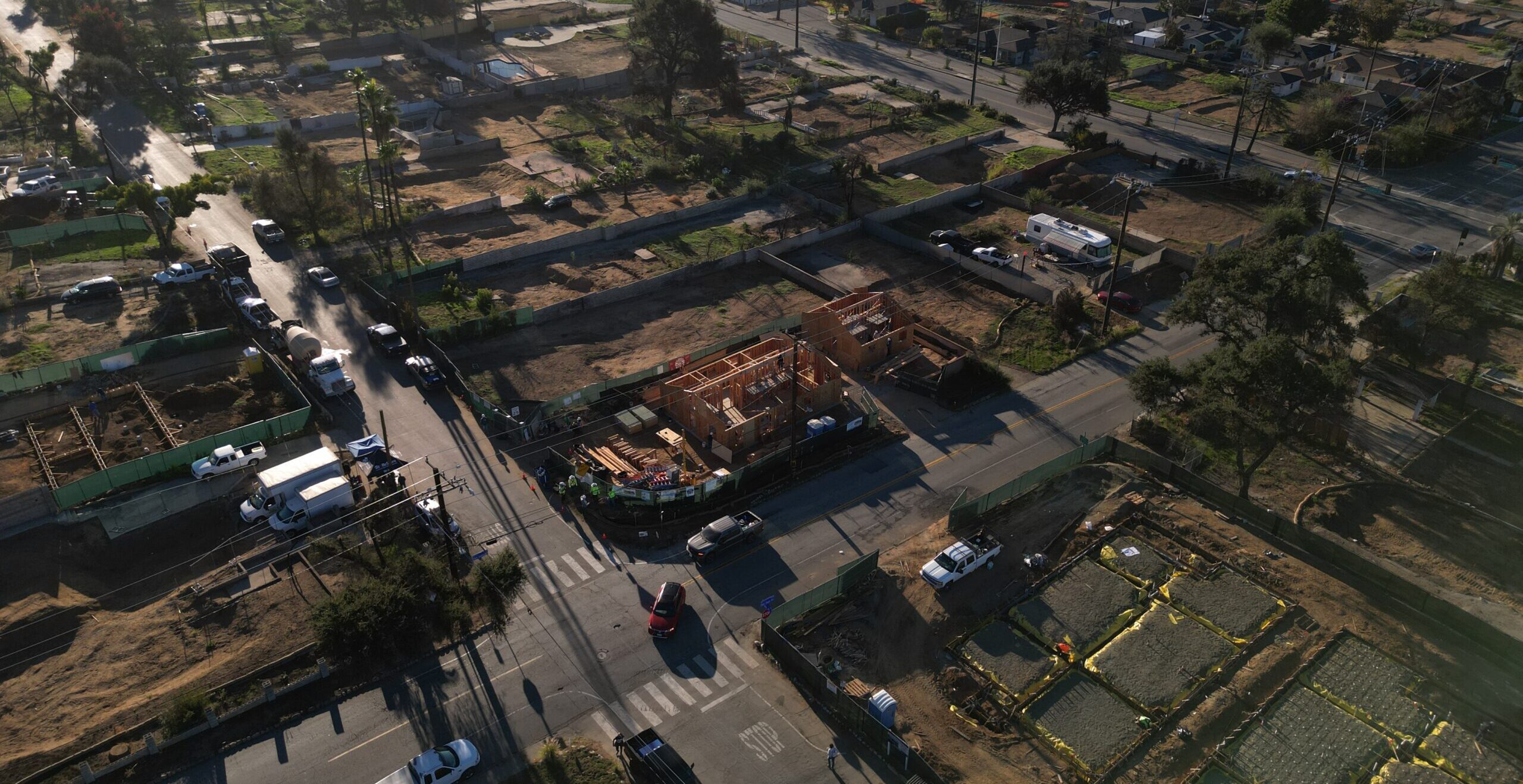
As of August 2026, 57% of owners of severely fire-damaged homes at the time of the fire were in the rebuilding permit pathway, up from 48% one year after the fire and from about 23% seven months after the fire (Figure 1). The growth in permitting shows that more homeowners have moved from the uncertainty that characterized the first months of recovery toward taking a publicly observable step to rebuild.
Rebuilding activity increased across all racial and ethnic groups, although the pace of recovery varied. Latino homeowners remain the most likely to be moving through the rebuilding process, with 67% with active permit applications by August 2026 (Figure 1). The early recovery period raised particular concerns about whether Black homeowners would be able to overcome the disproportionate damage they experienced and move toward rebuilding. However, Black homeowners have experienced one of the most notable increases in rebuilding activity as of the time of our analysis. Seven months after the fire, only 22% had entered the permitting process; by August 2026, 60% were in the permit pathway, an increase of roughly 38 percentage points (Figure 1). Asian homeowners also continued to make progress, reaching 59% in the permitting process by August 2026, one of the largest increases (11 percentage points) from February 2026 to August 2026 (Figure 2). In comparison, about 53% of white homeowners were in the permit pathway and LLC-owned properties remained the least likely to move toward rebuilding, with 39% with submitted permit applications as of August 2026 (Figure 1).
Figure 1: Share of Homeowners of Severely Fire-Damaged Altadena Homes Who Filed Rebuild Permit Applications by Race, Ethnicity, and LLC Ownership, August 2025, February 2026, August 2026
As of August 2025
As of February 2026
As of August 2026
Note: Homeowners identified as “Other” race are not displayed as a separate category in the figure; however, they are included in the totals for all homeowners.
Source: UCLA LPPI analysis of California Department of Forestry and Fire Protection, CAL FIRE Damage Inspection Program (DINS) database, accessed September 28, 2025, available online; and Los Angeles County Department of Public Works, EPIC-LA Case History Data, February 2025–August 13, 2026, accessed August 13, 2026, available online.
Figure 2. Percentage Point Difference of Homeowners of Severely Fire-Damaged Altadena Homes Who Filed Rebuild Permit Applications by Race, Ethnicity, and LLC Ownership, August 2025, February 2026, August 2026
Note: Homeowners identified as “Other” race are not displayed as a separate category in the figure; however, they are included in the totals for all homeowners. Source: UCLA LPPI analysis of California Department of Forestry and Fire Protection, CAL FIRE Damage Inspection Program (DINS) database, accessed September 28, 2025, available online; and Los Angeles County Department of Public Works, EPIC-LA Case History Data, February 2025–August 13, 2026, accessed August 13, 2026, available online.
Fact 2: Property sales of severely fire-damaged homes have increased but remain a minority pathway in recovery. White homeowners and LLC-owned homes continue to show a modestly higher rate of sales than Black and Latino homeowners.
As of August 2026, 10% of pre-fire homeowners with severely fire-damaged single-family homes had sold their properties—more than double the share sold seven months after the Eaton Fire—suggesting that, despite the increase in sales over time, most pre-fire homeowners have not chosen to sell their property and leave Altadena (Figure 3).
Sales remain relatively uncommon across every group, yet white homeowners now show a modest but discernibly higher rate of sale than Black and Latino homeowners. As of August 2026, 11% of white-owned properties sold, compared with 8% of Asian-owned and 7% of both Black- and Latino-owned properties (Figure 3). LLC-owned properties continue to sell at higher rates than properties owned by individuals, with 14% sold as of August 2026 (Figure 3). This gap has narrowed as sales among individually owned properties have increased, while sales among LLC-owned properties have grown at a slower rate in the later stages of recovery.
Figure 3: Share of Homeowners of Severely Fire-Damaged Altadena Homes Who Sold or Put Their Homes up for Sale by Race, Ethnicity, and LLC Ownership, August 2025, February 2026, August 2026
SOLD
As of August 2025
As of February 2026
As of August 2026
UP FOR SALE
As of August 2025
As of February 2026
As of August 2026
Note: Homeowners identified as “Other” race are not displayed as a separate category in the figure; however, they are included in the totals for all homeowners.
Source: UCLA LPPI analysis of California Department of Forestry and Fire Protection, CAL FIRE Damage Inspection Program (DINS) database, accessed September 16, 2025, available online; PropertyShark Property Reports; Los Angeles County Office of the Assessor, “Assessor Historical Parcel Data File”; and Redfin, “Altadena, CA Homes for Sale and Real Estate,” available online.
Most of the property sales by the pre-fire owners occurred relatively soon after the fire, for single-family homes with severe fire damage. Nearly half of all properties that had changed hands by the 18-month mark (225 of 475, or 47%) were sold by their pre-fire owners within the first seven months after the fire (Figure 4). Over the last 18 months, home sales peaked in April 2025, when 63 properties changed ownership, and have since decreased but fluctuated between 42 and 5 sales in a given month (Figure 4). Although additional pre-fire homeowners continued to sell their properties throughout the following year, the pace of first-time post-fire property turnover generally remained below the levels seen during the earliest months of recovery.
Among the properties that were sold, investors accounted for a substantial share of purchases across seller groups. Pre-fire sellers varied by race, ethnicity, and ownership structure (Appendix Figure B).
At the same time, the prospect of future sales has slowed or remained the same across all homeowner groups. At the seven-month mark, 2% of severely fire-damaged homes were actively listed for sale (Figure 3). A year after the fire, only about 1% of these homes were up for sale (Figure 3). Listing activity also showed no statistically significant differences across racial and ethnic homeowner groups. Taken together, these patterns suggest that while some homeowners sold their properties—particularly in the months immediately following the fire—the initial pressure to sell appears to have eased, with many remaining homeowners choosing to hold their properties as rebuilding decisions unfold.
Figure 4: First Sales of Severely Fire-Damaged Altadena Homes by Pre-Fire Owners by Month, February 2025 to August 2026
Note: There were 359 total sales from February 2025 through January 2026.
Source: UCLA LPPI analysis of PropertyShark Property Reports; Los Angeles County Office of the Assessor, “Assessor Historical Parcel Data File”; Redfin, “Altadena, CA homes for sale & real estate,” available online; Biz Profile, “Online Directory of registered business entities in the United States,” accessed August 13, 2026, available online; and California Secretary of State, “Business Search,” accessed August 13, 2026, available online.
Fact 3: Investors remain a majority of buyers of severely fire-damaged homes 18 months after the Eaton Fire, but their share has fallen from the seven-month and one-year benchmarks.
Among the severely fire-damaged properties that changed hands from their pre-fire owners, investors have remained a major presence in the post-fire housing market. In this analysis, we define investors as buyers registered as LLCs, corporations, or individuals associated with real estate investment activity, as well as buyers operating multiple LLCs under the same ownership or address, suggesting an umbrella investment structure (see Who’s Coming Home? for methodology details). During the first seven months after the fire, investors purchased about two-thirds of the 225 severely damaged single-family homes sold by pre-fire owners, or 145 homes (Figure 5). At the one-year mark, investors accounted for 58 percent of the 369 properties that had sold, or 211 homes. By the 18-month mark, investors had purchased 271 of the 475 properties that had changed hands, or 57 percent. Although investors remain the majority of buyers, their share has gradually declined as non-investor buyers have made up a larger share of post-fire purchases as of August 2026.
White-owned homes continue to account for the largest share of properties purchased by investors. As of August 2026, an estimated 58% of investor acquisitions had previously been owned by white homeowners, a share that has remained relatively consistent across the recovery period (Figure 6). This pattern partly reflects the larger number of white-owned homes in the severely damaged housing stock, as well as the somewhat higher overall sale rate among white homeowners. Importantly, however, among properties that were sold, investors purchased a similar majority across racial and ethnic groups: approximately 56% of sales by white homeowners, 57% of sales by Black homeowners, 58% of sales by Latino homeowners, and 59% of sales by Asian homeowners (Appendix Figure A). This suggests that investor activity is not concentrated only among one racial or ethnic group of sellers; rather, investors have remained a common buyer whenever severely damaged properties have entered the market.
Figure 5: Number of Altadena Homes with Severe Fire Damage Purchased by Investors and Non-Investors, August 2025, February 2026, August 2026
As of August 2025
As of February 2026
As of August 2026
Source: UCLA LPPI analysis of PropertyShark Property Reports; Los Angeles County Office of the Assessor, “Assessor Historical Parcel Data File”; Biz Profile, “Online Directory of Registered Business Entities in the United States,” accessed August 2025, available online; and California Secretary of State, “Business Search,” accessed August 13, 2026, available online.
Figure 6: Share of Altadena Homes with Severe Fire Damage Purchased by Investors, by Race, Ethnicity, and LLC Ownership, August 2026
Note: Homeowners identified as “Other” race are not displayed as a separate category in the figure; however, they are included in the totals for all homeowners.
Source: UCLA LPPI analysis of PropertyShark Property Reports; Los Angeles County Office of the Assessor, “Assessor Historical Parcel Data File”; Redfin, “Altadena, CA homes for sale & real estate,” available online; Biz Profile, “Online Directory of registered business entities in the United States,” accessed August 13, 2026, available online; and California Secretary of State, “Business Search,” accessed August 13, 2026, available online.
Fact 4: The holding pattern has shrunk dramatically—especially among Latino and Black homeowners—but one-third of severely damaged properties still show no public recovery action 18 months after the Eaton Fire.
Rates of “no visible recovery action”—defined as homes that had not been sold, listed for sale, or filed for a rebuilding permit—declined from the seven-month mark to the 18-month mark of recovery. Seven months after the fire, about 70% of severely fire-damaged homes showed no observable recovery activity (Figure 7). At the one-year mark, that share had fallen to 44 percent (Figure 7). By 18 months, it had fallen further to 33 percent, a 37 percentage point decline from the seven-month mark (Figure 7). This indicates that more homeowners have moved from an observable holding pattern into a documented recovery pathway, most commonly through permitting.
The decline was particularly pronounced among Black and Latino homeowners. At seven months, about 73% of Black homeowners had taken no visible recovery action; by 12 months, that share had fallen to 44 percent; by 18 months, the share fell further to 32 percent, representing the largest decline among all homeowner groups observed (Figure 7). Latino homeowners saw a similar shift, with the share showing no visible recovery activity, falling 40 percentage points from seven months to 18 months post-fire (65% to 25%) (Figure 7). As of the 18-month mark, Latino homeowners were the least likely to have not taken any public action in recovery.
In contrast, LLC-owned properties showed the smallest change in recovery activity over the time periods observed. Seven months after the fire, about 65% of LLC-owned homes had taken no visible action; 12 months after the fire, that share had declined only slightly to 55%; and 18 months after the fire, the share declined to 45%, which was a total drop of only 20 percentage points since the 7-month mark (Figure 7).
Figure 7: Share of Homeowners with Severely Fire-Damaged Altadena Homes that Have Taken No Observable Action by Race, Ethnicity, and LLC Ownership, August 2025, February 2026, August 2026
As of August 2025
As of February 2026
As of August 2026
Note: Homeowners identified as “Other” race are not displayed as a separate category in the figure; however, they are included in the totals for all homeowners.
Source: UCLA LPPI analysis of California Department of Forestry and Fire Protection, CAL FIRE Damage Inspection Program (DINS) database, accessed September 16, 2025, available online; PropertyShark Property Reports; Los Angeles County Office of the Assessor, “Assessor Historical Parcel Data File”; Redfin, “Altadena, CA Homes for Sale and Real Estate,” available online; and Los Angeles County Department of Public Works, EPIC-LA Case History Data, February 2025–August 13, 2026, accessed August 13, 2026, available online.
Conclusion
Eighteen months after the Eaton Fire, recovery in Altadena has clearly shifted from an early period of uncertainty toward more active rebuilding. Most pre-fire homeowners with severely damaged homes have not sold, and rebuilding has become the dominant observable recovery pathway, with particularly substantial gains among Black and Latino homeowners. At the same time, one-third of severely damaged properties still show no public recovery activity, underscoring that recovery remains incomplete. Investor purchases also continue to account for most post-fire sales, even as their share has gradually declined. Taken together, these trends suggest that Altadena’s recovery is progressing, but unevenly and at different speeds—and the decisions made in the coming months will continue to shape who is able to return and what the community’s post-fire housing landscape looks like.
Eighteen months after the Eaton Fire, recovery in Altadena has clearly shifted from an early period of uncertainty toward more active rebuilding. Most pre-fire homeowners with severely damaged homes have not sold, and rebuilding has become the dominant observable recovery pathway, with particularly substantial gains among Black and Latino homeowners. At the same time, one-third of severely damaged properties still show no public recovery activity, underscoring that recovery remains incomplete. Investor purchases also continue to account for most post-fire sales, even as their share has gradually declined. Taken together, these trends suggest that Altadena’s recovery is progressing, but unevenly and at different speeds—and the decisions made in the coming months will continue to shape who is able to return and what the community’s post-fire housing landscape looks like.
Appendix
Figure A: Count and Share of Severely Fire-Damaged Altadena Homes Sold by Race, Ethnicity, and LLC Ownership, August 13, 2026
Count
Share
Source: UCLA LPPI analysis of PropertyShark Property Reports accessed August 13, 2026; Los Angeles County Office of the Assessor, “Assessor Historical Parcel Data File,” accessed August 13, 2026.
Figure B: Share of Altadena Homes with Severe Fire Damage Purchased by Investors and Non-Investors by Seller Race, Ethnicity, and LLC Ownership, August 2025, February 2026, August 2026
As of August 2025
As of February 2026
As of August 2026
Source: UCLA LPPI analysis of PropertyShark Property Reports accessed August 13, 2026; Los Angeles County Office of the Assessor, “Assessor Historical Parcel Data File,” accessed August 13, 2026.
Acknowledgments
This factsheet was made possible with the generous support of the Conrad N. Hilton Foundation. International hotelier Conrad N. Hilton established the grantmaking foundation that bears his name in 1944 to help people living in poverty and experiencing disadvantage worldwide. More than eighty years later, the work continues, concentrating on efforts to ensure healthy early childhood development and sustainable livelihoods for youth and refugee populations, support young people transitioning out of foster care, improve access to housing and support services for people experiencing homelessness, identify solutions to safe water access, and lift the work of Catholic sisters. Additionally, following selection by an independent, international jury, the Foundation annually awards the $3 million Conrad N. Hilton Humanitarian Prize to an organization doing extraordinary work to reduce human suffering. The Foundation is one of the world’s largest, with approximately $7.3 billion in assets. It has awarded grants to date totaling more than $3.6 billion worldwide, and nearly $300 million in 2024. Please visit www.hiltonfoundation.org for more information.
The UCLA Latino Policy and Politics Institute acknowledges the Gabrielino and Tongva peoples as the traditional land caretakers of Tovaangar (the Los Angeles basin and Southern Channel Islands) and that their displacement has enabled UCLA’s flourishing. As a land grant institution, we pay our respects to the Honuukvetam (Ancestors), Ahiihirom (Elders), and Eyoohiinken (our relatives nations) past, present, and emerging.
Disclaimer
The views expressed herein are those of the authors and not necessarily those of the University of California, Los Angeles as a whole. The authors alone are responsible for the content of this factsheet.