








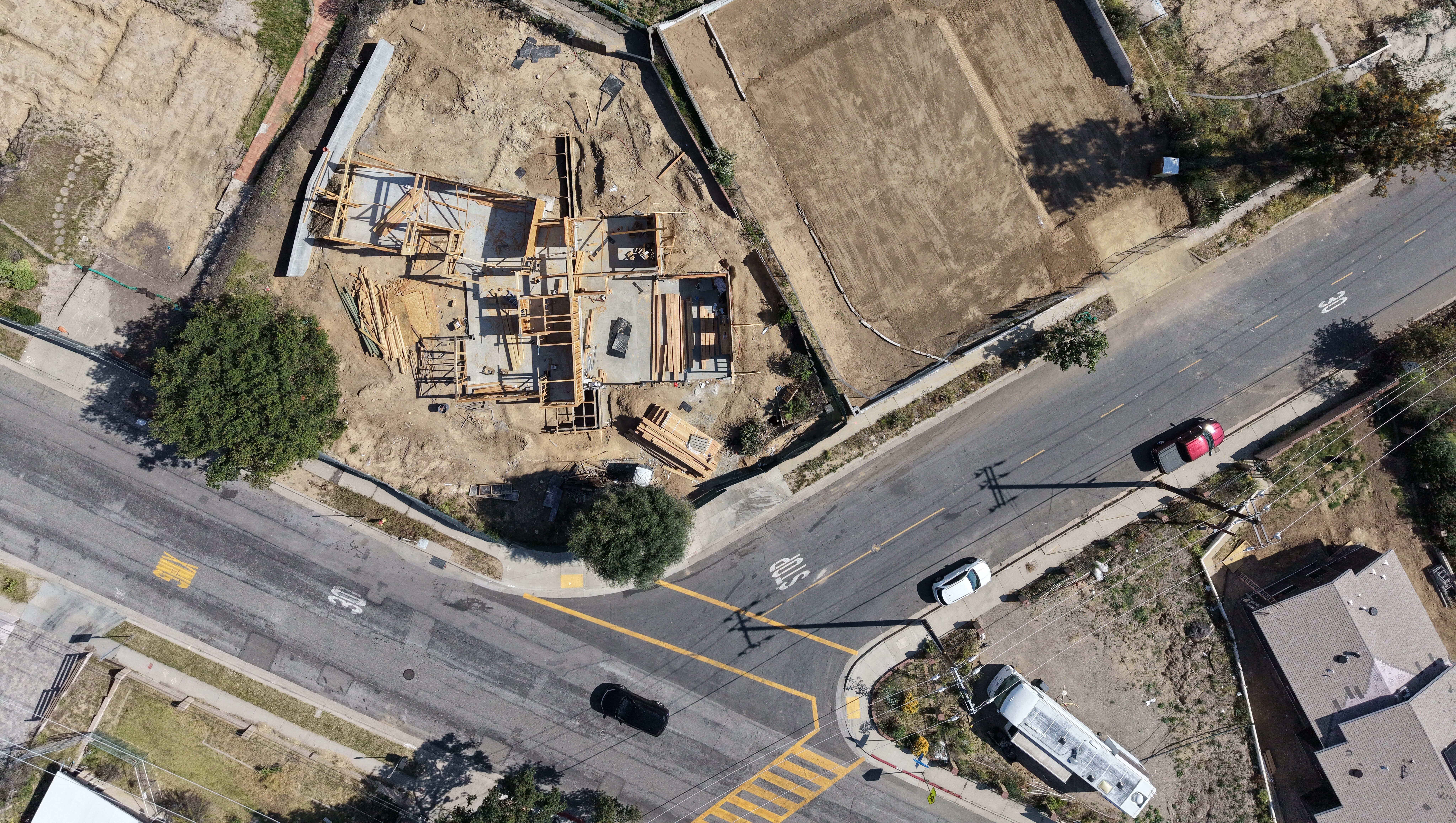
One Year Later, Who’s Coming Home?
Introduction
This factsheet provides a one-year update to our data brief Who’s Coming Home?, which examined how Altadena single-family homeowners with severe fire damage (defined as homes where 50% or more of the structure was destroyed by the fire) were recovering in the first seven months after the January 2025 Eaton Fire. That earlier analysis combined property sales records, building permit applications, and fire damage assessments to track whether homeowners were selling, rebuilding, or remaining undecided about their future in the community.
Because public data do not include self-reported race and ethnicity for property owners, we use a probabilistic method (Bayesian Improved Surname Geocoding, or BISG) to estimate these characteristics. As a result, findings by race and ethnicity should be interpreted as ranges rather than exact counts. We report average estimates alongside confidence intervals to reflect this uncertainty. For a more detailed explanation of this approach, please refer to the methodology section in the Who’s Coming Home? brief.
Using the same data sources and methodology, this factsheet updates those indicators through February 2026, offering four facts on how recovery decisions among owners of severely fire-damaged homes have evolved during the first year after the fire.
Key Findings
Fact 1: Rebuilding activity is accelerating. Permit applications to rebuild have doubled since the seven-month mark, with the largest increases among Black and Latino single-family homeowners in severely fire-damaged homes.
Between seven months and 12 months after the Eaton Fire, rebuilding activity accelerated substantially among single-family homes with severe fire damage, which is defined as homes where 50% or more of the structure was destroyed by the fire. Seven months after the fire, about 23% of these homeowners had applied for rebuilding permits using the County Disaster Recovery Permit application. By the one-year mark, that share had more than doubled to 48% (Figure 1).
Rebuilding activity increased across all groups, but the data suggest that the largest gains occurred among Black and Latino homeowners. Seven months after the fire, about 22% of Black homeowners had filed a rebuilding permit application; by the one-year mark, that share had increased to about 50%. Latino homeowners filed applications at the highest rates of any racial or ethnic group, with about 57% having submitted permit applications 12 months after the fire—an increase of about 27 percentage points since the seven-month mark. Differences between Black and Asian homeowners were not statistically significant at the seven-month or the one-year marks. Homes that were owned by limited liability companies (LLCs) prior to the fire were slower to move toward rebuilding. Twelve months after the fire, only about 30% of LLC-owned homes had filed permit applications.
Figure 1: Share of Homeowners of Severely Fire-Damaged Altadena Homes Who Filed Rebuild Permit Applications by Race, Ethnicity, and LLC Ownership, August 2025 versus February 2026
As of August 2025
As of February 2026
Note: Homeowners identified as “Other” race are not displayed as a separate category in the figure; however, they are included in the totals for all homeowners.
Source: UCLA LPPI analysis of California Department of Forestry and Fire Protection, CAL FIRE Damage Inspection Program (DINS) database, accessed September 28, 2025, available online; and Los Angeles County Department of Public Works, EPIC-LA Case History Data, February 2025–February 2026, accessed March 18, 2026, available online.
Most homeowners who have filed permit applications have progressed through the early stages of the rebuilding process, but fewer have transitioned into active construction. Among homes in the permitting process, 91% have cleared zoning, the first stage in which projects are reviewed by the county’s Planning Department for land use and code compliance (Figure 2). Progress slows at the building plan review stage, when permit applications are routed to Building and Safety and require submission of detailed architectural and engineering plans. About 41% of homeowners had their building plans received, and 54% had their building plans approved, indicating they had cleared Building and Safety review. Following this step, plans are reviewed by Public Health and Fire, after which permits are issued. As of February 2026, 44% had permits issued, making these homeowners eligible to begin rebuilding. This marks progress from earlier in the recovery. In our Who’s Coming Home? brief we found that as of August 2025, although 54% of permit applications had cleared zoning, a substantial share remained on hold due to missing building plans.
Despite this progress, only 30% of homeowners who filed permit applications had actually started construction as of February 2026, suggesting delays in securing the financing and contractors to move from approval to action. In our analysis, we found no meaningful differences across racial and ethnic groups in permit progression at this stage; therefore, results are presented only for all homeowners of severely fire-damaged homes with permits filed.
Figure 2: Share of Homeowners of Severely Fire-Damaged Altadena Homes Who Filed Rebuild Permit Applications, By Permit Progress, February 2026
Note: Estimates are based on 2,369 permit applications filed for single-family homes with severe fire damage. A homeowner may have multiple reconstruction permits; therefore, statuses reflect the progress of any permit submitted. Because permits can meet multiple thresholds, percentages do not sum to 100 across categories.
Source: UCLA LPPI analysis of California Department of Forestry and Fire Protection, CAL FIRE Damage Inspection Program (DINS) database, accessed September 28, 2025, available online; and Los Angeles County Department of Public Works, EPIC-LA Case History Data, February 2025–February 2026, accessed March 18, 2026, available online.
Fact 2: Sales of severely fire-damaged homes have increased 12 months after the fire, but properties up for sale have declined. Sale patterns show no statistically significant differences across homeowner groups, suggesting that no group is exiting the market at disproportionate rates.
In the first year after the fire, sales among severely damaged single-family homes rose modestly. Seven months after the fire, homeowners had sold about 5% of these homes. By the one-year mark, that share had increased to 7% (Figure 3).
Sales patterns reveal no notable racial or ethnic differences in which homeowners sold or listed their properties during the first year after the fire (Figure 3). While white homeowners accounted for the largest share of properties sold—about 58% of total sales—this mostly reflects their larger homeowner share in Altadena rather than a greater likelihood of selling (Appendix Figure A). In other words, the share of homes sold within each racial and ethnic group did not differ significantly, indicating that no group of homeowners sold a disproportionately larger share of their fire-damaged properties over the past year.
Sales were most common among LLC-owned homes. Seven months after the fire, about 10% of LLC-owned homes had been sold, compared with substantially lower rates among other homeowner groups. By the one-year mark, the share of LLC-owned homes sold had increased to 13%.
Figure 3: Share of Homeowners of Severely Fire-Damaged Altadena Homes Who Sold or Put their Homes up for Sale by Race, Ethnicity, and LLC Ownership, August 2025 versus February 2026
SOLD
As of August 2025
As of February 2026
UP FOR SALE
As of August 2025
As of February 2026
Note: Homeowners identified as “Other” race are not displayed as a separate category in the figure; however, they are included in the totals for all homeowners.
Source: UCLA LPPI analysis of California Department of Forestry and Fire Protection, CAL FIRE Damage Inspection Program (DINS) database, accessed September 16, 2025, available online; PropertyShark Property Reports; Los Angeles County Office of the Assessor, “Assessor Historical Parcel Data File”; and Redfin, “Altadena, CA Homes for Sale and Real Estate,” available online.
Most of these property sales took place early in the recovery period. Nearly 40% of all sales occurred within the first four months after the fire, with additional spikes in October and December, which together accounted for about 20% of total sales (Figure 4). Although sales continued throughout the year, they did not reach the same intensity seen in the immediate months following the disaster.
At the same time, the prospect of future sales has slowed or remained the same across all homeowner groups. At the seven-month mark, 2% of severely fire-damaged homes were actively listed for sale. A year after the fire, only about 1% were up for sale. Listing activity also showed no statistically significant differences across racial and ethnic homeowner groups. Taken together, these patterns suggest that while some homeowners sold their properties—particularly in the months immediately following the fire—the initial pressure to sell appears to have eased, with many remaining homeowners choosing to hold their properties as rebuilding decisions unfold.
Figure 4: Sales of Severely Fire-Damaged Altadena Homes by Month, as of February 2026
Note: There were 359 total sales from February 2025 through January 2026.
Source: UCLA LPPI analysis of California Department of Forestry and Fire Protection, CAL FIRE Damage Inspection Program (DINS) database, accessed September 16, 2025, available online; and Los Angeles County Planning, EPIC-LA, February 2025-February 2026, available online.
Fact 3: Investor purchases remain high among severely fire-damaged homes 12 months after the Eaton Fire, but they account for a smaller share of total sales than they did at the seven-month mark. White homeowners are the most likely to sell their property to investors.
While investors continued to account for most home purchases 12 months after the fire, their share of total sales declined over time. In this analysis, we define investors as buyers registered as LLCs, corporations, or family trusts associated with real estate investment activity, as well as buyers operating multiple LLCs under the same ownership or address, suggesting an umbrella investment structure (see Who’s Coming Home? for methodology details). In the first seven months, investors made up about two thirds of all buyers (145 of the 225 home sales) (Figure 5). By the one-year mark, that share had fallen to 58% (211 of the 359 home sales), reflecting a growing presence of non-investor buyers in the later stages of recovery.
Figure 5: Number of Altadena Homes with Severe Fire Damage Purchased by Investors and Non-Investors, August 2025 versus February 2026
As of August 2025
As of February 2026
White homeowners remain the most likely to sell their property to investors. By the one-year mark, investors had purchased 126 white-owned homes, accounting for nearly 60% of all investor sales (Figure 6). Compared to other homeowner groups, white homeowners are five times more likely to sell their property to investors.
Taken together, these patterns suggest that while investors continue to play a major role in Altadena’s post-fire housing market, the composition of buyers may be evolving. The decline in investor share could indicate that severely damaged properties have become less attractive to investor purchasers over time, or that increased participation from non-investor buyers—such as prospective owner-occupants—has begun to reshape the market.
Figure 6: Share of Altadena Homes with Severe Fire Damage Purchased by Investors and Non-Investors, by Race, Ethnicity, and LLC Ownership, February 2026
Note: Homeowners identified as “Other” race are not displayed as a separate category in the figure; however, they are included in the totals for all homeowners.
Source: UCLA LPPI analysis of UCLA LPPI analysis of PropertyShark Property Reports; Los Angeles County Office of the Assessor, “Assessor Historical Parcel Data File”; Redfin, “Altadena, CA homes for sale & real estate,” available online; Biz Profile, “Online Directory of registered business entities in the United States,” accessed February 2026, available online; and California Secretary of State, “Business Search,” accessed February 2026, available online.
Fact 4: More homeowners are moving into active recovery 12 months after the fire. Latino homeowners show the lowest “no action” rates across all groups.
Rates of “no visible recovery action”—defined as homes that had not been sold, listed for sale, or filed for a rebuilding permit—declined from the seven-month mark to the 12-month mark of recovery. Seven months after the fire, about 70% of severely fire-damaged homes showed no observable recovery activity (Figure 7). By the end of the first year, that share had fallen to 44%, a decline of 26 percentage points. This suggests that many homeowners moved from being in a holding pattern to making clearer recovery decisions, most commonly by filing rebuilding permit applications.
The decline was particularly pronounced among Black and Latino homeowners. At seven months, about 73% of Black homeowners had taken no visible recovery action; by 12 months, that share had fallen to 44%, representing the largest decline among homeowner groups. Latino homeowners saw a similar shift, with the share showing no visible recovery activity, falling from 65% to about 37%, the lowest no-action rate across all groups.
As of the one-year mark, Latino homeowners were the most likely to have moved into active recovery. Black homeowners also experienced a substantial decline in no-action rates, though their one-year no-action rate was not statistically different from those of white, Black, or Asian homeowners.
In contrast, LLC-owned properties showed the smallest change in recovery activity. Seven months after the fire, about 65% of LLC-owned homes had taken no visible action; 12 months after the fire, that share had declined only slightly to 55%, a drop of 10 percentage points.
Figure 7: Share of Homeowners with Severely Fire-Damaged Altadena Homes that Have Taken No Observable Action by Race, Ethnicity, and LLC Ownership, August 2025 versus February 2026
As of August 2025
As of February 2026
Note: Homeowners identified as “Other” race are not displayed as a separate category in the figure; however, they are included in the totals for all homeowners.
Source: UCLA LPPI analysis of California Department of Forestry and Fire Protection, CAL FIRE Damage Inspection Program (DINS) database, accessed September 16, 2025, available online; PropertyShark Property Reports, Los Angeles County Office of the Assessor, “Assessor Historical Parcel Data File”; Redfin, “Altadena, CA Homes for Sale and Real Estate,” available online; and Los Angeles County Department of Public Works, EPIC-LA Case History Data, February 2025–February 2026, accessed March 18, 2026, available online.
Appendix
Figure A: Count and Share of Severely Fire-Damaged Altadena Homes Sold by Race, Ethnicity, and LLC Ownership, February 2026
Count
Share
Source: UCLA LPPI analysis of PropertyShark Property Reports accessed March 5, 2026; Los Angeles County Office of the Assessor, “Assessor Historical Parcel Data File,” accessed March 5, 2026.
Figure B: Share of Altadena Homes with Severe Fire Damage Purchased by Investors and Non-Investors by Seller Race, Ethnicity, and LLC Ownership, August 2025 versus February 2026
As of August 2025
As of February 2026
Source: UCLA LPPI analysis of PropertyShark Property Reports accessed March 5, 2026; Los Angeles County Office of the Assessor, “Assessor Historical Parcel Data File,” accessed March 5, 2026.