
Fewer Families in the Park: Weekend Visits to LA County Regional Parks Fell After the Immigration Enforcement Surge of Summer 2025
Executive Summary
Amid the surge in immigration raids across Los Angeles in the summer of 2025, the county’s regional parks emptied out. Across 12 summer weekends, a total of roughly 21,000 fewer vehicles entered LA County’s six fee-charging regional parks compared to the same weekends in 2024. Vehicle entries dropped by 17%, resulting in approximately 83,000 fewer park visitors. Losses were concentrated in the regional parks closest to large Latino neighborhoods, such as Santa Fe Dam Recreation Area and Whittier-Narrows Park.
One year later, park attendance still had not recovered. In summer 2026, weekend vehicle entries increased by only 4% compared to 2025 and remained 14% lower than before the initial enforcement surge. In total, about 17,000 fewer vehicles and 68,000 fewer estimated visitors attended LA County regional parks on weekends in summer 2026 compared to 2024 levels.
Had park attendance remained at summer 2024 levels, the County would have seen roughly 150,000 more weekend summer park goers over the past two years, resulting in approximately $380,000 in additional entry fees.1 The ongoing immigration enforcement surge continues to have lasting implications for how communities show up, or not, in public life.
Introduction
In the summer of 2025, the U.S. Department of Homeland Security announced a surge in immigration enforcement across the country, especially in California and LA County. Scores of arrests and protests followed. On Saturday, June 7, the Trump administration signed a memorandum directing thousands of National Guard soldiers to Los Angeles, with the Marines set to follow just days later.2 Scores of masked immigration agents in unmarked cars roamed streets and public locations, taking unsuspecting community members, the vast majority Latino, into custody.3 A month later, images of armed military personnel clearing MacArthur Park in the Westlake neighborhood, two miles from downtown Los Angeles, proliferated across the media, signaling that public spaces for recreation and relaxation were not safe.4
Research indicates the ongoing social and economic costs borne from these federal actions have extended well beyond those targeted. Immigration and Customs Enforcement (ICE) raids have been associated not only with depressed school attendance,5 medical visits,6 and potentially religious participation,7 but have also affected worker show-rates,8 foot traffic at small businesses,9 and consumer spending more broadly.10
In this report, we use official daily vehicle entry data from the Los Angeles County Department of Parks and Recreation to evaluate how ICE raids may have affected regional park attendance over 12 summer weekends during and after the enforcement surge.
Understanding the relationship between enforcement and park attendance in these locales is important because recreational areas are critical health, civic, and social assets for communities. Indeed, parks provide places for families to engage in recreation, including those that encourage physical activity and promote overall health.11 Parks offer individuals opportunities to be in nature, which is known to support positive mental health and well-being.12 Additionally, they provide opportunities for individuals and families to spend time together, which helps promote social cohesion, reduce isolation, and create outlets for play and stress reduction.13
LA County Parks and Recreation oversees more than 180 public parks ranging from small neighborhood playgrounds to expansive recreational areas. Six of these parks stand out as major recreational destinations that charge vehicle entry fees and maintain daily records of vehicle attendance (Figure 1). Together, these six parks encompass thousands of acres of public space, including trails for hiking and biking, equestrian centers, sports complexes, swimming areas staffed with lifeguards, lakes for boating and fishing, and more. They are the places where families often gather for birthdays and celebrations, where parents escape their homes to watch children swim at lakeside beaches, where sports are played recreationally, and where communities take in the joys of barbecues, carne asadas, and the outdoors during LA summers. Vehicle entry fees average roughly $10 per car, regardless of the number of passengers. In high cost-of-living cities, there are few recreational alternatives that offer as much for so little.
Figure 1. LA County Recreational Parks Charging Vehicle Entry
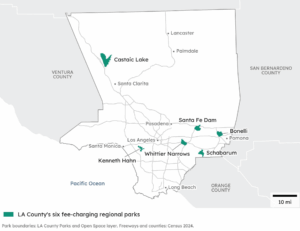
Source: LPPI analysis of LA County Parks and Open Space layer. Roads, water, places and counties: Census 2024. Basemap: Esri.
Specifically, we used data on LA County park vehicle entries to estimate trends in park attendance before and after the summer of 2025, which saw the highest levels of ICE activity around LA County. Our analysis focused solely on weekend attendance, when parks are most frequented. We conducted a year-over-year analysis, comparing vehicle entry totals for every weekend at each park to its corresponding weekend vehicle entry total the year prior, in 2024. We also examined if park attendance rebounded in summer 2026.
Findings
Weekend Visits Were Lower in Summer 2025 Compared to Summer 2024
The results show a substantial overall decline in weekend attendance in summer 2025, corresponding closely to the initial publicized raids in LA County. The figures below show the change in attendance between summer 2024 and summer 2025 across matched weekends in June, July, and August, the months historically known for peak park visitation. Overall, we observe a 17% decrease in vehicle attendance, amounting to roughly 21,000 fewer vehicles.
Figure 2: Percent Change in Weekend Vehicle Entries at LA County Parks, Summer 2025 vs. 2024
Source: Authors’ analysis of vehicle entry across six LA County parks.
On the weekend of June 7-8, 2025, total vehicle entries across the six parks were 9% higher than the same weekend in 2024 (June 8-9; Figure 2). This weekend took place barely a day after the initial enforcement actions and the sizable protests of June 6. At that time, families may not yet have known the lasting implications of the enforcement surge. But for the 11 weekends that followed, many thousands of people stayed home. And we see in these data that public park attendance dropped considerably during this period across LA County’s six regional parks.
Notably, vehicle entries are only a proxy for estimating total attendance rates. Assuming 4 people per vehicle as a conservative approximation, we estimate that 83,000 fewer people visited LA County regional parks from June through August 2025. That amounts to an average of roughly 7,000 fewer park visitors per weekend.
The consequences of public withdrawal are most felt by those directly impacted, but their costs are even more widespread. Vehicle entry fees are an important source of revenue for the LA County parks department, and had 2024 visitation levels held over the summer of 2025, the county would have collected roughly $210,000 more in revenue over those 12 summer weekends.14
Four LA County Parks Saw Significant Declines in Visitors During Summer 2025
Importantly, the broader park attendance trends are not uniform across all six parks. Drops in vehicle entries were particularly striking at Santa Fe Dam and Whittier Narrows, two regional parks near large Latino communities (Figure 3). Santa Fe Dam sits in Irwindale, near Baldwin Park and Azusa, where 73% and 65% of residents identify as Latino, respectively.15 Whittier-Narrows is located between South El Monte and Pico Rivera, where Latinos account for approximately 74% and 90% of residents.
Figure 3: Change in Number of Weekend Vehicle Entries at Santa Fe Dam and Whittier Narrows Parks, Summer 2025 vs. 2024
Source: Authors’ analysis of vehicle entry across six LA County parks.
Attendance at Santa Fe Dam Park and Whitter-Narrows Park fell considerably, with over 1,000 fewer vehicle entries at each park on many weekends. The weekend comparisons in Figure 3 illustrate that declines were most substantial in June and July but persisted through August.
Across all observed weekends, Santa Fe Dam saw approximately 8,500 fewer vehicle entries, a 30% drop compared to summer 2024. Whittier Narrows saw over 7,000 fewer vehicle entries, a 23% decline.
Bonelli Park and Castaic Park are distinct in that they both experienced one month of unrelated closures across the study period, and are located the farthest from central LA, where some of the city’s most publicized enforcement actions and protests took place.16 Yet each park experienced substantial drops in park attendance in July and August 2025 compared to the year prior (Figure 4). Bonelli Park saw roughly 5,900 fewer vehicle visits across the eight weekends observed, and Castaic Park experienced approximately 2,600 fewer.
Figure 4: Change in Number of Weekend Vehicle Entries at Bonelli and Castaic Parks, Summer 2025 vs. 2024
Source: Authors’ analysis of vehicle entry across six LA County parks.
Two LA County Parks Saw Modest Gains in Weekend Entries
By contrast, the two remaining parks, Schabarum and Kenneth Hahn, both experienced small increases in total visits (Figure 5). Although the data do not explain why these parks saw increases in attendance, it is noteworthy that both parks are situated in communities with distinct demographic profiles. Schabarum Park is located in Rowland Heights, where 61% of residents are Asian, and 30% are Latino.17 Schabarum also offers more space for trails, hiking, biking, and horseback riding compared to the lakes and swimming areas that attract families to other regional parks. Meanwhile, Kenneth Hahn State Recreation Area is situated in the historically Black Baldwin Hills area of Los Angeles, surrounded by smaller Latino populations compared to other county parks.18 ICE raids may not have affected this neighborhood’s inclination to spend time in public spaces in the same ways as elsewhere. It is also plausible that some park attendees may have assessed lower risk at these two park locations and opted to visit them instead of other parks, resulting in slight overall increases in attendance.
Figure 5: Change in Number of Weekend Vehicle Entries at Schabarum and Hahn Parks, Summer 2025 vs. 2024
Source: Authors’ analysis of vehicle entry across six LA County parks.
Losses at Four Parks far Outweighed the Gains at the Two Parks That Grew
However, the moderate increases in park attendance at Schabarum and Hahn parks did little to offset the much larger declines at all other LA County regional parks over the same period (Figure 6). Overall, the data show a marked, real drop in weekend attendance across LA County parks as the broader community witnessed an unprecedented surge in immigration enforcement activity.
Figure 6: Change in Number of Weekend Vehicle Entries by LA County Park, Summer 2025 vs. 2024
Source: Authors’ analysis of vehicle entry across six LA County parks.
Notably, the ICE enforcement surge in the Los Angeles area did not cease in the summer of 2025. Recent reports indicate that after small seasonal declines, at-large immigration arrests in June 2026 rose considerably, approaching levels last observed in late summer 2025.19
Figure 7: Total Weekend Vehicle Entries at LA County Parks, Summer 2026 vs. 2025 and 2024
Source: Authors’ analysis of vehicle entry across six LA County parks.
To assess the duration of declines in public park participation, we extended our analysis to the summer of 2026. Across the same 12 matched summer weekends for 2024, 2025, and 2026, we tallied the total number of vehicle entries across all six parks for each year. We found that summer 2026 park attendance remained depressed by approximately 17,000 fewer vehicle entries and 68,000 fewer visitors compared to summer 2024.20 While a portion of the 2026 decline may be attributable to county park fee increases (of roughly $3 per vehicle), we expect that immigration enforcement and the fear it generates will continue to play an integral role.
Summary
The data clearly show that fewer LA County residents are congregating in public compared to summer 2024. Fewer public family celebrations are being held outdoors. Fewer children are experiencing the shared joys of summer swimming, public play, and outdoor time with family. The impacts of heightened immigration enforcement have extended well past summer 2025, have translated into real revenue losses for the region, and could have lingering social and health consequences for LA residents and families.
Research Methods
We analyzed data from the Los Angeles County Parks Department showing vehicle entries at all six of the county’s fee-collecting parks for June through August in 2024, 2025, and 2026. We obtained the data through a California Public Records Act request. We matched vehicle entries for each weekend in 2025 to the exact weekend 52 weeks prior in 2024, for each of the six county parks. For example, vehicle entries on June 7-8, 2025 were matched to those on June 8-9, 2024. We only report comparisons for weekends where full vehicle entry data were available for every matched day.
After accounting for park closures (Castaic in June 2024; Bonelli in June 2025) and one day of missing data (Hahn, June 30, 2024), full analyses include 15 matched park weekends across the month of June, 24 matched park weekends across July, and 24 matched park weekends across August, for a total of 63 for each summer of comparison. We calculated vehicle entries as the total of all paid vehicle categories recorded at each park’s entrance.
Estimated revenue losses were calculated with an average-cost basis of $10 per vehicle based on 2024 amounts multiplied by total vehicle declines for each of 2025 and 2026, respectively.
Other factors may have contributed to park attendance, such as the calendar and changes in vehicle entry fees. Parks are also open on weekdays, and major federal holidays, such as Juneteenth (June 19) and Independence Day (July 4), did not fall on a Saturday or Sunday in 2024 or 2025. Independence Day did fall on a Saturday in 2026, which could have increased park attendance for that weekend. The county fee structure also increased in August 2025 by roughly $3 per vehicle across most parks.
Additionally, our estimate of park attendees is conservative. Not all park attendees enter using vehicles, therefore not all are captured in the vehicle entry data. Further, we assume that each vehicle entry accounts for four attendees, which may undercount the actual total.
Official Park Descriptions from Los Angeles County Service Locator:
Frank G. Bonelli Regional Park (San Dimas) is a beautiful 1,800 acre facility featuring a 250 acre lake with 14 miles of multi-use trails. Bonelli Park offers a wide variety of recreational activities, including boating, jet skiing, fishing, swimming, family and group picnicking, nature walks, hiking, jogging, and biking. There are also concessionaires offering RV Camping, Hot Tubs, Wedding Facilities, and Horse Back Riding.
Santa Fe Dam Recreational Area (Irwindale) is nestled at the foot of the San Gabriel Mountains and is considered one of the many hidden jewels of Southern California. This 836-acre facility boasts a serene 70-acre lake with year-round fishing and non-motorized watercraft usage. During the summer months, the recreational area highlights a five-acre chlorinated swim beach, and the unique Water Play Area.
Castaic Lake State Recreation Area (Castaic) is one of the largest and most spectacular state water reservoirs in California! It not only provides fresh water to local communities, but this 12,658-acre facility is also a great local recreational escape for the entire family! This northern oasis features two lakes: the Upper Lake which offers two launch ramps for boating with various waterways and coves for exploring and the Lower Lake that includes picnic areas, launch areas for Kayaks, float tubes and other non-gasoline boating, and a swim beach.
Whittier Narrows Recreation Area is a 1,492-acre park located in the City of South El Monte and is one of Los Angeles County’s largest and most popular recreation areas. The park is located on both sides of the Pomona Freeway at Rosemead Boulevard and Santa Anita Avenue.
Peter F. Schabarum Regional Park, located in Rowland Heights, is a 575-acre facility with 75 acres developed for walking, hiking, picnics, youth camping, soccer and tennis. Youth tennis lessons are offered year-round and exercise classes are free of charge. There is a new “Life Trail” exercise area, a federally protected blue-line stream and the remaining acres of the park have been left in their natural state and crisscross with hiking, biking and horseback riding trails that connect to the historic Juan Bautista De Anza National Historic Trail.
Kenneth Hahn State Recreation Area is an urban oasis and one of the largest inner-city parks and regional open spaces in greater Los Angeles. Managed by the County of Los Angeles Department of Parks and Recreation and named after Los Angeles County Supervisor Kenneth Hahn, this lush and peaceful 338-acre recreational retreat offers new and returning hikers and park visitors many features. Come visit the Japanese Garden, play on the baseball and soccer fields, or try the ten station workout course. There is also the healthy but challenging trails that provide some of the best and most breathtaking views unlike any other in the city!
Disclaimer
The views expressed herein are those of the authors and not those of the University of California. The authors used generative AI to assist with the development of Stata code for data preparation and for preliminary analyses, including consolidating 42 separate data files into a single dataset. All research questions, methodological decisions, operationalizations, and interpretations were independently determined by the authors, who retain full responsibility for the content of this data brief. Final analyses were subsequently produced in Stata outside the AI environment.
Endnotes
1 This estimate is conservative. It covers only the 12 matched summer weekends. It does not include weekdays, or the rest of the year. Nor does it include other visit-related revenue, such as boating and watercraft fees, which the county records separately.
2 James Queally, Nathan Solis, Salvador Hernandez, et al., “National Guard Arrives in Los Angeles as Fallout from Immigration Raids Continues,” Los Angeles Times, June 8, 2025, available online; Jenny Jarvie and Grace Toohey, “As Marines Arrive in L.A., Military Experts Raise Concerns: ‘This Could Spiral Out of Control,’” Los Angeles Times, June 10, 2025, available online.
3 Nathan Solis and Richard Winton, “‘Who Are These People?’ Masked Immigration Agents Challenge Local Police, Sow Fear in L.A.,” Los Angeles Times, June 24, 2025, available online; Rachel Uranga, “Most Nabbed in L.A. Raids Were Men With No Criminal Conviction, Picked Up Off the Street,” Los Angeles Times, June 24, 2025, available online.
4 Melissa Gomez, Rachel Uranga, and Brittny Mejia, “Heavily Armed Immigration Agents Descend on L.A.’s MacArthur Park,” Los Angeles Times, July 7, 2025, available online; Jordan Rynning, “Immigration Enforcement Agents Descend on MacArthur Park, Causing Uproar,” LAist, July 7, 2025, available online.
5 John Rogers and Joseph Kahne, The Fear Is Everywhere: U.S. High School Principals Report Widespread Effects of Immigration Enforcement (Civic Engagement Research Group, January 27, 2026), available online.
6 Sarah Axeen, Cameron Kaplan, Annie Ro, Anna Gorman, Daniel Cordova, Manuel Pastor, and Todd Schneberk, “Emergency Department Visits After Heightened Immigration Enforcement in Los Angeles County,” JAMA Network Open 9, no. 10 (2026): e2636734, available online.
7 Mike Cisneros and Kimmy Chacón, “As Latino Communities Live in Fear of ICE, LA Catholics Find Ways to Help Hurting Families,” The Pilot, August 15, 2025, available online; Hannah Fry, Christopher Buchanan, and Andrew J. Campa, “A Crisis of Faith: ICE Raids Force Some Churches to Take ‘Extraordinary’ Action,” Los Angeles Times, July 11, 2025, available online.
8 Laura Cooper, Arian Campo-Flores, and Enrique Pérez de la Rosa, “ICE Raids Have Sent Latino Shoppers into Hiding and Big Brands Are Hurting,” The Wall Street Journal, June 12, 2025, available online.
9 Amada Armenta, Nicholas Vargas, Albert Kochaphum, et al., The Cost of Fear: The Impacts of Immigration Enforcement on Small Businesses and Latino Entrepreneurs in LA County (Los Angeles: UCLA Latino Policy & Politics Institute, 2026), 14–15, available online.
10 Uma De Balanzo, Núria Rodríguez-Planas, and Jennifer Roff, “Immigration Enforcement Visibility and Consumer Spending” (CESifo Working Paper No. 12662, 2026), available online.
11 Deborah A. Cohen, Thomas L. McKenzie, Amber Sehgal, Stephanie Williamson, Daniela Golinelli, and Nicole Lurie, “Contribution of Public Parks to Physical Activity,” American Journal of Public Health 97, no. 3 (2007): 509–514, available online.
12 Gregory N. Bratman, Christopher B. Anderson, Marc G. Berman, et al., “Nature and Mental Health: An Ecosystem Service Perspective,” Science Advances 5, no. 7 (2019): eaax0903, available online.
13 Viniece Jennings and Omoshalewa Bamkole, “The Relationship Between Social Cohesion and Urban Green Space: An Avenue for Health Promotion,” International Journal of Environmental Research and Public Health 16, no. 3 (2019): 452, available online.
14 Cost per vehicle entry varies across the six parks, by permit type, and with discounts for senior citizens. The county fee structure also increased in August 2025 across most parks. The calculation is based on an estimated average-cost basis of $10 per vehicle, based on 2024 fee amounts. $10 x 21,000 fewer vehicles = $210,000.
15 U.S. Census Bureau, “QuickFacts: Baldwin Park City, California,” accessed October 23, 2026, available online; U.S. Census Bureau, “QuickFacts: Azusa City, California,” accessed October 23, 2026, available online; U.S. Census Bureau, “QuickFacts: South El Monte City, California,” accessed October 23, 2026, available online; U.S. Census Bureau, “QuickFacts: Pico Rivera City, California,” accessed October 23, 2026, available online.
16 June comparisons for Bonelli and Castaic Parks were not possible because Bonelli Park was closed in June 2025 and Castaic Park was closed in June 2024. As a result, the analysis for these two parks is limited to eight matched weekend comparisons from July and August.
17 U.S. Census Bureau, “QuickFacts: Rowland Heights CDP, California,” accessed October 23, 2026, available online.
18 Los Angeles City Council Redistricting Commission, “Los Angeles Times Neighborhoods with 2020 Legacy File Populations and Maps,” accessed October 27, 2026, available online.
19 Citlalli Chávez-Nava, “15,000 People in Los Angeles Region Were Deported During Recent ICE Enforcement Surge,” UCLA Newsroom, October 7, 2026, available online.
20 Extending the foregone losses calculation from above, had summer 2026 park attendance remained at summer 2024 rates, LA County would have collected approximately $170,000 in additional entry fees. Across summer 2025 and summer 2026, this amounts to roughly $380,000 in foregone revenues.