FOR IMMEDIATE RELEASE
Contact: lppipress@luskin.ucla.edu
UCLA Report Finds LA County Park Attendance Plummeted Amid Immigration Enforcement Surge and Has Not Recovered
Analysis of six regional parks shows 151,000 fewer visitors on summer weekends in 2025 and 2026, with the most significant declines in predominantly Latino neighborhoods.
LOS ANGELES (November 12, 2026) — Attendance in regional parks in Los Angeles dropped following the June 2025 federal immigration raids and has not bounced back, according to new research from the UCLA Latino Policy and Politics Institute (LPPI) and the UC Berkeley Latinx Research Center. The faculty expert brief examines daily vehicle entry data from the LA County Department of Parks and Recreation across the same 12 summer weekends during and after the enforcement surge.
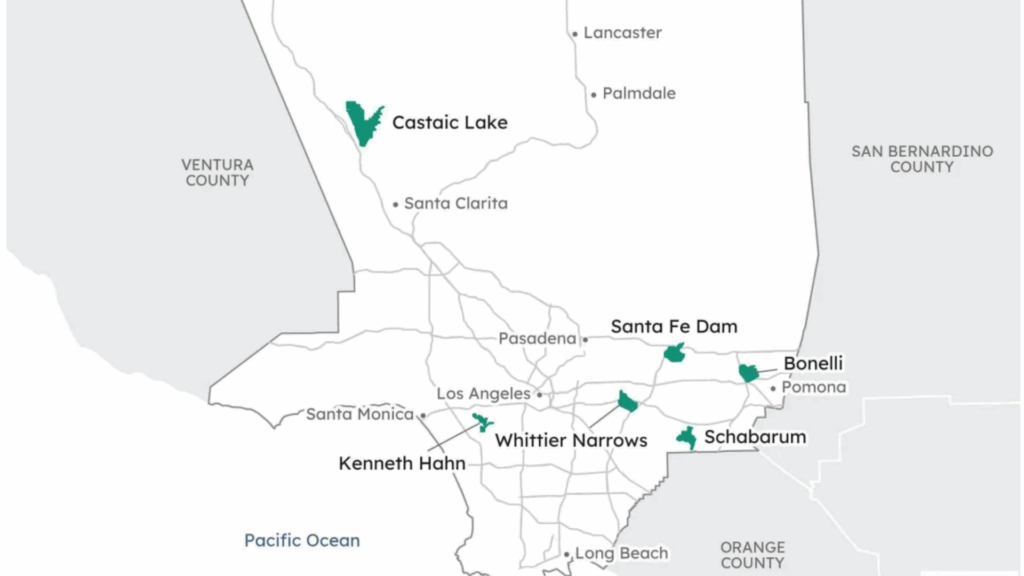
Researchers found that across six parks—Bonelli, Castaic Lake, Kenneth Hahn, Santa Fe Dam, Schabarum, and Whittier Narrows—there were approximately 21,000 fewer vehicle entries in 2025 and 17,000 fewer in 2026, compared to 2024. Based on an estimate of four visitors per vehicle, that amounts to 83,000 fewer park visitors in 2025 and 68,000 fewer visitors in summer 2026. Parks near large Latino communities were especially hard-hit. Santa Fe Dam and Whittier Narrows Recreation Area—both in areas where over 70% of residents identify as Latino—saw over 8,500 and 7,000 fewer vehicle entries in 2025, respectively. Using the average entry fee of $10 per vehicle, they also calculated approximately $380,000 in potential lost revenue across both summers.
The six parks analyzed provide thousands of acres of nature to relax, exercise, and celebrate. On summer weekends in 2024, they were full of people hosting birthday parties, enjoying the trails, and bringing their kids to the lakeside. This analysis reveals that heightened immigration enforcement took these spaces away from tens of thousands of families – especially in Latino neighborhoods – who no longer feel safe leaving their homes.
“Parks are vital to the health of a community. They are where many Angeleno families form memories grilling, swimming, celebrating family events, and decompressing in nature. And as costs rise, they are one of the few outings that families can still afford,” said G. Cristina Mora, co-director of the UC Berkeley Institute of Governmental Studies and co-author of the report. “Our research shows that federal immigration crackdowns emptied these spaces. Many parents were likely too afraid to take their children to playgrounds, fields, and lakes that belong to all county residents. And more than a year after the initial raid surge, families have not come back.”
“Previous LPPI research has shown that immigration raids already affect where many Angelenos feel safe shopping and eating out,” said Nicholas Vargas, associate professor of Chicanx/Latinx Studies at UC Berkeley and co-author of the report. “Our latest findings show how these effects extend to something as simple as families spending a day in nature. Angelenos are already dealing with the economic pressures of rising costs. Losing safe access to parks where they can relax, experience the joys of community, and get away from those stresses only makes things harder.”
This brief builds on LPPI’s The Cost of Fear report published in July 2026. The report examines the impacts of heightened immigration enforcement on small businesses and Latino entrepreneurs in LA County. Together, the findings of both analyses provide a broad picture of how heightened enforcement coincides with changes in economic activity, health, and everyday community life.
###
About the UCLA Latino Policy and Politics Institute
The UCLA Latino Policy and Politics Institute is a nonpartisan research institute that seeks to inform, engage and empower Latinos through innovative research and policy analysis. LPPI aims to promote equitable and inclusive policies that address the needs of the Latino community and advance social justice. latino.ucla.edu.