FOR IMMEDIATE RELEASE
Contact: lppipress@luskin.ucla.edu
UCLA Report Finds Immigration Enforcement Surge Triggered Immediate and Lasting Economic Disruption Across Los Angeles County’s Latino Business Corridors
Analysis shows 46,000 fewer business visits and an estimated $3.16 million in accumulated losses near nine enforcement sites within two weeks. Latino entrepreneurs reported continuing financial, psychological, and physical consequences nearly one year later.
LOS ANGELES (July 22, 2026) — The June 2025 ICE raids triggered an immediate economic shock in Los Angeles County’s Latino business corridors that had not resolved nearly a year later, according to a new study from the UCLA Latino Policy and Politics Institute (LPPI) in partnership with Inclusive Action for the City. The report pairs mobility data on all businesses near nine enforcement sites with surveys and focus groups of 75 Latino entrepreneurs countywide. Researchers found that across 989 formal-sector businesses located within half a mile of nine documented enforcement sites, there were 46,000 fewer customer visits and an estimated $3.16 million in accumulated revenue losses during the two weeks following enforcement activity.
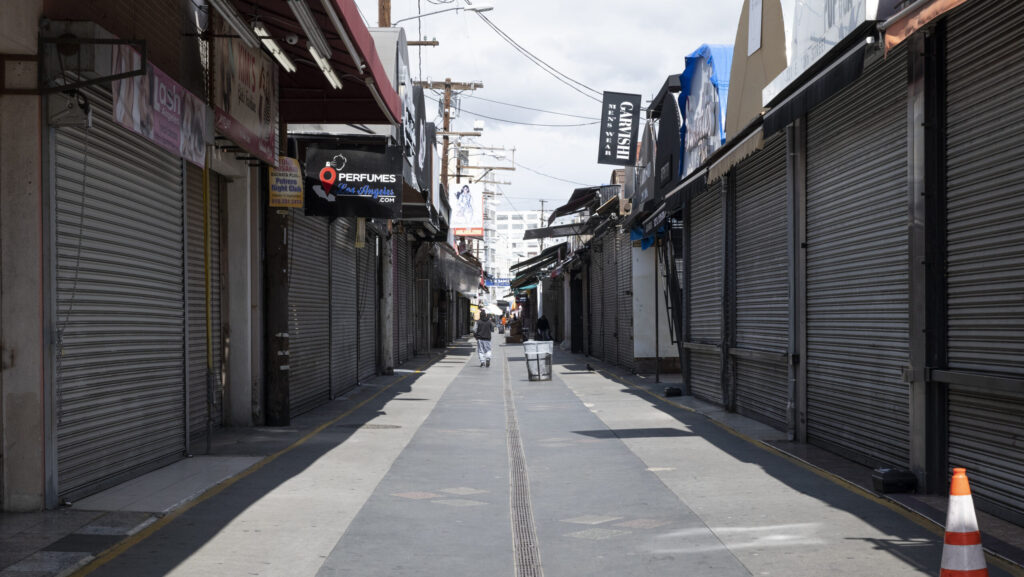
The effects worsened over time and spread beyond the immediate area. By the end of the second week, foot traffic had declined by 3.23% within a quarter mile of enforcement sites and by 1.63% between a quarter and a half mile away. Eight of the nine commercial areas studied experienced reduced foot traffic.
The authors also estimate that a similar decline extrapolated county-wide could represent up to $52 million in losses within two weeks and $114 million over a month of sustained enforcement, an illustrative extrapolation they describe as a plausible order of magnitude rather than a precise measure.
Latino entrepreneurs’ experiences show how the initial decline in commercial activity developed into prolonged financial strain. Participants described fewer customers, canceled orders, reduced operating hours, staffing disruptions, depleted savings, and accumulated debt.
Among the key findings:
- Every participating small business owner reported fewer customers and fewer sales.
- 59% reported revenue declines exceeding 50%, while another 20% reported declines between 26% and 50%.
- 68% temporarily closed or reduced their operating hours.
- 51% reported staff missing work due to fear of enforcement.
- Nearly one year later, 95% continued to report financial stress.
- 52% said revenue no longer consistently covers operating costs, while another 43% reported breaking even with little or no profit.
As revenues remained depressed, some took outside employment, reduced payroll, assumed work previously performed by employees, consolidated locations, and postponed or abandoned plans for growth and investment.
“Our research shows that immigration enforcement functioned as an economic shock that extended far beyond the immediate disruption associated with enforcement operations,” said Amada Armenta, director of LPPI and a co-author of the report. “The loss of customers disrupted businesses across sectors and formats, regardless of the owner’s immigration status. A year later, many business owners remain financially vulnerable, with fear, uncertainty, and financial strain contributing to worsening health and wellbeing.”
“The federal government’s surge of immigration enforcement has devastated our communities and economy,” said Rudy Espinoza, CEO of Inclusive Action. “Small businesses and commercial corridors have sat vacant, while business owners and workers struggle, and families suffer. This research shines a spotlight on the horrific toll these policies have taken and gives our community members a platform to share their truth.”
The authors found that financial strain and worsening health reinforced one another. Fear, prolonged uncertainty, and financial pressure took a toll on entrepreneurs’ health, which in turn limited their ability to work, manage their businesses, and recover.
Other findings from the interviews and survey include:
- 76% of participants reported a substantial emotional impact.
- In focus groups, respondents described sustained fear, anxiety, depression, sleep disruption, hypervigilance, and stress.
- Respondents also described gastrointestinal disorders, panic attacks, worsening chronic conditions, and other stress-related illnesses. Several reported beginning new medications, increasing medical visits, or requiring hospitalization.
- Business owners described reassuring frightened customers and comforting employees and family members while managing their own anxiety.
The report concludes that these health consequences were both outcomes of immigration enforcement and mechanisms that prolonged the economic damage.
“Latino businesses have not recovered. These businesses function as local economic engines. They employ neighbors, buy from local suppliers, and keep money circulating in their communities. When enforcement drives away their customers and workers, the harm extends to the health, wellbeing, and safety of entire communities,” Armenta concluded.
Read the report here.
The research was conducted in partnership with Inclusive Action for the City and supported by the California Wellness Foundation, the Latino Community Foundation, and the Evelyn and Walter Haas, Jr. Fund.
###
About UCLA Latino Policy and Politics Institute
The UCLA Latino Policy and Politics Institute is a non-partisan research institute that seeks to inform, engage, and empower Latinos through innovative research and policy analysis. LPPI aims to promote equitable and inclusive policies that address the needs of the Latino community and advance social justice. latino.ucla.edu.
About Inclusive Action for the City
Inclusive Action for the City is a nonprofit organization and a community development financial institution (CDFI) based in Boyle Heights and serving communities across LA County. We champion working people, invest in entrepreneurs, and change systems to build an economy that works for all of us.