What Rebuilding Altadena Really Looks Like: Five Key Takeaways
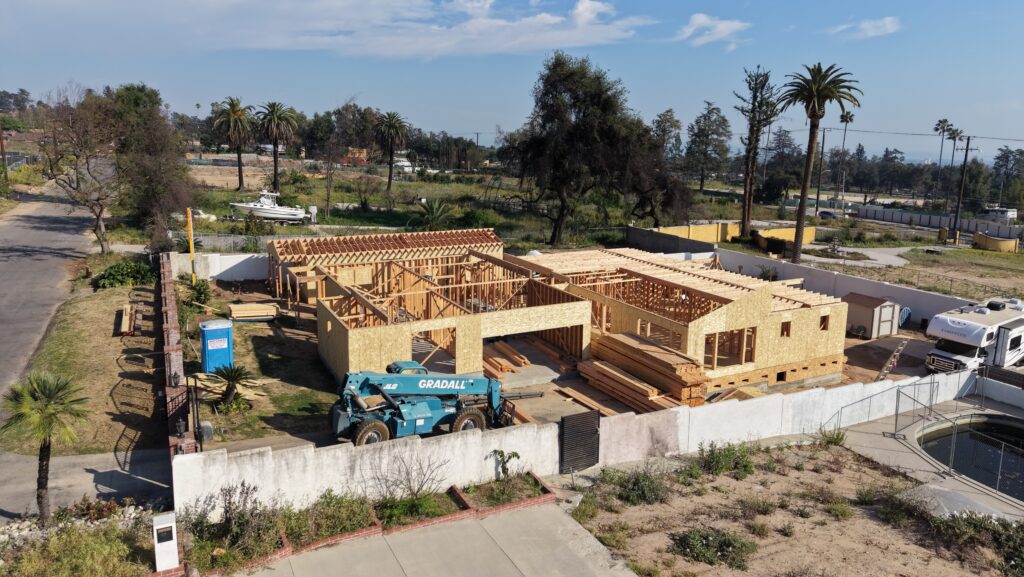
In the aftermath of the Eaton Fire, recovery in Altadena is not an abstract policy concept, it is a daily, uneven, and deeply human process unfolding lot by lot. On a recent rebuilding and recovery tour hosted by Neighborhood Housing Services of Los Angeles County (NHSLA), that reality was on full display. The tour, which spotlighted nine households with fire-impacted properties, captured the full spectrum of rebuilding: from newly poured foundations to homes nearing completion, reflecting both progress and ongoing obstacles in recovery.
The tour also underscored the scale and complexity of recovery infrastructure required to make rebuilding possible. NHSLA, which serves on the UCLA Latino Policy and Politics Institute (LPPI) research advisory board on Altadena recovery, has been central to this effort providing technical assistance, financial counseling, estate planning, inspections, and over $8.1 million in direct gap funding grants and 172 interim housing grants to more than 1,500 clients.1
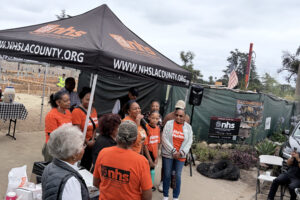
Description: Press conference held at the rebuilding site of an NHSLA client, who is an 89-year-old Army veteran rebuilding the home he lost in the Eaton Fire.
Source: UCLA LPPI Staff.
Five Things to Know About Housing Recovery in Altadena
1. Rebuilding and Returning is about Preserving Legacy in Altadena
The homeowners on the tour have resided in Altadena for several decades, continuing the legacy of Black homeownership, which began in 1850 with the first Black resident Robert Owens.2 The homes lost in the Eaton fire represent more than personal devastation; they erased generational wealth built and passed down over decades. In Altadena, Black homeownership has outpaced the Black homeownership rate in Los Angeles County as a whole: 70 percent of Black households owned their home in Altadena, compared to just 38 percent across LA County.3
However, due to the history of redlining, Black homeowners were disproportionately in the fire’s path. Over half of Black households in Altadena were located within the Eaton Fire perimeter, compared to 50 percent of non-Black households.4 Once the fire hit, the damage showed this legacy: 58 percent of Black households were severely damaged, significantly above the 46 percent average for all homeowners.5
2. The rebuilding path faces high costs and large coverage gaps
A recurring concern was the obstacles to returning home in Altadena. High rebuilding costs, displacement risks, and inadequate insurance coverage were hardships all residents expressed on the tour. Their hardships reflect broader recovery trends in the community; as LPPI research shows, less than half of homeowners with severely fire damaged homes had applied for rebuilding permits at the one-year mark (February 2026).6 And only 30 percent of homeowners who filed permit applications had actually started construction. The slow progress underscores that most families remain stuck in permit and construction holds.
However, Black homeowners have shown particularly strong commitment to rebuilding. About 22 percent had filed a permit application seven months after the fire; by the one-year mark, that share had more than doubled to around 50 percent.7
3. A combination of grants, loans, and community support makes rebuilding possible
Nearly every family relied on a mix of resources to make rebuilding possible: philanthropic grants, NHSLA support, insurance, SBA loans, and crowdfunding campaigns. No single source was enough; recovery required multiple streams of support.
This pattern reflects a broader trend across the county. A June 2025 survey of LA County wildfire victims found that 39 percent of respondents received only partial insurance payments, and 17 percent reported having no coverage at all.8 Black and Latino households were twice as likely as white households to be uninsured.9
The stories shared on the tour show the same pattern. Of the nine households showcased, only one had insurance that fully covered the cost of rebuilding. One household (household F in Table 1), who have lived in Altadena for 27 years, was the only one with full replacement coverage because they contacted their insurance provider the year before the fire and were advised to increase their policy limits to reflect current rebuilding costs. As a result, their insurance covered the full cost of rebuilding as well as three years of rental assistance, allowing them to expect a return home as early as December 2026. The remaining households with reported rebuilding costs and insurance payouts had insurance that covered, on average, about 73% of rebuilding costs, leaving an average uninsured gap of $309,400 before additional assistance from NHS or federal aid (Table 1).
Table 1. Total Rebuild Cost and Funding Sources by Recovery Tour Households, June 2026
Source: Neighborhood Housing Services of Los Angeles County (NHSLA), “Rebuilding & Recovery Tour Hosted by NHS of LA County, SoCal NOMA, and the RLA Coalition” (Los Angeles: NHSLA, June 2026), handout distributed at Altadena Rebuilding Tour, Altadena, CA, June 29, 2026.
4. Tenants face an uncertain path back to homeownership
While rebuilding efforts have largely focused on homeowners, thousands of Altadena tenants continue to face uncertainty about whether they will be able to return. Before the Eaton Fire, more than one in five Altadena households (approximately 3,300 households) were renters, and nearly 70 percent had lived in the community since 2010.10 This underscores that Altadena’s tenants were not temporary residents but longtime community members whose ability to return will shape whether recovery restores the community that existed before the fire.
During the tour, NHSLA highlighted one pathway forward for tenants through the story of a household, who rented her Altadena home for 17 years before it was destroyed in the fire. After being displaced, NHSLA acquired and is redeveloping the property, creating an opportunity for her and her son to return—not as renters, but as homeowners. While her story demonstrates how community-based organizations can help expand homeownership opportunities for displaced tenants, it also illustrates the broader challenge facing thousands of renters whose return remains uncertain without sustained investment and long-term recovery strategies.
5. Altadena is Not For Sale
Throughout the rebuilding tour and recovery, signs reading “Altadena Is Not for Sale” and “Altadena STRONG” reflected a shared concern among residents that the recovery process could lead to displacement through speculative real estate investment. Survivors described feeling pressure to sell their properties rather than rebuild, particularly as they navigated insurance gaps, financial strain, and the lengthy rebuilding process.
LPPI research shows that these concerns are grounded in market trends. During the first seven months after the Eaton Fire, investors accounted for nearly two-thirds of all home purchases (145 of 225 sales).11 By the one-year mark, investors still represented 58 percent of all buyers (211 of 359 sales),12 despite an increase in non-investory purchasers. While the investor share has declined over time, residents continue to worry that financial pressures could permanently reshape Altadena’s ownership landscape and threaten the community’s historic character.
Moving Forward
The recovery tour highlighted the unique complexities a household can face, from full insurance coverage to none at all, the pathway back home is rarely linear. Understanding the roots of the Altadena community matters: residents are here to stay and will not be bought out.
For more research, check out our Rebuilding Altadena Research Series.
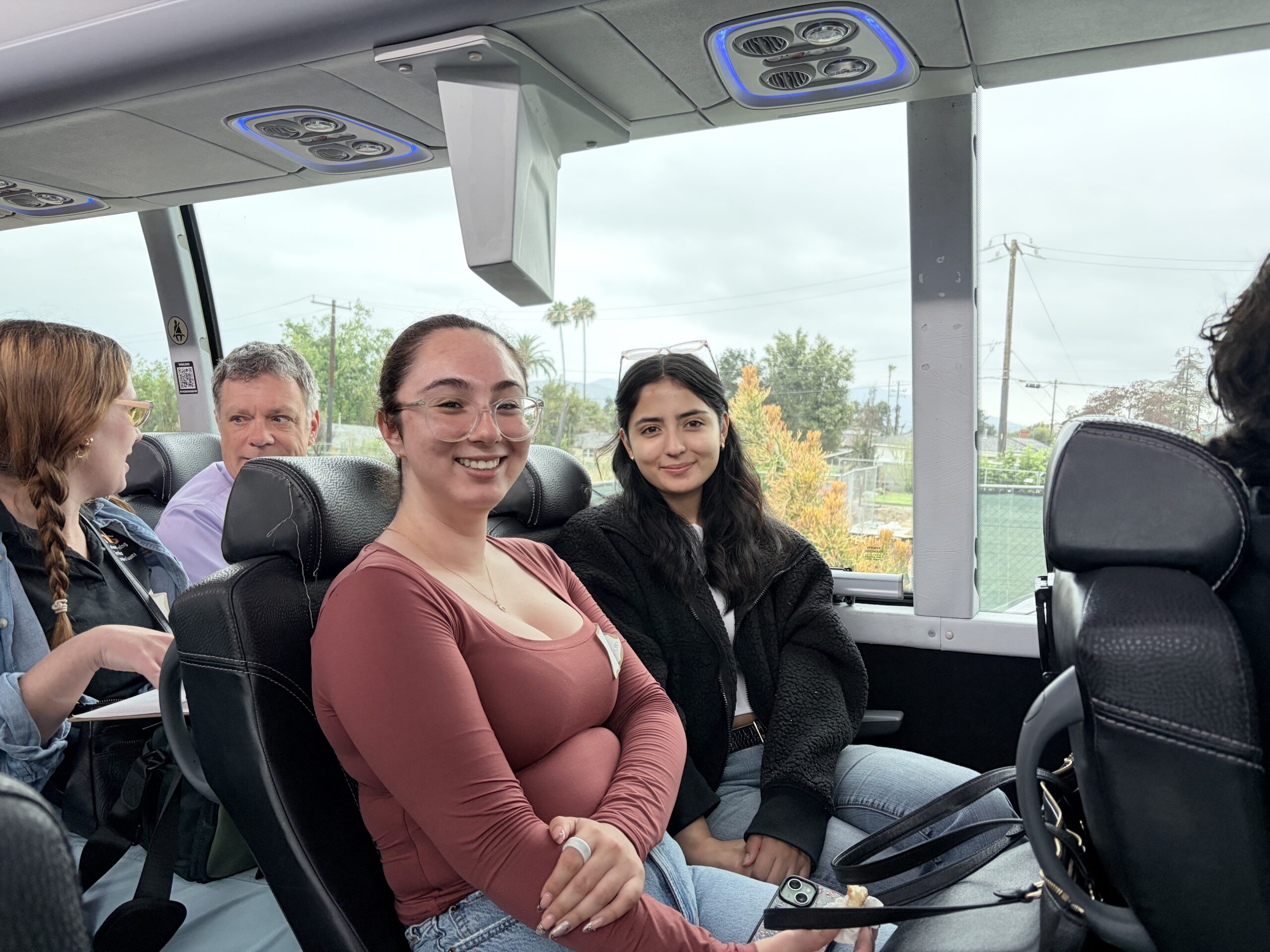
Description: Ana Lua Martel (left) and Sofia Barajas (right) aboard the community tour bus following the press conference, en route to visit rebuilding sites and hear firsthand from residents and partners about the ongoing recovery in Altadena.
Source: UCLA LPPI Staff.
End Notes
1 Neighborhood Housing Services of Los Angeles County (NHSLA), “Restore the Legacy LA Coalition (RLA) Impact Report, January 2025 to 2026” (Los Angeles: NHSLA, June 2026), handout distributed at Altadena Rebuilding Tour, Altadena, CA, June 29, 2026.
2 Aldra Allison, “Still We Rise… Voices of Black Pasadena & Altadena, Past & Present” (Pasadena, CA: Alkebudan Cultural Center Genealogy Class), 86.
3 Paul Ong, Chhandara Pech, Lorrie Frasure, Samyu Comandur, Eric Lee, and Silvia R. González, LA Wildfires: Impacts on Altadena’s Black Community Data Brief Examining the Impacts of the January 2025 Eaton Fire on Altadena’s Historic Black Community (Los Angeles: UCLA Bunche Center for African American Studies, January 28, 2025), available online.
4 Ibid.
5 Gabriella Carmona, Paul M. Ong, Xalma M. Palomino, Vinit Mukhija, and Rodrigo Dominguez-Villegas,Who’s Coming Home? An Analysis of the Property Sales, Permits, and Rebuilding Efforts of Single-Family Homeowners in Altadena, CA After the Eaton Fire (Los Angeles: UCLA Latino Policy & Politics Institute, October 8, 2025), available online.
6 Sofia Barajas, Gabriella Carmona, Paul M. Ong, Dr. Vinit Mukhija, One Year Later, Who’s Coming Home? (Los Angeles: UCLA Latino Policy & Politics Institute, April 9, 2026), available online.
7 Ibid.
8 Department of Angels, “Survey of Wildfire-Impacted Areas,” updated June 2025, available online.
9 Sofia Barajas, Gabriella Carmona, Paul M. Ong, Dr. Vinit Mukhija, One Year Later, Who’s Coming Home?.
10 Gabriella Carmona, Dr. Vinit Mukhija, Rodrigo Dominguez-Villegas, Mariah Bonilla, Sofia Barajas, Xalma M. Palomino, and Ana Guadalupe Lua Martel, Rebuilding for Whom? An Analysis of Tenant Demographics, the Rental Market, Affordability, and the Rebuilding Efforts in Altadena.
11 Sofia Barajas, Gabriella Carmona, Paul M. Ong, Dr. Vinit Mukhija, One Year Later, Who’s Coming Home?
12 Ibid.
Acknowledgments
This blog was made possible with the generous support of the Conrad N. Hilton Foundation. International hotelier Conrad N. Hilton established the grantmaking foundation that bears his name in 1944 to help people living in poverty and experiencing disadvantage worldwide. More than eighty years later, the work continues, concentrating on efforts to ensure healthy early childhood development and sustainable livelihoods for youth and refugee populations, support young people transitioning out of foster care, improve access to housing and support services for people experiencing homelessness, identify solutions to safe water access, and lift the work of Catholic sisters. Additionally, following selection by an independent, international jury, the Foundation annually awards the $3 million Conrad N. Hilton Humanitarian Prize to an organization doing extraordinary work to reduce human suffering. The Foundation is one of the world’s largest, with approximately $7.3 billion in assets. It has awarded grants to date totaling more than $3.6 billion worldwide, and nearly $300 million in 2024. Please visit www.hiltonfoundation.org for more information.
The UCLA Latino Policy and Politics Institute acknowledges the Gabrielino and Tongva peoples as the traditional land caretakers of Tovaangar (the Los Angeles basin and Southern Channel Islands) and that their displacement has enabled UCLA’s flourishing. As a land grant institution, we pay our respects to the Honuukvetam (Ancestors), Ahiihirom (Elders), and Eyoohiinken (our relatives nations) past, present, and emerging.
Disclaimer
The views expressed herein are those of the authors and not necessarily those of the University of California, Los Angeles as a whole. The authors alone are responsible for the content of this blog.