
The Lineage Logistics Fire in Boyle Heights: Who Lives and Works in the Smoke Zone?
Photo credit
Featured photo: Walter Cicchetti on iStock.
Introduction
Over the past several days, a massive fire at a Lineage Logistics cold storage facility in Boyle Heights, Los Angeles, has triggered a variety of public health and safety concerns. The fire ignited on June 17, 2026 at the nearly 500,000-square-foot warehouse has since prompted emergency declarations from both Mayor Karen Bass and Governor Gavin Newsom, shelter-in-place orders for nearby residents and businesses, the opening of smoke relief centers to assist those impacted, and the relocation of several nearby schools.1
Boyle Heights is a predominantly Latino neighborhood on the Eastside of Los Angeles, located within the City of Los Angeles and adjacent to the unincorporated community of East Los Angeles. These working-class neighborhoods are historically and culturally rich and have long been characterized by disinvestment, limited access to health care, and disproportionate exposure to environmental hazards.2 The fire compounds these pre-existing conditions, exposing an already overburdened community to another health crisis.
Although the Lineage Logistics facility is located in Boyle Heights, smoke and air quality impacts have extended beyond the immediate area into surrounding neighborhoods, including East Los Angeles. This data brief, the first in a series, focuses specifically on jobs and workers located within the smoke advisory zone in Boyle Heights and East Los Angeles. Future briefs will examine the broader geographic reach of the fire’s impacts, including communities outside the advisory zone that have experienced degraded air quality and related disruptions.
Data and Methods
This data brief uses data from the Longitudinal Employer–Household Dynamics (LEHD) OnTheMap platform, produced by the U.S. Census Bureau, to estimate the number and characteristics of workers and jobs associated with the smoke advisory zone established for the Lineage Logistics fire. The brief presents two complementary profiles:
- A worker profile describing employed residents who live within the smoke advisory zone, and
- A job profile describing jobs located within the smoke advisory zone, regardless of where workers reside.
Limitations: LEHD primarily relies on employment records from unemployment insurance programs; therefore, these estimates do not fully represent the workforce, particularly workers in informal, self-employed, or other non-covered employment. In addition, the analysis is based solely on private primary jobs and does not fully capture workers who hold multiple jobs. Private primary jobs include private-sector employment only and assign each worker to a single primary job (the job with the highest earnings). Secondary jobs and most public-sector employment are not included. Unless otherwise noted, all figures should be interpreted as estimates rather than precise counts.
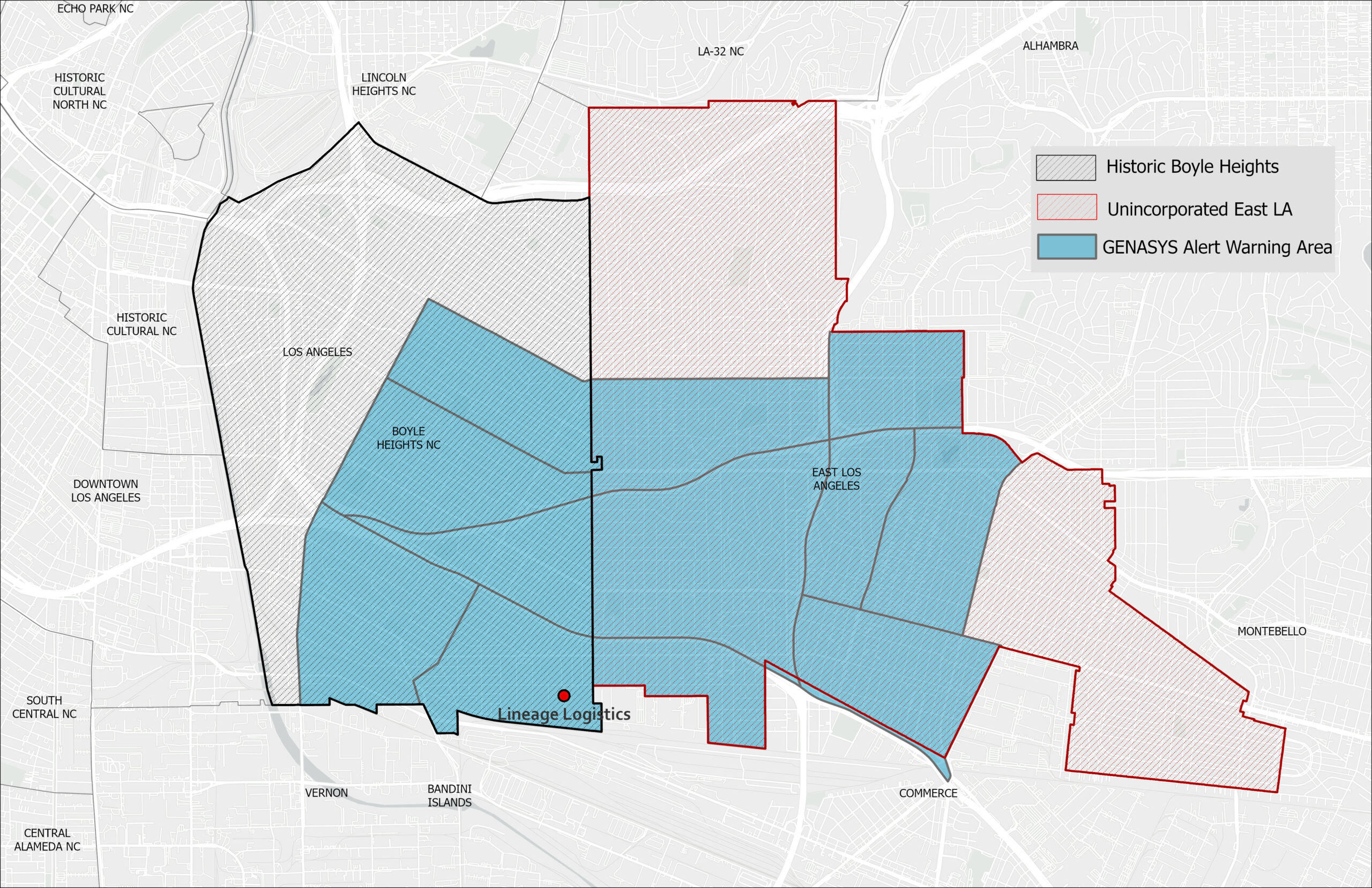
As shown in Figure 1, the smoke advisory zone encompasses most of Boyle Heights and portions of unincorporated East Los Angeles (East LA). The Lineage Logistics warehouse, where the fire originated, is located in the southern portion of the Boyle Heights neighborhood near the boundary with East LA. The smoke advisory zone is defined using the Los Angeles County Public Emergency Map GENASYS Alert and Warning Notification Area as of June 22, 2026, at 12:27 p.m.3 According to the GENASYS Project website, these zones help public officials communicate emergency information to specific geographic areas and may be either predefined or created in response to a particular incident.4
Figure 1: Lineage Logistics Warehouse Fire Smoke Advisory Zone, June 22, 2026
Worker Profile Findings
Finding 1: At least 31,700 workers reside within the smoke advisory zone, and roughly 8 in 10 are Latino.
At least 31,700 employed residents (workers) live within the smoke advisory zone. As shown in Table 2, of these, approximately 26,000 workers (about 81%), identify as Hispanic or Latino. These residents work across a range of industries, with health care and social assistance (16%), retail trade (12%), and accommodation and food services (11%) representing the three largest employment sectors. Transportation and warehousing, the sector most directly tied to the incident, ranks sixth among all industries (6%).
Table 1: Workers Profile, Estimated Total Private Primary Jobs, 2023
Source: U.S. Census Bureau, OnTheMap Application and LEHD Origin-Destination Employment Statistics (Beginning of Quarter Employment, 2nd Quarter of 2002-2023).
Finding 2: Nearly half of resident workers in the smoke advisory zone earn less than LA County’s very-low-income threshold.
The Lineage Logistics Fire threatens the livelihoods of workers, many of whom may have little financial cushion to weather lost wages, health costs, or disruptions to their daily lives. Among the workers living in the smoke advisory zone, about 50%, over 15,400 workers, earn $3,333 per month or less (see Table 1). For context, the U.S. Department of Housing and Urban Development (HUD) defines “very low income” in Los Angeles County as $48,550 annually (approximately $4,046/month) for a single-person household.5 Nearly half of resident workers earn below this threshold. About 12% of resident workers earn $1,250 or less per month, falling well below even the “extremely low income” threshold of $2,429/month for a single person. At these low-income levels, the added pressures of smoke exposure, missed work, and potential permanent displacement can push already stretched residents to a breaking point.
Finding 3: Over half of resident workers in the smoke advisory zone may have limited access to paid leave, health coverage, or remote work.
Among the workers 30 and older 6 living in the smoke advisory zone, about 14,000, or 58%, have a high school diploma or less. Research consistently finds that lower educational attainment is often associated with lower earnings, less job flexibility, and reduced access to employer-provided benefits such as paid leave, health insurance, and remote work options.7 For instance, workers may be less able to avoid smoke exposure because they cannot work remotely, seek timely medical care because they lack health insurance, or recover from lost wages resulting from the fire and its aftermath.
Jobs Profile Findings
Finding 4: Two-thirds of jobs in the smoke advisory zone are held by Latinos.
Almost 13,600 jobs are located within the smoke advisory zone, and 66% are held by Hispanic or Latino individuals. The three largest employment sectors within the smoke advisory zone are health care and social assistance (27%), manufacturing (13%), and retail trade (13%), with transportation and warehousing ranking in 7th place. Many of these jobs require an on-site presence, which could increase workers’ exposure during active smoke events. Online reports and anecdotal stories suggest that many employment sites, particularly small businesses in retail, accommodation, and food service, have closed or experienced a steep decline in clients who do not want to be exposed to smoke. Many of these small business owners are Latino.
Table 2: Jobs Profile, Estimated Total Private Primary Jobs, 2023
Source: U.S. Census Bureau, OnTheMap Application and LEHD Origin-Destination Employment Statistics (Beginning of Quarter Employment, 2nd Quarter of 2002-2023).
Finding 5: Nearly 9 in 10 jobs in the smoke advisory zone are held by workers who live outside the area.
Of the approximately 13,600 jobs located within the smoke advisory zone, nearly 88% are held by workers who live outside the area, while only about 13% are held by residents who both live and work within the zone. These commuting patterns suggest that disruptions from the warehouse fire affect not only residents living within the smoke advisory zone but also thousands of workers who travel into the area for work.
Figure 2. Estimated Inflow/Outflow Job Counts, 2023
Source: U.S. Census Bureau, OnTheMap Application and LEHD Origin-Destination Employment Statistics (Beginning of Quarter Employment, 2nd Quarter of 2002-2023).
Conclusion
The aftermath of the Lineage Logistics Fire is unfolding in a community that was already bearing a disproportionate share of environmental, economic, and health burdens. While the fire’s smoke has spread across Los Angeles, its most immediate and lasting impacts will be felt by those who live and work in the smoke advisory zone and surrounding areas. Addressing these compounding challenges requires an equitable disaster response that centers on the needs of both residents and workers, including access to health care, income support, and multilingual emergency resources. As the fire continues, policymakers and elected officials must draw on lessons learned from recent disasters, including the January 2025 wildfires, to prioritize coordinated, equitable relief that reaches residents and workers without delay.
Acknowledgments
This brief was made possible with the generous support of the James Irvine Foundation. The authors thank Lila Burgos, Professor Paul Ong, and Belem Lamas for their valuable insights and review, as well as Yina Marin and Adriana Perez for their design support, and Alberto Lammers and Cristian Rivera for their support with dissemination and media outreach.
The UCLA Latino Policy and Politics Institute and the UCLA Center for Neighborhood Knowledge acknowledge the Gabrielino and Tongva peoples as the traditional land caretakers of Tovaangar, the Los Angeles basin and Southern Channel Islands, and recognize that their displacement has enabled UCLA’s flourishing. As a land-grant institution, we pay our respects to the Honuukvetam (Ancestors), Ahiihirom (Elders), and Eyoohiinken (our relatives’ nations), past, present, and emerging.
References
1. Hayley Smith and Laurence Darmiento, “What We Know About the Boyle Heights Fire,” The Los Angeles Times, June 20, 2026, available online; Jonathan Lloyd and Lauren Coronado, “LAUSD Relocates Some Summer Programs Due to Boyle Heights Fire,” NBC Los Angeles, June 22, 2026, available online. ↩
2. East LA Community Corporation, “Boyle Heights,” ArcGIS StoryMaps, accessed June 2026, available online; Erica J. Montes, Nadereh Pourat, and Allison L. Golden, “Access to and Use of Health Care Services Among Latinos in East Los Angeles and Boyle Heights,” Health Services Research 51, no. 5 (2015): 1482–1501, available online. ↩
3. Los Angeles County Enterprise GIS, “Public Emergency Map — GENASYS Alert and Warning Notification Area,” ArcGIS Hub, accessed June 23, 2026, available online. ↩
4. See GENASYS “What’s a Zone?” definition, accessed June 23, 2026, available online. ↩
5. Los Angeles Housing Department, “2024 Income and Rent Limit — Land Use Schedule I,” effective July 1, 2024, available online. ↩
6. Educational attainment data are only available for workers aged 30 and older; workers aged 29 and younger are excluded from this calculation. ↩
7. Lauren Schudde and Kaitlin Bernell, “Educational Attainment and Nonwage Labor Market Returns in the United States,” AERA Open 5, no. 3 (2019), available online. ↩