As Midterm Elections Near, LPPI, UnidosUS, and Project BRAVO Highlight Latino Voters’ Economic Priorities
LPPI and UnidosUS, the country’s largest Hispanic civil rights organization, co-hosted an Oct. 20 webinar on how the wealth gap and the country’s economic state are shaping Latino voters’ perspectives ahead of the midterm elections.
Over 250 people attended the discussion, which included an overview of LPPI’s research on the Latino electorate, context as to why the Latino vote is so influential from UnidosUS, and a Q&A panel with leaders from UnidosUS, LPPI, and Project BRAVO – a non–profit organization in El Paso, Texas.
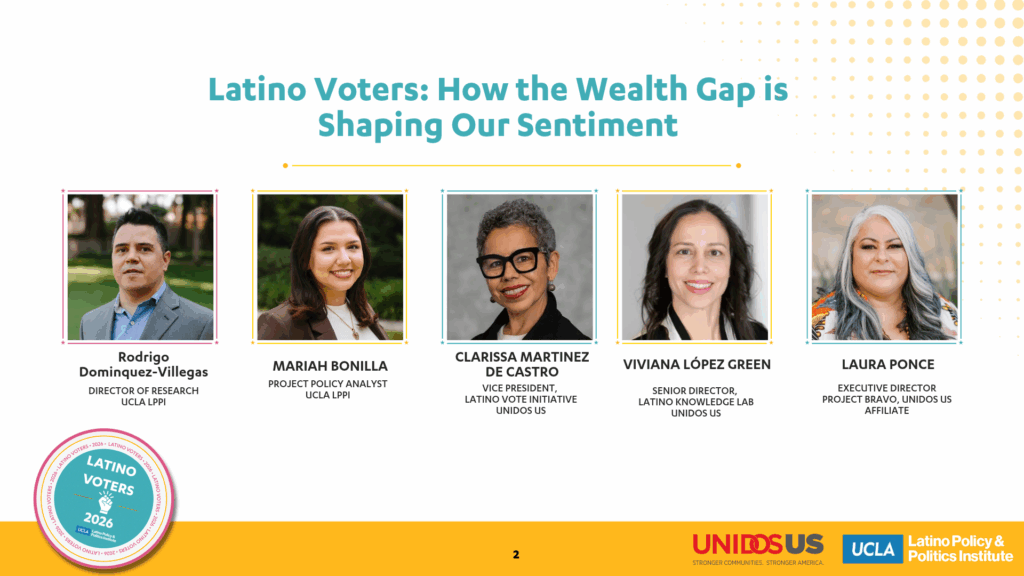
LPPI Project Policy Analyst Mariah Bonilla began the webinar by sharing highlights from LPPI’s 2026 Latino Voter Profiles, which uses data from the Latino Data Hub to provide detailed snapshots of Latino eligible voters in Washington, North Carolina, and Texas. Bonilla shared that many Latino voters face disparities in wages, homeownership, and insurance coverage compared to their white counterparts and other non-Latino groups.
“These gaps can make it harder for one to build savings, purchase a home, or weather financial shocks, and they help provide context for why economic concerns consistently rank among the top priorities for Latino voters,” Bonilla said.
However, Bonilla also shared that Latino voters are likely to have greater political influence this election and in the future since the Latino electorate is predominantly young. For instance, she said that over 45% of young voters in Texas are Latino.
Clarissa Martinez, the vice president of the Latino Vote Initiative at UnidosUS, presented important information necessary to understand the Latino electorate and to be effective in encouraging Latinos to vote, as Latinos often receive poor outreach from political candidates.
Martinez said that “pocketbook” issues, or those related to the economy such as the cost of living, wages, healthcare, and housing, are often the most important for Latino voters, since only 15% of Latino voters say they are doing well financially. She added that Latinos will be especially important and influential in several competitive districts in 2026, as they are often a swing electorate, and nearly 40% of Latinos fall in the middle group of potentially swayable voters.
“These voters are going to have a decisive role, but yet the outreach doesn’t seem to match that,” Martinez said.
Martinez also mentioned that UnidosUS provides many resources to help Latino voters get their foot in the door, including voter registration, status checks, state info, an electorate data hub with information on top issues for Latino voters, and a bilingual voter assistance hotline.
Building off of the context provided by Bonilla and Martinez, Viviana Lopez Green, the senior director of the Latino Knowledge Lab at UnidosUS, introduced a panel of two Latino voter experts, including LPPI Director of Research Rodrigo Dominguez-Villegas and Laura Ponce, the executive director of Project BRAVO.
Lopez Green posed questions to Dominguez-Villegas and Ponce about why Latino voters are so influenced by the wealth gap, how Latino community members are responding to the economic state of the country, and how candidates can better target Latinos in their messaging.
Dominguez-Villegas said Latino voters are more attuned to the economy because they are less likely to have a cushion of generational wealth to hold them through hard times.
“Latino households hold substantially less wealth than other demographic groups in the country,” he said. “What does that mean? This means that a rise in rent or a spike in grocery prices or an unexpected expense often has much larger consequences for Latino voters.”
Ponce said that the stakes are high for Latino voters, especially in relation to housing, as she is seeing many Latinos in her community get displaced due to the rise in housing costs.
“With the increase in prices for housing, for rents, and for homes, the other risk that we are seeing is people being displaced from these neighborhoods that they’ve built and supported for many generations, and now these neighborhoods are becoming very unaffordable,” she said. “Not only will they lose their home, but they will lose their connection to their community.”
The webinar concluded with Lopez Green opening the panel to all presenters and speakers for audience questions, including how candidates can better campaign to Latino voters, how LPPI’s data on Latino voter profiles can be leveraged to create positive change, and more.
“These challenges are not simply the results of short-term economic conditions, as Rodrigo highlighted for us today,” Lopez Green said. “Based on our research, they reflect longstanding structural policy gaps that have limited economic opportunity and wealth building for Latino communities.”