FOR IMMEDIATE RELEASE
Contact: lppipress@luskin.ucla.edu
UCLA Analysis Finds Severe Gaps in Protections for Altadena Wildfire Recovery Workers
Day laborers removing debris and rebuilding fire-affected areas faced hazardous exposure, income loss, and immigration enforcement.
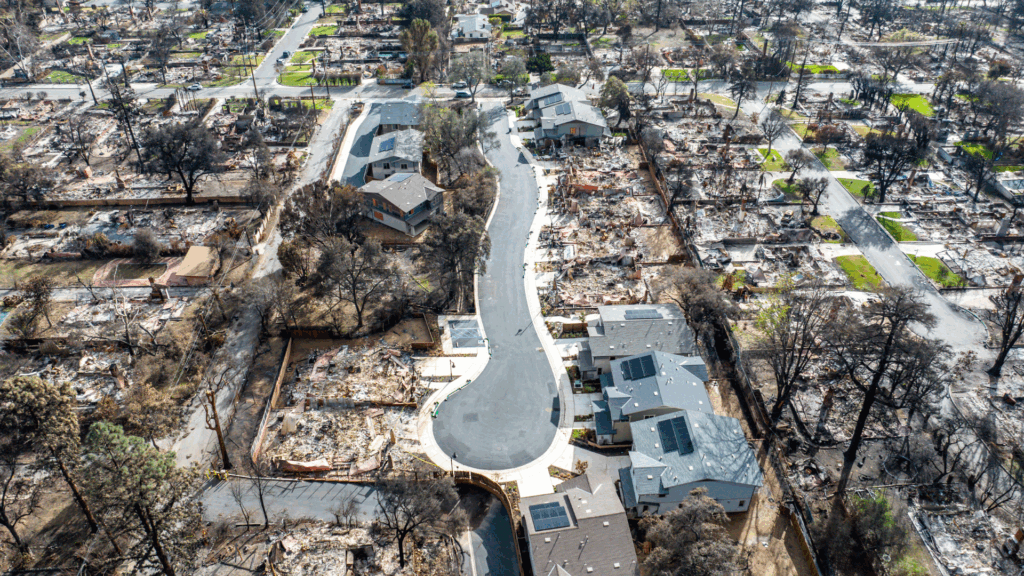
LOS ANGELES (August 27, 2026) — A new policy brief from the UCLA Latino Policy and Politics Institute finds that many day laborers and other outdoor workers who played an essential role in debris cleanup and recovery after the January 2025 Eaton Fire in Altadena, California, often worked through informal arrangements that provided inconsistent safety protections and limited government oversight.
The findings are based on 11 in-depth interviews conducted nine months after the Eaton Fire with outdoor workers who were employed or seeking employment during cleanup and recovery. Eighty-two percent of participants had worked directly in fire-affected areas, while 64 percent reported witnessing or experiencing immigration enforcement during the wildfire recovery period. The study is based on a limited qualitative sample intended to document workers’ experiences rather than represent all workers involved in recovery.
Among the key findings:
- Income losses were driven by both disaster-related disruption and immigration enforcement. Among workers who provided a dollar estimate, average self-reported income loss exceeded $4,300 since the start of the fire.
- Workers faced hazardous conditions both at work and at home. Nearly half also lived in or near fire-affected neighborhoods, exposing some workers to environmental hazards both while working and where they lived.
- Safety training and protective equipment were inconsistent. Workers connected with community organizations were more likely to report receiving safety training, whereas those hired through informal or subcontracted arrangements were more likely to report limited training and inconsistent access to adequate protective equipment.
- The effects of recovery extended to workers’ mental health. Every worker interviewed rated their mental health as fair, poor, or very poor. Workers linked their stress not only to the fire, but also to unstable employment, unsafe conditions, and immigration enforcement.
“Day laborers are rebuilding our communities after wildfires, but too often the systems responsible for disaster recovery do not account for the conditions under which this work is actually happening,” said Michael Méndez, associate professor at UC Irvine and co-author of the brief. “When workers are hired informally, sent into hazardous environments without consistent protections, and facing significant economic pressures, the burden of recovery is being shifted onto the very people doing some of its most dangerous work.”
The researchers also found that worker-focused community organizations like NDLON, CARECEN, and IDEPSCA filled critical gaps in disaster response. These groups were essential and served as trusted providers of safety gear, recovery aid, and immigration alerts while government inspectors were largely absent.
To protect workers during future disasters, the authors recommend the following policies:
- Increase proactive labor inspections in disaster recovery zones and establish dedicated funding to expand enforcement capacity during declared emergencies.
- Require site-specific worker protection plans for wildfire debris removal and incorporate those requirements into cleanup permits, contracts, and rebuilding authorizations.
- Establish a standing disaster income stabilization program for informal workers whose earnings are disrupted during recovery.
- Integrate behavioral health services into disaster workforce policies and recovery programs.
The authors also call for stronger, formally funded partnerships between state and local agencies and trusted community-based organizations that already serve day laborers and outdoor workers. Such partnerships, they argue, could help ensure that safety information, income support, and other recovery resources reach workers quickly during future disasters.
“Almost every worker we talked to told us the same thing – when something went wrong, they didn’t think to call a government agency. They called the community organizations that are holding up the system of worker protection,” added Carlo A. Chunga Pizarro, Ph.D. candidate at UC Irvine and co-author of the study. “If we’re serious about disaster recovery, then protecting these workers can’t be an afterthought. It has to be part of the plan long before a disaster happens.”
Read the policy brief here.
###
About UCLA Latino Policy and Politics Institute
The UCLA Latino Policy and Politics Institute is a non-partisan research institute that seeks to inform, engage, and empower Latinos through innovative research and policy analysis. LPPI aims to promote equitable and inclusive policies that address the needs of the Latino community and advance social justice. latino.ucla.edu.