







Charlita: Mariah Bonilla on Disparities Latinos Continue to Face in California
Latinos represent 40% of California’s population, driving economic and workforce growth. At the same time, Latinos in California face alarming gaps in earned income, homeownership, and insurance coverage compared to non-Latinos. We talked to Mariah Bonilla, project policy analyst at LPPI, who examined both sides of this narrative in a new report, State of Latinos in California, 2026.
In this conversation, Mariah speaks on the central role Latinos play in California’s workforce, implications of the report’s findings for future generations, and how policymakers can best support Latinos in California.
Q: What factors make Latinos so crucial to California’s long-term economy?
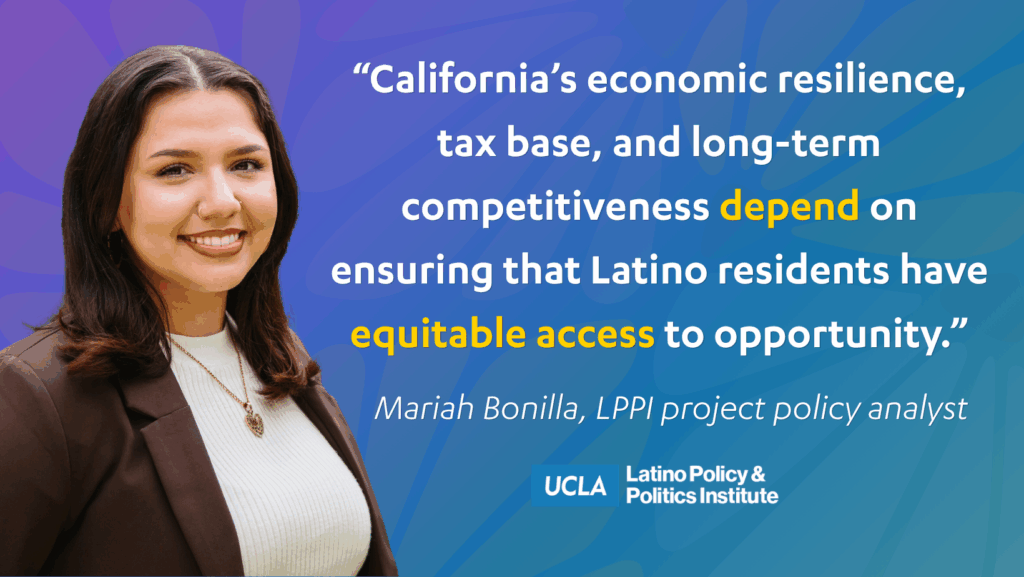
California’s long-term prosperity is closely tied to the outcomes of Latino communities. Latinos make up about 40 percent of California’s population, and that share is projected to remain steady through 2070, meaning that our communities will shape California’s future. And, Latinos are younger, have higher labor force participation rates, and have higher college completion rates than older generations. Because of this, the state’s economic resilience, tax base, and long-term competitiveness depend on ensuring that Latino residents have equitable access to opportunity.
Q: How are the disparities Latina women face different from those of Latino men, and how does that impact the Latino community as a whole?
Latina women navigate overlapping barriers that create some of the widest opportunity gaps in the state. When looking at wages, Latina women are paid the lowest hourly wage on average ($18 an hour) compared to $29 for non-Latina women and $20 for Latino men. This gap translates into long-term wealth disparities with a lifetime loss of over $1.2 million over a 40‑year career compared with a white, non‑Hispanic man.
While both Latino men and women face high housing cost burdens, our report shows that Latina-headed households are more likely to be severely cost-burdened (spending over half their income on rent). This puts them at a higher risk of displacement and the cascading effects of housing instability.
What’s more, a college degree does not necessarily guarantee access to higher-paying jobs for Latinas. Latina women outpace Latino men in college attainment. But even with a bachelor’s degree, they earn the lowest median wage of $31 an hour – $21 less than college-educated non-Latino men.
Q: What findings were consistent across all employment types and sectors and why do you think that is?
A consistent finding in our report is that Latinos are paid less than their non-Latino peers. This is true across educational attainment, industry, and citizenship status. We know that Latinos tend to be concentrated in lower-wage and labor-intensive industries. But even when Latinos work alongside non-Latinos in the same industries, the wage gap persists.
These disparities are actually the largest in high-wage industries. For example, when we look at professional and scientific sectors, Latina women and men are paid about half the hourly rate of their non-Latino counterparts. Although college-educated Latinos are more likely than their peers without college degrees to enter higher-paying industries, disparities between Latinos and non-Latinos remain. Latinos are underrepresented in high-wage sectors like professional and scientific services, finance and insurance, and information technology. And when they do enter those fields, they are paid less than their non-Latino peers with the same credentials.
Q: What are the implications of your findings on the low-income and homeownership rates of Latinos for future generations of Latinos?
The implications are intergenerational and affect wealth-building opportunities across generations. In California, home equity is the largest source of wealth for most families, and access to ownership is often the dividing line between economic stability and long-term precarity.
Our report found that 45% of Latino households own their homes, compared to 60% of non-Latino households. And when Latino families do achieve homeownership, their homes are worth significantly less ($229,000 less on average). This means that families build equity more slowly, even when they make the same financial investment, directly translating into lower equity, smaller financial cushions, and less wealth to pass on to the next generation.
Q: How do economic disparities in Latino neighborhoods intersect with environmental risk, and what are the implications as climate change worsens?
Latino neighborhoods experience higher environmental risks and have fewer resources to cope with them. On average, Latino neighborhoods have higher air pollutant levels, are located more closely to hazardous waste sites, and have nearly three times the diesel particulate matter of non-Latino white neighborhoods. At the same time, they have less tree canopy, more pavement, and families with lower incomes and less wealth to adapt.
Latino neighborhoods also experience more extreme heat days than non-Latino white neighborhoods (60 days compared to 37 days, respectively), and that number is projected to grow. We also know that twice as many residents in Latino neighborhoods work in heat-exposed industries like agriculture and construction. Economic disparities, environmental and health risks are deeply intertwined, and they leave Latino communities bearing disproportionate health and opportunity burdens.
Q: How should the findings on school-age and college-educated Latinos and Latinas inform decision-makers in education?
We found that on average, Latinos in California are younger than their non-Latino counterparts. A much larger share of Latinos are minors, and a larger share are in reproductive and early- or mid‑career ages – meaning Latinos will continue to shape California’s schools, workforce, and public systems. We see promising trends in educational attainment, with younger Latinos achieving higher levels of educational attainment than older generations. Yet, we still see disparities in industry sorting and pay gaps for Latinos with a college degree.
These findings should inform decision makers that we need to invest in California’s future. There is a need to expand access to career services and strengthen early-career readiness to support young professionals and college students in building skills and navigating the labor market.
Q: How do you hope to build on these findings in future research?
I hope to build on these findings in future research by taking deeper dives into the experience of Latino workers, disparities in homeownership and housing stability for Latinos, and climate and health disparities in California’s Latino neighborhoods. My hope with this report and further research is to inform decision-makers to prioritize policies that address the structural barriers we’ve highlighted and to serve as an asset for our partners on the ground who are working every day to improve the lives of our communities.
Read the full report.