2026 LPPI Field Fellows reflect on a summer of public service
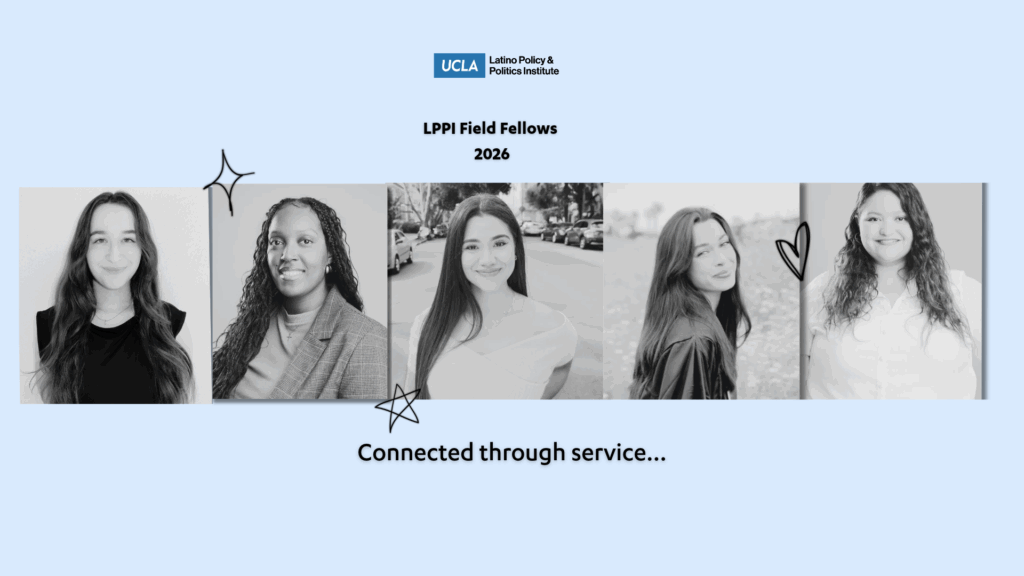
On August 19, five students from the UCLA Luskin School of Public Affairs marked the completion of the UCLA Latino Policy and Politics Institute’s 2026 Field Fellowship by presenting the projects and lessons from their summer placements.
The eight-week Field Fellowship provides Luskin students with hands-on public policy experience at government offices and community-based organizations across Los Angeles and Southern California. Fellows work alongside organizational leaders on projects that respond to community needs while developing skills in policy analysis, advocacy, direct service, and community engagement.
This year’s fellows worked with the Community Coalition, St. Joseph Center, Los Angeles City Council District 6, and California Assembly District 80. Their presentations showed the range of work involved in shaping public policy, from navigating the federal appropriations process and developing legislative proposals to supporting formerly unhoused residents and gathering community input on neighborhood development.
Skye Isabella Waid Dechant, a Master of Public Policy candidate, worked with St. Joseph Center to develop a federal appropriations strategy for the organization. St. Joseph Center provides housing and services for youth and families across Los Angeles.
Dechant created a 36-page playbook and four accompanying one-page resources that explain the federal appropriations process, identify potential funding opportunities, and provide templates for communicating with government offices. Designed as a living document, the playbook can be updated as congressional leadership, federal processes, and the organization’s priorities change.
Gabriella Macias, also a Master of Public Policy candidate, took on a more community-facing role at St. Joseph Center. She supported 22 older adults living in permanent supportive housing in Compton, working alongside case managers to connect residents with public benefits, housing assistance, and other resources.
Macias met with residents individually, documented their needs, and helped organize activities including breakfasts, movie nights, and karaoke. She also worked with community organizations that provided residents with health services, clothing, food, and phones.
Kelese Bryant, a Master of Social Welfare candidate, spent the summer with the Community Coalition in South Los Angeles. Her work included supporting the “We the People” art exhibit, a community photo walk, farmers’ markets, and Backyard Thursdays. This series brings residents together for food, music, activities, and conversations about civic engagement.
Bryant helped organize events, canvassed neighborhoods, and contacted residents to encourage participation. She also supported activities that invited community members to share their experiences and ideas for the future of the Vermont and Manchester corridor.
Glafira Lopez, a Master of Urban and Regional Planning candidate, joined the planning and land use team in the office of Los Angeles City Councilmember Imelda Padilla. Lopez focused on environmental and land-use challenges in Sun Valley, where industrial facilities—including recycling centers, landfills, and scrapyards—operate near residential neighborhoods.
Lopez conducted 20 stakeholder interviews and developed a stakeholder map, a geographic information systems map of approximately 100 recycling facilities, and a database of industrial businesses with zoning violations. She also prepared policy memos on air-quality oversight, the Los Angeles Department of Water and Power’s Valley Generating Station,n and other industrial sites.
Karen Andrea Estrada Díaz, a dual Master of Social Welfare and Master of Public Policy candidate, worked in the district office of California Assemblymember David Alvarez. Her placement focused on strengthening educational pathways for multilingual, binational and transborder students in California’s border region.
Estrada Díaz visited dual-language programs in three school districts and gathered input from students, parents, teachers, administrators and education experts. Drawing from those conversations, she developed three legislative proposals: one to establish dedicated liaisons for transborder students, another to expand access to California schools for eligible U.S. citizens living in Mexico, and a third to support long-term dual-language immersion programs.
LPPI Deputy Director Lila Burgos closed the program by thanking the fellows for their contributions and encouraging them to carry what they learned into their continued studies and public-service careers.
The presentations reflected a central purpose of the fellowship: to give students the opportunity to apply what they learn at UCLA while contributing directly to organizations and public offices serving communities across Southern California.