Recovery Starts Here: Kimberly Vandenberg
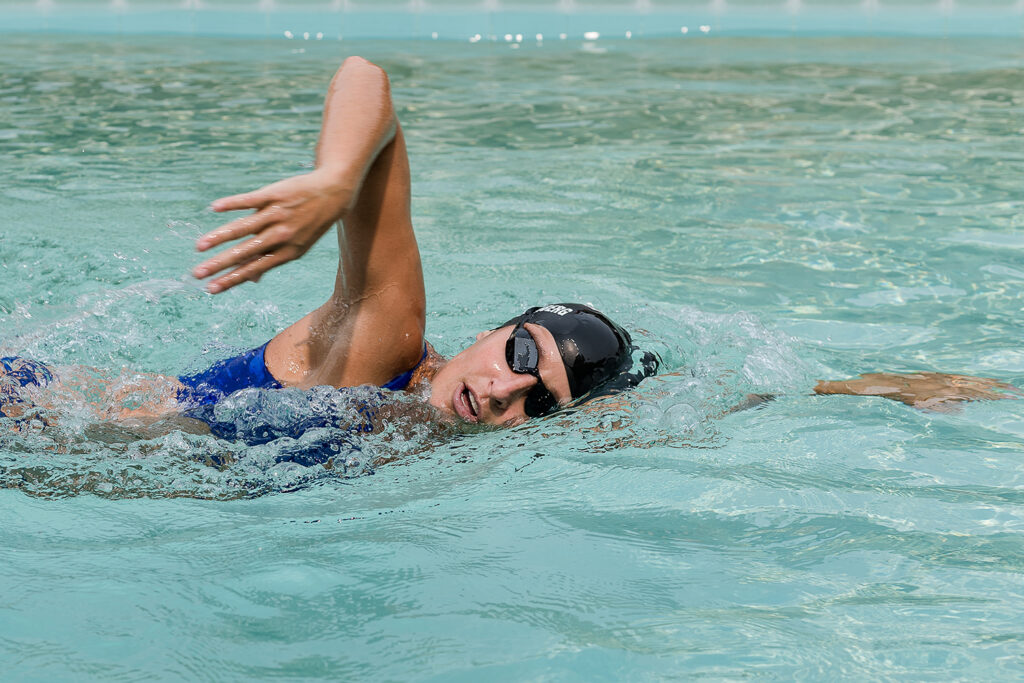
Kimberly Vandenberg has spent much of her life in the water. A competitive swimmer from California, she eventually became an Olympic medalist, competing in the 2008 Olympic Games in Beijing. Teaching was a natural next step when her competing days wound down. She had always coached in some capacity alongside her athletic career, and when demand for private swim instruction grew, she formalized what she had already been doing and launched Kim Swim Studios.
In 2020, she relocated from New York to Pacific Palisades. Her model was mobile and relational: she taught lessons at client homes and rented two pools in the Palisades for additional sessions. Business administration happened from her home. There was no storefront — just Kimberly, her clients, and the pools they made available to her. Scheduling around school drop-offs and nap times was a recurring puzzle, and finding pools of the right size and temperature was always a challenge, but demand was strong. Her clientele was loyal, and it kept growing.
The LA wildfires were not part of her business plan.
When asked whether she had thought about what she would do in an emergency, Kimberly said it was simply not on her radar. Before the fires, she didn’t know who to contact or where to turn for resources. Neither did most of her neighbors.
Nearly all of the homes where Kimberly taught burned down in the Palisades Fire. The pools she rented were gone. She and her family were displaced – smoke damage made her home unlivable. The community she had built her business around scattered overnight.
“It was really devastating. It was hard for all the kids and the families that I taught, knowing they lost their homes. Everyone was displaced, so we lost our community. That, on top of income loss, not being able to work, not knowing when I would be able to work again. . . even the pools that survived, the families had to drain them, clean them, test them. It took a while to get back up and running. So that was really stressful and scary as a business owner.” – Kimberly Vandenberg
The nature of her business made recovery especially complicated. Because Kimberly primarily taught at client homes rather than owning a facility, she was caught in a gap: the homes that burned weren’t hers, but their loss was partly hers, too.
Kimberly found meaningful support as a resident and a mother. The American Red Cross and FEMA provided some assistance for her family. The nonprofit Baby2Baby donated essentials and connected her with counselors. 211LA pointed her toward donation events and resources for displaced families. Her daughter’s preschool became a hub of information-sharing.
As a business owner, she found almost no support that worked.
Kimberly applied for both a loan and a grant through the Small Business Administration (SBA). The process was unclear and deeply frustrating. She had an existing, COVID-era SBA loan, and technical issues with her account created cascading problems she couldn’t resolve. She spoke with SBA representatives in person, on the phone, and online, but got nowhere.
“You would think that I would qualify, considering my business was based in the Palisades,” she said. She never received an explanation for why she didn’t qualify. Eventually, she stopped trying.
What she needed, she reflected, was someone who could guide her step by step — not a lawyer or a formal agent, but a case manager of sorts. Someone who could say: here is what to apply for, here is what you need, here is who to talk to.
What ultimately kept Kim Swim Studios alive wasn’t a grant or a program – It was her clients. Families in Santa Monica and Mar Vista offered their pools for her to teach other students. She rented a smaller pool to fill in gaps for younger kids. Slowly, the business found its footing again.
About two months after the fires, Kimberly began teaching again. Today, she is settled in Brentwood and teaches regularly across Brentwood, Santa Monica, and the surrounding areas. Business has picked back up, but the commute has become its own kind of burden. In the Palisades, her rented pool was five minutes from home. Now she navigates traffic to drive across Los Angeles every day.
She has had no contact with local officials or legislators about her experience. No community-based organizations or chambers of commerce have reached out about her business. In that sense, her recovery has unfolded the same way her business always did — largely on her own, through relationships she built herself.
Kimberly’s story demonstrates a gap that disaster recovery systems have yet to seriously reckon with. When policymakers and programs talk about small business recovery, they tend to picture a storefront: a restaurant, a salon, a shop with a sign out front and a lease to restart. But a significant share of small businesses don’t look like that – Coaches, instructors, trainers, freelancers, and home-based service providers make up a real and often overlooked part of local economies. When disaster strikes, they fall through the cracks. There is no address to return to, no commercial lease that signals a legitimate loss, no brick-and-mortar recovery milestone to track. The metrics that recovery programs use to measure need and progress were largely built without businesses like Kim Swim Studios in mind. Until that changes, businesses like Kimberly’s will keep being left behind.
Kimberly’s advice to other small business owners is straightforward: don’t close too soon, and lean on your community. In the immediate aftermath, she says, it’s easy to make irreversible decisions under pressure. She believes time, patience, and willingness to relocate can give a business a real chance to recover.