






Charlita: Julia Silver on Unequal Exposure to Extreme Heat in the Central Valley
California experienced its first major heat wave in the first three months of 2026. As climate change lengthens and intensifies periods of extreme heat, it becomes crucial to examine who is most exposed, why, and how we can mitigate the health risks. That’s why the UCLA Latino Policy and Politics Institute created a policy toolkit addressing the unequal risk of extreme heat exposure with Latino communities in the Central Valley.
We spoke with LPPI senior research analyst Julia Silver, who co-authored the toolkit, about its findings and implications.
Q: What are the key findings highlighted in the extreme heat policy toolkit?
From the data, residents in Central Valley Latino neighborhoods endure longer heatwaves and are more likely to work in heat-exposed industries than those in non-Latino white neighborhoods. They live in areas with high pollution burden and sparse tree canopy, while also experiencing higher rates of asthma-related emergency visits.
From the community perspective, participants identified key challenges across three issue areas. Regarding health and public services, people face language barriers, a lack of affordable healthcare, limited education about heat illness, and inaccessible or underfunded cooling centers. Regarding the environment and housing, residents face poor housing conditions, limited shade, and a lack of control for renters. Related to workforce protections and economic equity, workers experience unsafe conditions, a lack of enforcement of heat protections, fear of retaliation, and limited information about their rights.
The toolkit also highlights community-driven solutions, including expanding in-person and multilingual outreach, investing in trusted community-based organizations, improving neighborhood conditions, and strengthening workplace safety.
Q: How are the impacts and issues distinct in the Central Valley from other regions in California?
The Central Valley stands out because of how environmental, economic, and social factors overlap. The region experiences some of the most extreme and prolonged heat in the state. At the same time, many residents work in agriculture, construction, and other outdoor industries, which increases their direct exposure to heat. Community members described being pressured to skip breaks, limit water intake, or continue working in unsafe conditions.
Housing also plays a major role. Many homes are older, poorly insulated, and expensive to cool, forcing families to endure unsafe indoor temperatures. Participants emphasized that even when air conditioning exists, energy costs make it inaccessible.
In addition, the built environment intensifies heat. Latino neighborhoods often have fewer trees and more pavement, which traps heat and limits outdoor livability. These combined conditions create a level of constant, compounding exposure.
Q: How does data from the Latino Climate and Health Dashboard support knowledge and advocacy?
The dashboard strengthens advocacy by providing clear, localized evidence that validates what communities are already experiencing.
It also helps advocates and policymakers target resources more effectively. For example, data on tree canopy, heat exposure, and employment patterns can guide where to invest in cooling infrastructure or workplace protections.
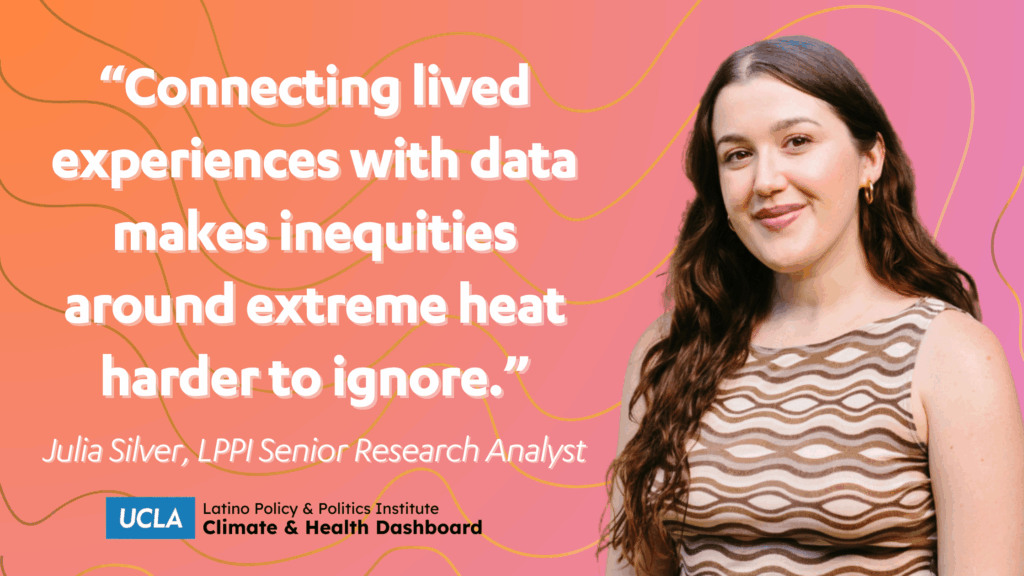
Community participants emphasized the need for accountability, and the dashboard supports this by offering measurable indicators that can track progress. Connecting lived experiences with data makes inequities around extreme heat harder to ignore.
Q: What implications do the findings around workforce protections and economic equity have for the economy?
Unsafe working conditions under extreme heat have serious economic consequences.
Workers often face heat-related illness, which leads to missed work, lost wages, and long-term health issues. Community members described having to choose between their health and their income, especially when they lack insurance or paid time off.
At the same time, fear of retaliation or immigration consequences prevents workers from reporting unsafe conditions, allowing harmful practices to continue and reducing overall workplace safety.
Key industries like agriculture and construction depend on this labor force. Reduced productivity, higher health costs, and worker burnout can disrupt economic stability.
Q: This March was one of the hottest on record in Southern California. How can this toolkit inform other regions in preparing to face extreme heat?
The toolkit offers a model that other regions can adapt by combining community insight with data-driven action.
It shows the importance of engaging directly with affected communities to understand real barriers – such as fear, language access, and lack of trust in institutions. Policies become more effective when they reflect these realities.
It also provides concrete strategies that can be applied elsewhere. These include expanding multilingual and in-person outreach, investing in community-based organizations, improving access to cooling through housing and infrastructure, and strengthening workplace protections.
Finally, it emphasizes the need for coordination across sectors like public health, housing, labor, and emergency response. Other regions can use this approach to move from reactive responses to proactive planning, especially as extreme heat becomes more frequent and severe.